Neiguan (内观), “inner observation”, means turning attention inward to watch what arises in the mind and body: thoughts, feelings, sensations, moods. It does not try to stop them or follow them. It simply sees them come and go, until the mind that watches grows quieter than the things it watches.
Of the methods on this series’ map, inner observation is the one most often practised today, and the one that most resembles meditation taught elsewhere. This page sets out where the Taoist version comes from and how it is practised. For the posture and a first ten minutes, start with Taoist Meditation.
A scripture devoted to looking inward
The Taishang Laojun neiguan jing (太上老君内观经), the “Scripture of Inner Observation”, is a short Tang-dynasty text spoken in the voice of the deified Laozi. It describes how a person is formed, month by month, from the qi of heaven and earth, how spirits reside in the organs, and how the heart-mind, restless and easily scattered, governs the whole. The heart-mind, it says, is “the master of the whole body and the commander of all its spirits”. Its answer to that restlessness gives the practice its name: quiet the spirit and settle the mind, so that confused thoughts do not arise and nothing false or harmful gets in; that, the scripture says, is why it is called inner observation.
Its language owes something to its time. Tang Taoists and Buddhists practised side by side, and the scripture’s idea of “observation” (guan 观) shares much with Buddhist insight practice. The Neiguan jing sets it in a Taoist frame: the aim is not only to see clearly but to return to the stillness of the Tao.
Three observations in the Classic of Purity and Stillness
The best-known statement of inner observation is a few lines in the Qingjing jing (清静经), the “Classic of Purity and Stillness”, which Quanzhen Taoists, including those at Wudang, recite every morning as part of their daily liturgy (the Xuanmen risong zaotan gongke jing). It describes three ways of looking:
- look inward at the mind, and the mind has no fixed mind;
- look outward at the body, and the body has no fixed form;
- look far out at things, and things have no fixed thing.
Once all three are understood, the text says, only emptiness is seen. The point is not that nothing exists, but that nothing observed holds still long enough to be grasped, and that seeing this loosens the grip of craving and worry.
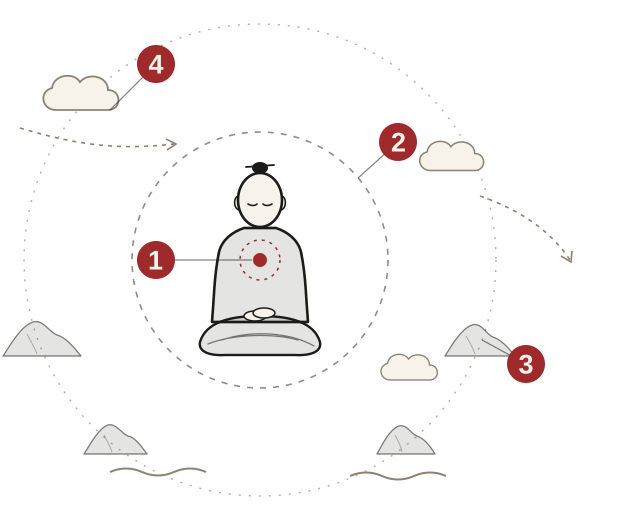
The three observations of the Qingjing jing, inner, outer and far, with thoughts passing through like clouds. A schematic drawing, not a map of the body.
- Inner: observing the mind, a still point at the heart (内观其心)
- Outer: observing the body, the form that sits (外观其形)
- Far: observing things, the world beyond the body (远观其物)
- Thoughts arriving and leaving like clouds, watched but not followed
The same idea runs through Sima Chengzhen’s Zuowang lun, whose fifth stage is “true observation”, seeing what arises without being moved by it. Our page on Zuowang follows that method, and Guarding the One describes the steadier attention that usually comes first.
How the practice is done
Inner observation is usually built on a settled sitting. Guarding the One gathers attention; inner observation then widens it. Instead of holding one place, you let whatever arises be seen: a sound, an ache, a memory, a plan, a wave of irritation.
The rule is simple and hard: notice, and do not follow. When a thought appears, you know it is there. You do not argue with it, develop it or push it away. Like a cloud crossing a still sky, it arrives and leaves on its own. Teachers often say the watching mind should be like a mirror, showing everything and holding nothing.
- Settle (3 minutes). Arrange the posture and rest attention lightly below the navel, as in Guarding the One.
- Widen (5 minutes). Let attention open to whatever is present: breath, body, sounds, thoughts. When something arises, notice it with a quiet “there it is”, and let it go.
- Notice the noticing (1 minute). For a moment, turn to the awareness that sees all this, without trying to find or hold it.
- Close (1 minute). Return to the breath, rub the palms, and stand up slowly.
If observation turns into rumination, the same worry circling again and again, return to the breath or to the lower belly for a while. Observation needs a steady base; without it, looking inward can simply mean thinking harder.
What to expect, and when to stop
Inner observation is gentle, but not always comfortable. Looking honestly at the mind shows its habits, and some of them are unpleasant. Old memories or strong feelings can surface. Meet them with the same light attention, keep sessions short, and stop if you feel overwhelmed rather than steadier. People with a history of trauma, psychosis or severe depression should speak to a doctor and an experienced teacher before practising, and choose a teacher who knows how to adapt the practice.
The tradition’s own measure of progress is modest: a little less carried away by thoughts, a little quicker to notice them, and a little more ease in daily life.
Further on the site
- The Qingjing Jing: the full Classic of Clarity and Stillness, where the three observations come from.
- The Small Heavenly Circuit: what xiao zhoutian is, what it is not, and why it is learned only from a teacher.
- Guarding the One: the steady attention that comes first.
- Zuowang: Sitting and Forgetting: “true observation” as the fifth stage.
- Taoist Meditation: the five methods, the posture and a first practice.
- The three regulations: body, breath and mind in practice.