Shouyi (守一), “guarding the One”, is one of the oldest instructions in Taoist practice and one of the most argued over. Everyone agreed that the One should be kept. They did not agree on what the One is, or where it is to be found. Following that disagreement is the best way to understand the practice, and to do it sensibly today.
This page is part of our series on sitting practice. For the posture and a first ten minutes, start with Taoist Meditation.
“Embracing the One” in the Tao Te Ching
The phrase grows out of the Tao Te Ching (Dao De Jing). Chapter 10 asks whether one can carry the soul and “embrace the One” without letting them part (chapter 10). Chapter 22 says the sage embraces the One and so becomes a model for the world (chapter 22), and chapter 39 describes how heaven, earth and the spirits each “obtained the One” and so became what they are (chapter 39).
In these chapters the One is the unity of the Tao itself, the wholeness that things lose when they scatter. None of them gives a method. Later readers took “embracing” as something a person could practise, and “guarding” became the usual word.
Three answers to the question “what is the One?”
A method for long life. The Taiping jing (太平经), a Han-period scripture, treats guarding the One as a central practice for health and long life: gathering the spirit so that it does not scatter, and keeping body and spirit together.
The precepts, not a place in the body. The Xiang’er commentary, one of the earliest Taoist religious readings of the Tao Te Ching, says that the One, dispersed, is qi, and gathered, takes form as the deified Laozi. It says plainly that the One is not located in the body: it comes and goes through the whole person, not one spot, and attempts to fix it in a part of the body are dismissed as the “common false arts of the world”. Guarding the One, it says, means keeping the precepts of the Tao without fail. Our page on the great commentaries sets the Xiang’er beside the others.
Three places in the body. In the fourth century, Ge Hong (葛洪) took the opposite view in the Baopuzi (抱朴子). Guard the One and preserve the true, he writes, and you can reach the spirits. He gives the One names and colours, and he places it in three locations: below the navel, below the heart in the “crimson palace”, and between the eyebrows a little way inside the head. These became known as the three dantian.
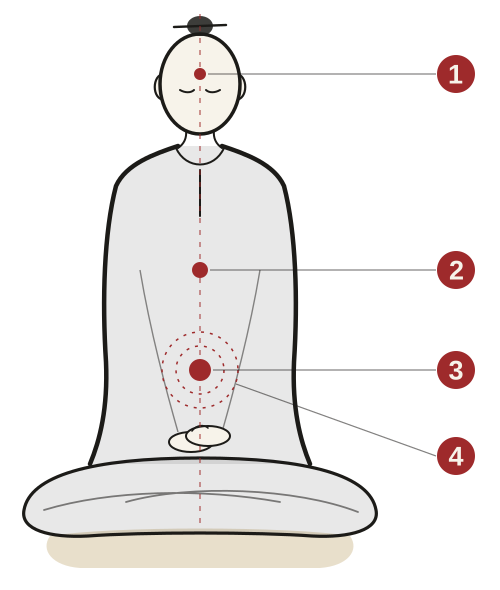
The three places where Ge Hong’s Baopuzi says the One can be guarded, with the light attention later teachers ask for. A schematic drawing; other texts, the Xiang’er among them, reject locating the One in the body at all.
- Upper place: between the eyebrows, a little inward (the upper dantian)
- Middle place: below the heart, the “crimson palace” (jianggong 绛宫)
- Lower place: below the navel (the lower dantian), where beginners usually rest attention
- Light, steady attention: neither forgetting the point nor forcing it
Both views run through later tradition. Internal alchemy builds on Ge Hong’s map of the body; the monastic orders keep the Xiang’er’s insistence that conduct comes first. A practitioner today can hold both: the body gives attention a place to rest, and the way one lives decides whether that rest lasts.
How the practice is done
In most modern teaching, guarding the One means resting attention on a single place, usually the lower dantian below the navel, and keeping it there gently. Ge Hong’s three places are a map, not three exercises to do at once. The lower point is where beginners are normally asked to start, because attention resting low in the body tends to settle; attention held hard at the brow or the head is more likely to bring tension.
The quality of attention matters more than the place. Later practitioners borrowed a phrase from Mencius to describe it: neither forget it nor force it (勿忘勿助). If you lose the point, come back. If you are gripping it, let go a little. The aim is a steady, almost casual presence, like keeping an eye on a pot that is not yet boiling.
A simple way to begin, building on the ten-minute practice on our Taoist Meditation page:
- Settle (2 minutes). Arrange the posture and let the breath find its own pace.
- Find the place (1 minute). Rest a hand on the belly below the navel, notice the movement of the breath there, then let the hand return to the lap.
- Guard it lightly (6 minutes). Keep a soft attention on that place. When thoughts carry you off, notice, and return without commentary.
- Let go (1 minute). Release the point, sit openly for a moment, then rub the palms and stand up slowly.
Where it goes wrong
Concentrating hard on one spot can produce heat, pressure, headaches or a sense of strain, especially when attention is fixed on the head. Do not force the breath, do not try to move sensations along the body, and do not lengthen sessions quickly. If discomfort persists, widen your attention to the whole body or stop for the day. People with a history of psychosis, severe anxiety or trauma should speak to a doctor and an experienced teacher before practising.
The older texts add their own warning. The Xiang’er’s quarrel with Ge Hong is a reminder that a point in the body is not the goal. Guarding the One is meant to gather a scattered life, not to create a new thing to fixate on.
Further on the site
- Inner Observation: neiguan, watching the mind without following it.
- Zuowang: Sitting and Forgetting: the method that lets go rather than holds.
- The Three Treasures: jing, qi and shen in Taoist medicine.
- The Taoist View of the Body: organs, channels and the dantian.
- Standing Practice: resting attention low while standing.