Zuowang (坐忘), “sitting and forgetting”, is one of the oldest names in Taoist meditation. It begins as two sentences in the Zhuangzi and ends, eight centuries later, as a seven-stage method for life in a Tang-dynasty hermitage. Following how the phrase changed is the clearest way to understand what Taoist sitting asks of a practitioner, and what it does not.
This page follows that path. For the wider map of Taoist sitting, the posture and a first practice, start with Taoist Meditation.
Two sentences in the Zhuangzi
In chapter 6 of the Zhuangzi, “The Great and Venerable Teacher” (大宗师), Confucius’s student Yan Hui reports his progress three times. First he has forgotten humaneness and rightness; then he has forgotten rites and music. Confucius says this is good, but not yet enough. The third time Yan Hui says simply: “I sit and forget.”
Asked what he means, he answers in one line: 堕肢体,黜聪明,离形去知,同于大通,此谓坐忘. In plain English: he lets the limbs and body fall away, dismisses cleverness, leaves form behind, sets knowing aside, and becomes one with the great thoroughfare; this is sitting and forgetting. Confucius, the teacher of the dialogue, then asks to become Yan Hui’s follower.
It is worth reading this as the Zhuangzi wrote it. Our page on the core themes of the Zhuangzi makes the point carefully: the passage describes a condition, inside a story, and gives no method. There is no posture, no breath and no timetable. What it does say is that much of what stands between a person and the world is accumulated, and that forgetting means letting the accumulation go. The Tao Te Ching (Dao De Jing) makes a similar point in a single line: in pursuing the Way, one loses a little more each day (chapter 48).
From a condition to a method
Later practitioners read the passage as instruction, and over time they built practice around it. The decisive step came in the Tang dynasty with Sima Chengzhen (司马承祯, 647–735), a patriarch of the Shangqing school who lived much of his life on sacred mountains and advised emperors. The Zuowang lun (坐忘论), “On Sitting and Forgetting”, circulates under his name. Modern scholars discuss how much of the received text is his own, and a shorter work of the same title survives as well; the tradition has read the longer version as his teaching for centuries.
The treatise keeps the Zhuangzi’s goal but adds what the Zhuangzi left out: an order, a daily discipline and warnings about what goes wrong. It is written for people who want to practise, not only to understand.
The seven stages
The Zuowang lun is divided into seven sections, and each names a stage.
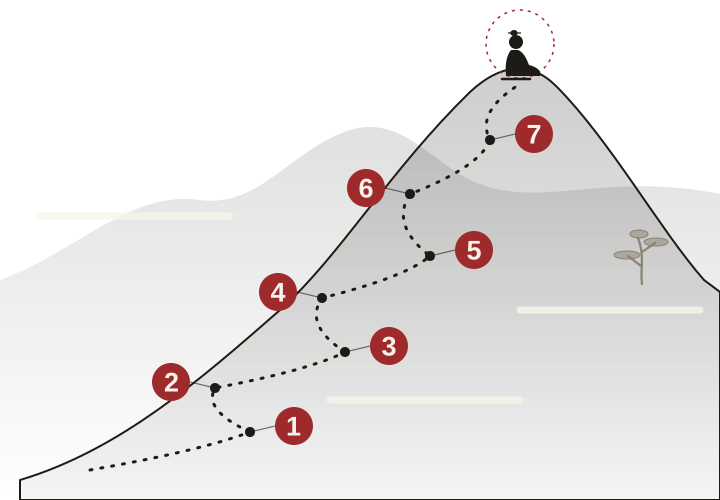
The seven sections of the Zuowang lun, read as a path up a mountain. A schematic drawing; the treatise presents them as stages, but it does not prescribe how long each takes.
- Respect and trust (jingxin 敬信): confidence that the way is real and worth walking
- Cutting ties (duanyuan 断缘): loosening the entanglements that keep the mind busy
- Gathering the mind (shouxin 收心): bringing attention home, gently and often
- Simplifying affairs (jianshi 简事): keeping only what life truly needs
- True observation (zhenguan 真观): seeing clearly what arises, without being moved by it
- Great stability (taiding 泰定): a settled calm that no longer needs effort
- Attaining the Tao (dedao 得道): the treatise’s name for where the path leads
The first four are about life more than sitting. Respect and trust come first because, the treatise argues, no one keeps up a practice they do not believe in. Cutting ties and simplifying affairs ask the practitioner to reduce the obligations, possessions and ambitions that keep the mind running. These are not calls to leave the world; they are a recognition that a crowded life makes a crowded mind.
The centre of the method is gathering the mind. The treatise does not ask for a blank mind. A well-known line puts it this way: 唯灭动心,不灭照心 — still only the restless mind, not the mind that sees clearly. When attention wanders, it is brought back without force, and the text warns against both extremes: straining after stillness, and drifting along with every thought.
True observation and great stability describe what follows when that work has matured: seeing what arises clearly, and a calm that holds without effort. The treatise borrows another image from the Zhuangzi here, a body like withered wood and a mind like cold ashes (chapter 2), but it is careful to say that this stillness is alive, not dull. The last section, attaining the Tao, speaks the language of its religious setting: the body and spirit made whole and joined with the Way.
What this asks of a practitioner today
Read for practice, the Zuowang lun offers three plain lessons that do not depend on accepting its final claims.
- Sitting rests on how you live. Four of the seven stages happen away from the cushion. Ten minutes of sitting in an overloaded day will feel like it.
- Return, do not force. Bringing attention back gently, again and again, is the practice itself, not a sign of failure.
- Stillness is clear, not blank. The aim is to stop being pushed around by thoughts, not to stop seeing.
To try it, use the ten-minute practice on our Taoist Meditation page and add one step at the start: before sitting, name one thing you will set aside for these ten minutes, and when your mind returns to it, let it go again. That small act of “cutting ties” is the treatise in miniature. As with any sitting, keep the breath natural and the sessions short at first, and stop if practice leaves you distressed rather than steadier.
Further on the site
- Guarding the One: shouyi, from the Tao Te Ching to Ge Hong’s three dantian.
- Taoist Meditation: the five methods, the posture and a first practice.
- Famous parables of the Zhuangzi: the stories around this one.
- The Zhuangzi and Taoism: how a philosophical book became scripture.
- The three regulations: body, breath and mind in practice.