Seasonal Living When You Live in the Tropics
住在热带,怎样读“顺应四时”
You open the page for Winter Solstice (Dongzhi), and it tells you to keep warm and go to bed early. Outside your window in Singapore it is 31°C and the air feels like a damp towel. Is the advice simply wrong for you? Not exactly, but it was not written with you in mind. This page explains who it was written for, what lies underneath it, and how to read the solar-term pages from where you actually live.
What the seasonal advice was written for
The 24 solar terms are a calendar from the farming world of central and northern China, where the year has four clear seasons: a cold, dry winter, a warm spring, a hot summer and a cool autumn. Seasonal advice in Chinese tradition grew up in that setting. When a text tells people to cover up at the Winter Solstice or to rise early in spring, it is describing the weather its readers actually lived through. Our Winter Solstice page and Summer Solstice page are good examples: they keep the dates, the classical quotations and the food customs of that northern year.
Near the equator there is no such year. Day and night stay close to twelve hours each, and the sun rises and sets at almost the same time in every month. The temperature barely moves. What changes is the rain: heavier monsoon months, drier months, and the occasional haze.
A common misreading: treating each solar-term page as an instruction to be followed to the letter, and then feeling guilty or confused when it does not fit. The pages describe a tradition. They are not a prescription for your week.
The principle underneath
Behind the detail lies a simpler idea, which the tradition states in several ways: live in step with the rhythm you are actually in, and do not overdo things. The Huangdi Neijing describes the people of old as those who kept regular hours and ate and drank with restraint. Our page on practices for nourishing life points out that the organising idea of yangsheng (“nourishing life”) is moderation, and that there is no single schedule that every text agrees on.
So the useful question is not “What does the Winter Solstice page say?” but “What is the rhythm of my own days and weeks, and am I living with it or against it?” Applying the principle is different from copying the letter.
Use the day, not the year
If your seasons barely change, the cycle that does change for you is the day. Chinese tradition divides it into twelve double-hours, and our page on the Twelve Hours walks through it. Read it as a pattern to learn from, not a timetable to obey.
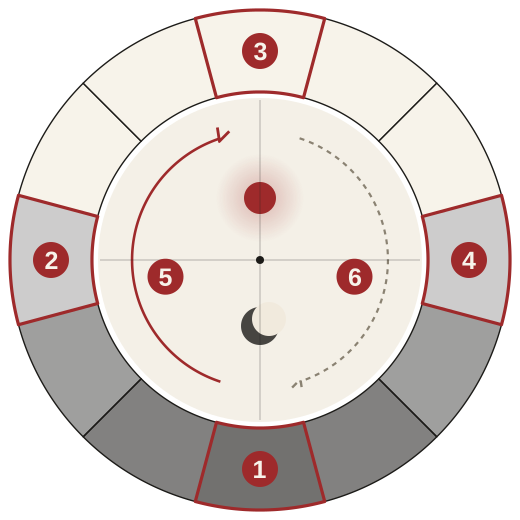
The Twelve Hours: the day divided into twelve double-hours, as the tradition describes it.
Near the equator this works well, because dawn and dusk are fairly steady all year. The tradition says yang rises through the morning and yin deepens toward night, and you can use that as a simple frame: do the more active things in the morning, the quieter things as evening comes on, and keep regular hours for getting up, eating and going to bed. You do not need to believe the explanation to find the regularity useful.
Notice: that regular hours are something you can arrange yourself, whatever the weather outside is doing.
Monsoon months and heavy rain
The solar-term pages mark the turn of the year with changes in rain, wind and cold. You will have your own equivalents. In the wetter months the light is dimmer, outdoor plans get cancelled, and many people feel slower. The tradition’s attitude to such times is to go with the season rather than push against it: plan a quieter day, practise indoors, and do not treat a rainy week as a failure of discipline. If you normally practise outdoors in a park, keep a short indoor version ready for the days it pours.
Heat and humidity
Heat is the weather you actually have, so it deserves a plain word. In a hot, humid climate, ordinary common sense does most of the work: practise in the cooler part of the morning or evening, choose shade, wear light clothes, slow down when the day is at its hottest, and drink water. You can take the traditional summer advice as a reminder not to push hard in the middle of the day.
Safety: in hot weather, drink water, rest in the shade, and stop exercising if you feel unwell. Get medical help if dizziness or weakness does not settle after resting somewhere cool. Confusion, fainting or a very high body temperature can mean heatstroke: call 995 at once. The NHS page on heat exhaustion and heatstroke is a clear reference. This page is cultural and practical information, not medical advice.
Air-conditioning: a man-made cold season
Here is something the old authors never saw: a room kept cool all day, a few steps away from a street that stays hot. You could think of an air-conditioned office or bedroom as a small, artificial winter, and the sharp change at the door as something worth noticing. The tradition does value dressing for the temperature you are in, and many people keep a light layer to hand for cold rooms. Beyond that, keep it modest: a cool room is not a problem to solve, only a condition to be aware of. If your bedroom is set very cold, you may simply want to notice whether you sleep better at a gentler setting.
Sleep, and a sun that keeps a fixed schedule
In northern China the winter night is long and the summer night is short, and traditional advice about sleeping and rising shifts with it. In Singapore, sunrise and sunset stay close to the same times all year. That makes a fixed bedtime and waking time easier to keep than it would be in a place where the daylight swings. The tradition’s steady advice is regularity, and the sun near the equator happens to agree. Artificial light, screens and late nights are your real competitors, not the season.
Why still read the solar-term pages
Read them as culture, calendar and food custom. They tell you how a great agricultural civilisation watched the sky, named the turning points of the year, and attached poems, customs and foods to many of them. Dongzhi, the day many families in Singapore still mark with tangyuan, is one of those turning points. You can enjoy them, and learn from them, without following every instruction literally or pretending your weather is theirs. When a page says “keep warm”, translate it: dress for the weather you are in. When it says “rest more”, ask what your own quieter time of year or day looks like.
For a wider introduction to the tradition and its limits, see Taoist medicine, which separates what the tradition says from what modern evidence supports.
Try this: one week of noticing your own rhythm
For seven days, change nothing. Each evening, write a line or two in a notebook: when you woke, when you were most alert, when you felt flat, when you ate, when you went to bed, and what the weather was like. Do not judge anything and do not add a new practice.
At the end of the week, look for one small mismatch between your habits and your own rhythm, such as a late meal, a hard task at your slowest hour, or a bedtime that drifts. Adjust one thing for the following week. That is the principle at work: you are following the rhythm you actually live in, not one borrowed from another climate. If you are unwell, have a medical condition or are unsure about a change in sleep or activity, speak to a doctor first.


