Yijinjing: The Sinew-Transforming Classic
易筋经:传说、历史与练法
Of the classic exercise sets, the Yijinjing (易筋经) carries the grandest legend and the most surprising true history. Learn both, because each teaches you something about how to practise it. Its name means “the classic of changing the sinews”: a slow method of lengthening, gentle twisting and steady breath meant to make the body supple and strong together.
The legend and the history
Tradition says Bodhidharma (达摩), the Indian monk who founded Chan Buddhism, left the method at the Shaolin Monastery, where it was found sealed in a wall after his death; prefaces in the book’s own pages are signed with the names of the Tang general Li Jing and the Song general Niu Gao. It is a good story, and it is not history.
In the 1930s the martial-arts historian Tang Hao (唐豪) showed that the attribution could not stand, and the historian Meir Shahar has since traced the earliest surviving text to 1624, the fourth year of the Tianqi reign, written by a Taoist of Mount Tiantai who called himself Zining Daoren (紫凝道人). The book drew together late-Ming Taoist daoyin (导引) and methods for strengthening the body. The twelve-posture sequence most people learn today, beginning with Wei Tuo Presenting the Pestle, became widely known in the Qing through illustrated health manuals such as Pan Wei’s Weisheng yaoshu (卫生要术, 1858). In 2003 the Health Qigong Management Centre of China’s General Administration of Sport published a standard modern version.
Notice what this means for you as a practitioner: the method’s value does not depend on the legend. It is an exercise tradition documented over several centuries; the history and evidence for the particular routine you learn should be considered separately, and you can approach it as that.
What “changing the sinews” means
The word jin (筋) covers what we would call tendons, ligaments and the connective tissue that ties the body together. The practice asks you to lengthen it gently: the crown lifts, the spine grows long, and the limbs extend with a mild spiralling tension, then release. Teachers describe this as “pulling the bones and stretching the sinews” (拔骨伸筋). The aim is connection: one long line from the feet through the spine to the fingertips, moved slowly and with calm breathing.
A common mistake is to stretch hard, as in athletic flexibility training. Here the tension is moderate and held only briefly, and you should never feel strain in the joints.
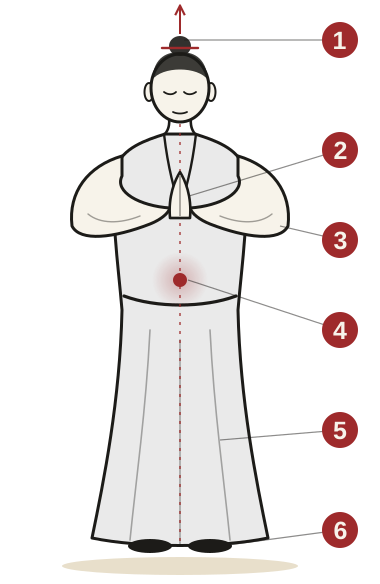
Wei Tuo Presenting the Pestle (韦驮献杵), the opening posture. A schematic drawing.
- The crown lifted: the spine lengthens upward
- Palms pressed together before the chest
- Elbows level, shoulders relaxed and low
- The lower belly: the breath settles here
- Knees soft, never locked
- Feet parallel, shoulder-width apart, rooted
The first posture: Wei Tuo Presenting the Pestle
Stand with your feet parallel, shoulder-width apart, knees soft. Let the crown of the head lift as if drawn up by a thread. Bring your palms together in front of your chest, fingers pointing up, elbows level and shoulders low. Breathe quietly into the lower belly and stay for a few breaths. Wei Tuo is the guardian figure of Chinese Buddhist temples, and the posture has his steadiness: still, upright, gathered at the centre.
To try: hold the posture for five calm breaths. Notice whether your shoulders creep up as the palms press; let them drop each time you breathe out.
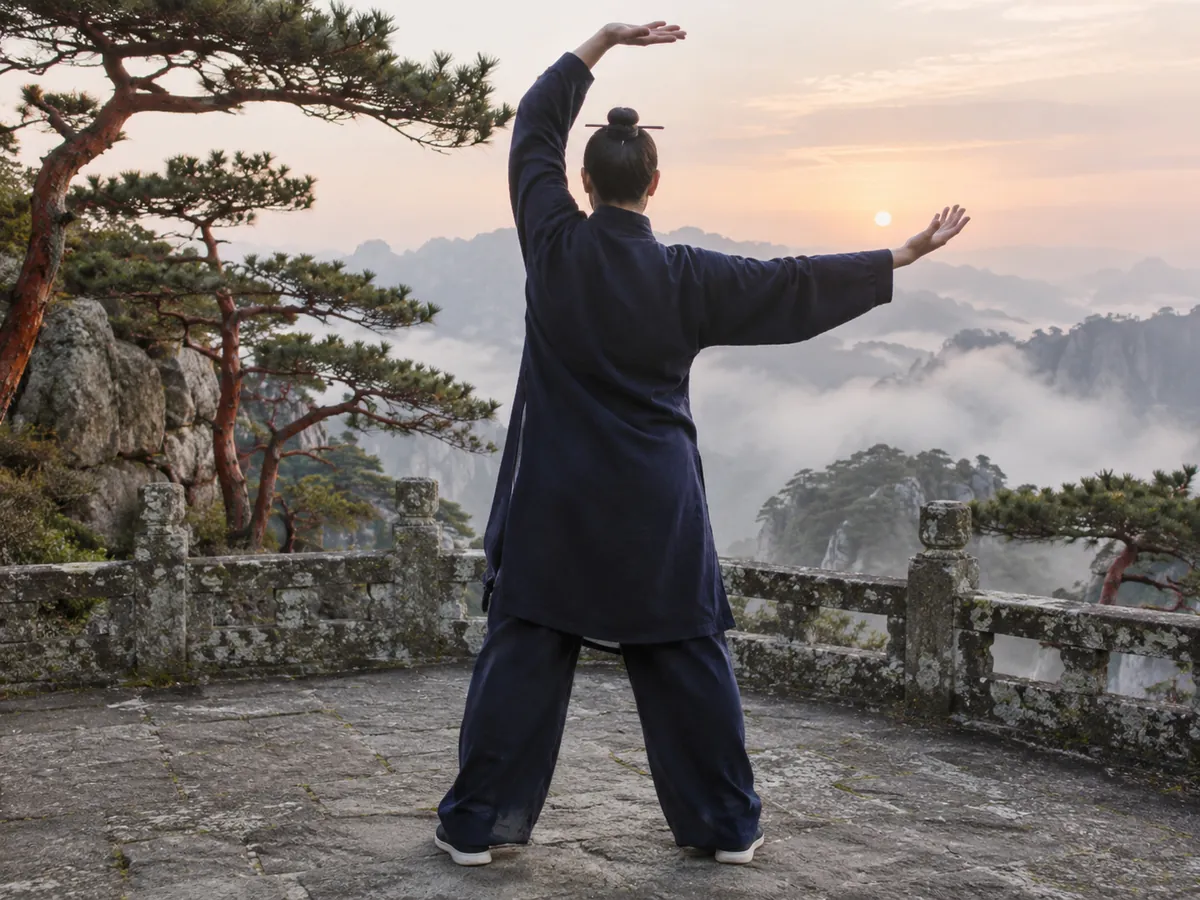
Tendon-changing practice relies on continuous, unforced lengthening from the rooted heels through the spine and fingertips.
Practising safely
Move slowly, keep the breath natural, and stop if anything hurts. The Yijinjing is a gentle-to-moderate exercise, not a treatment; if you have joint, heart or blood-pressure problems, ask your doctor first, and learn the full sequence from a qualified teacher. Our page on qigong and the evidence sets out what research shows.
To learn foundational standing and sinew-lengthening qigong in person with a teacher, see the Baduanjin workshop in Singapore.
To explore how late-Ming sinew cultivation bridges Shaolin lore and Taoist internal mechanics, read Wudang vs Shaolin and Choosing Your First Qigong Set.
Further on the site
- Qigong: the wider family of breath and movement practices.
- Baduanjin and the Five-Animal Frolics: two other classic sets.
- Standing practice: stillness on your feet, the ground of every posture.
- Neigong: internal training in the martial arts.


