Wuqinxi: The Five-Animal Frolics
五禽戏:华佗的五种动物
The Five-Animal Frolics (wuqinxi, 五禽戏) are the oldest named exercise set in Chinese tradition, and they are meant to be played, not endured: you move like a tiger, a deer, a bear, an ape and a bird. Before you try them, see how far back the idea of learning movement from animals goes.

Before Hua Tuo
The Zhuangzi, in its chapter “Constrained in Will” (刻意), already describes people who practise this way:
吹呴呼吸,吐故納新,熊經鳥申,為壽而已矣;此導引之士,養形之人,彭祖壽考者之所好也。
“Blowing and breathing, exhaling the old and taking in the new, hanging like a bear and stretching like a bird: this is simply for long life. It is what the practitioners of daoyin, who nourish the body, and those who would live as long as Pengzu, are fond of.” Read on in the chapter and you will see that Zhuangzi ranks them below the sage, who lives long “without daoyin”. Keep that in mind: the practice is a support, not the whole of the Way. A silk chart buried in 168 BCE at Mawangdui, the Daoyin tu, shows dozens of exercising figures, several of them named after animals.
Hua Tuo’s five animals
The physician Hua Tuo (华佗), at the end of the Han, gave the practice its five animals. The Book of the Later Han records what he told his student Wu Pu (吴普); the Records of the Three Kingdoms gives almost the same words:
人體欲得勞動,但不當使極耳。動搖則穀氣得銷,血脈流通,病不得生,譬猶戶樞,終不朽也。……吾有一術,名五禽之戲:一曰虎,二曰鹿,三曰熊,四曰猿,五曰鳥。亦以除疾,兼利蹄足,以當導引。
“The body wants to work, but never to the point of exhaustion. Movement lets the food be digested and the blood flow, so illness cannot arise, just as a door hinge never rots. … I have a method called the Frolics of the Five Animals: the tiger, the deer, the bear, the ape and the bird. It clears away illness and benefits the legs and feet, and it serves as daoyin.” The history adds that Wu Pu practised it and lived past ninety with sharp eyes and ears and sound teeth. Notice the first sentence: work, but not to exhaustion. It is the rule for everything that follows.
The histories name the animals but do not describe the movements. The earliest surviving description is in the Yangxing yanming lu, the same collection that preserves the Six Healing Sounds. Many versions grew up over the centuries; in 2003 the Health Qigong Management Centre of China’s General Administration of Sport published a standard modern routine of ten movements, two for each animal.
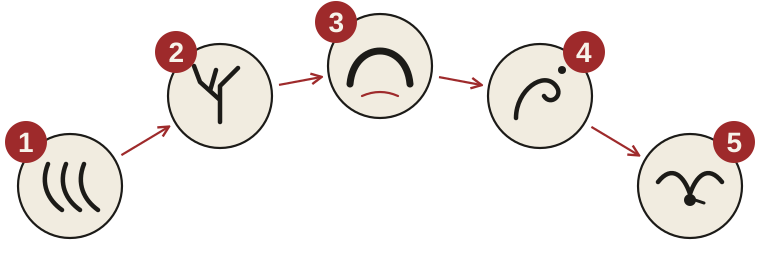
The five animals in Hua Tuo’s order, each drawn as the quality of its movement. A schematic drawing.
- Tiger (虎): power gathered and released; the hands become claws and the spine stretches up and forward
- Deer (鹿): turning and stretching the spine, light and alert
- Bear (熊): heavy, steady swaying from the waist, rooted feet
- Ape (猿): quick, light lifting and gathering, eyes bright
- Bird (鸟): opening the chest, balancing on one leg, arms spread like wings
The five qualities
Do not try to imitate the animals literally. Look for the quality each one teaches, and let it change the way you move:
- Tiger (虎): power gathered and released; the hands become claws and the spine stretches up and forward.
- Deer (鹿): turning and stretching the spine, light and alert.
- Bear (熊): heavy, steady swaying from the waist, rooted feet.
- Ape (猿): quick, light lifting and gathering, eyes bright.
- Bird (鸟): opening the chest, balancing on one leg, arms spread like wings.
A common mistake is to play every animal with the same tension. The tiger is strong, the deer light, the bear heavy, the ape quick, the bird open. The contrast is the training.
To try: stand and play only the bear for a minute, swaying slowly from the waist with your feet heavy on the floor. Then play the ape for a minute, light and quick. Notice how differently your breath and attention behave.
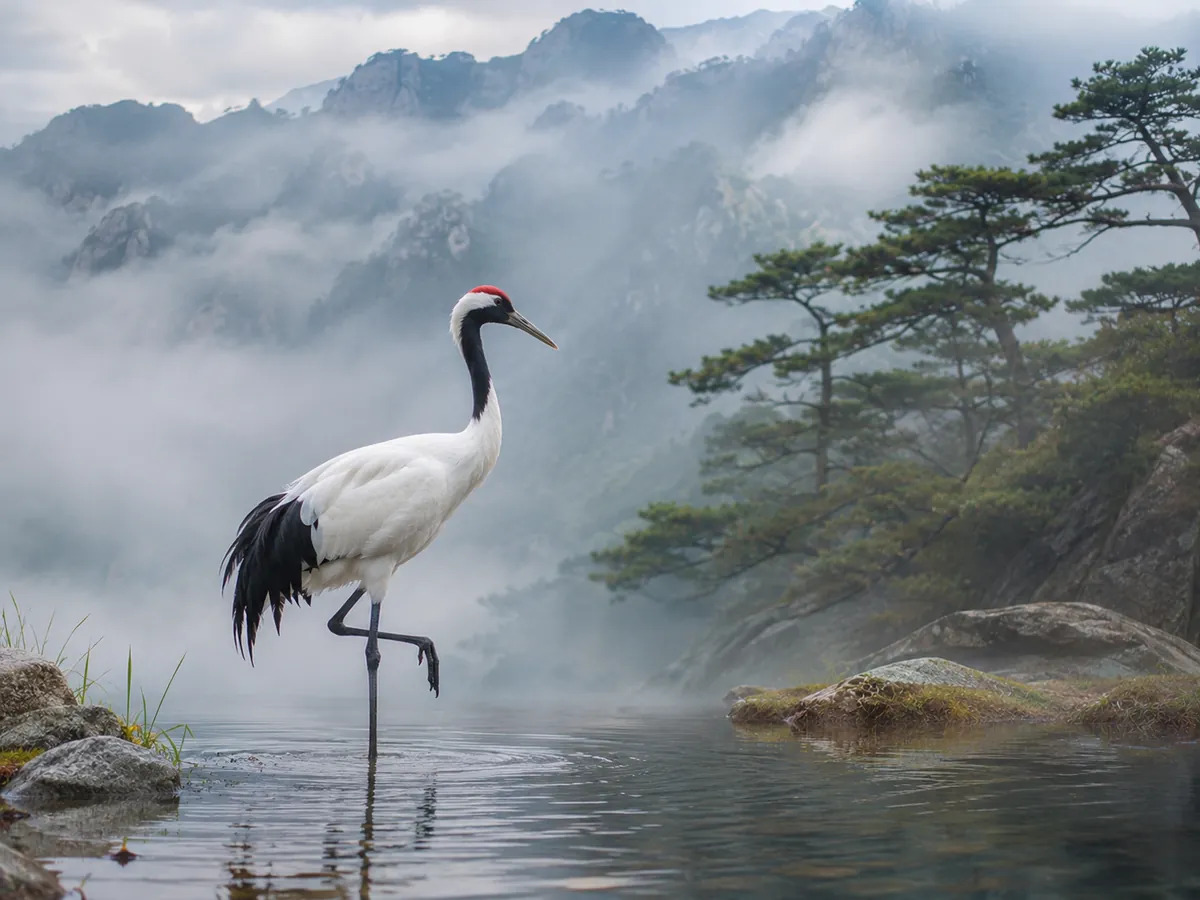
Lightness and rooted balance on one leg: the crane’s poised stillness inspires the bird section of Five-Animal Play.
Practising safely
Keep the movements within an easy range, especially the one-leg balance of the bird; hold a chair if you need it. The Frolics are gentle exercise, not a treatment: with joint, heart or balance problems, ask your doctor first, and learn the full routine from a qualified teacher. Our page on qigong and the evidence sets out what research shows.
To begin learning classical daoyin and qigong movement in person with a teacher, see the Baduanjin workshop in Singapore.
To compare Five-Animal Frolics side by side with Baduanjin, Liuzijue, and Yijinjing—or step into beginner Taijiquan footwork—see Choosing Your First Qigong Set and Wudang Tai Chi for Beginners.
Further on the site
- The Mawangdui Daoyin tu: the earliest exercise chart.
- The Six Healing Sounds and the Yijinjing: two other classic methods.
- Baduanjin: the eight-section routine.
- Qigong: the wider family of practices.


