The Twelve Hours: the Taoist Daily Rhythm
十二时辰:道家养生的一天
Before you learn any technique, learn the shape of a day. Chinese tradition divides the day and night into twelve double-hours (shichen, 时辰), each two of our hours long and each named after one of the twelve Earthly Branches, from Zi 子 (23:00–01:00) to Hai 亥 (21:00–23:00). Across those twelve, yin and yang rise and fall like a tide: yang is said to be born at midnight and to peak at noon, yin to be born at noon and to deepen until midnight.
The oldest medical classic, the Huangdi neijing, describes the people of old who knew the Way as those who “modelled themselves on yin and yang, kept in tune with the arts of measure, ate and drank with restraint, kept regular hours, and did not wear themselves out” (法于阴阳,和于术数,食饮有节,起居有常,不妄作劳). Notice how ordinary that list is. Nothing in it is secret. The skill is in living a day so that it follows the tide instead of fighting it.
This page walks you through that day as it is kept in Taoist practice, and as you can glimpse it on Wudang Mountain: from waking before dawn to the deep rest after midnight. Four hours anchor it, the four “cardinal” hours: Zi 子 at midnight, Mao 卯 at dawn, Wu 午 at noon and You 酉 at dusk. Read it as a pattern to learn from, not a timetable to obey.
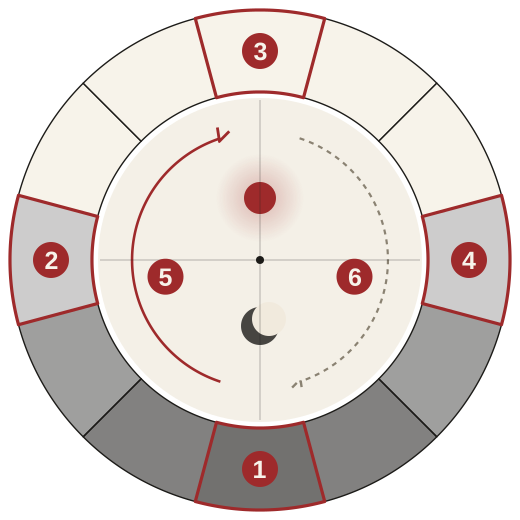
The twelve double-hours as a daily wheel, running clockwise from midnight. A schematic drawing.
- Zi 子, 23:00–01:00: midnight, where yang is born
- Mao 卯, 05:00–07:00: dawn
- Wu 午, 11:00–13:00: noon, where yin is born
- You 酉, 17:00–19:00: dusk
- The rising half, Zi to Si: yang grows (cinnabar)
- The falling half, Wu to Hai: yin grows (grey)
How to read the wheel
Start at the bottom, at midnight. Move clockwise and you pass Chou and Yin in the dark, reach Mao at dawn on the left, climb through the morning to Wu at the top, then descend through the afternoon to You at dusk on the right and back into the night. The left half of the wheel is the half in which yang grows; the right half is the half in which yin grows. Among the twelve “sovereign” hexagrams that map this tide, the one matched with Zi is Return: a single yang line coming back at the bottom.
A common mistake is to treat the four cardinal hours as switches, as if something happened at exactly midnight or noon. Think of them instead as turning points of a tide. The water does not stop at high tide; it turns. In inner-alchemy writings these four hours are often named as the classic times for quiet sitting, precisely because they are turns.

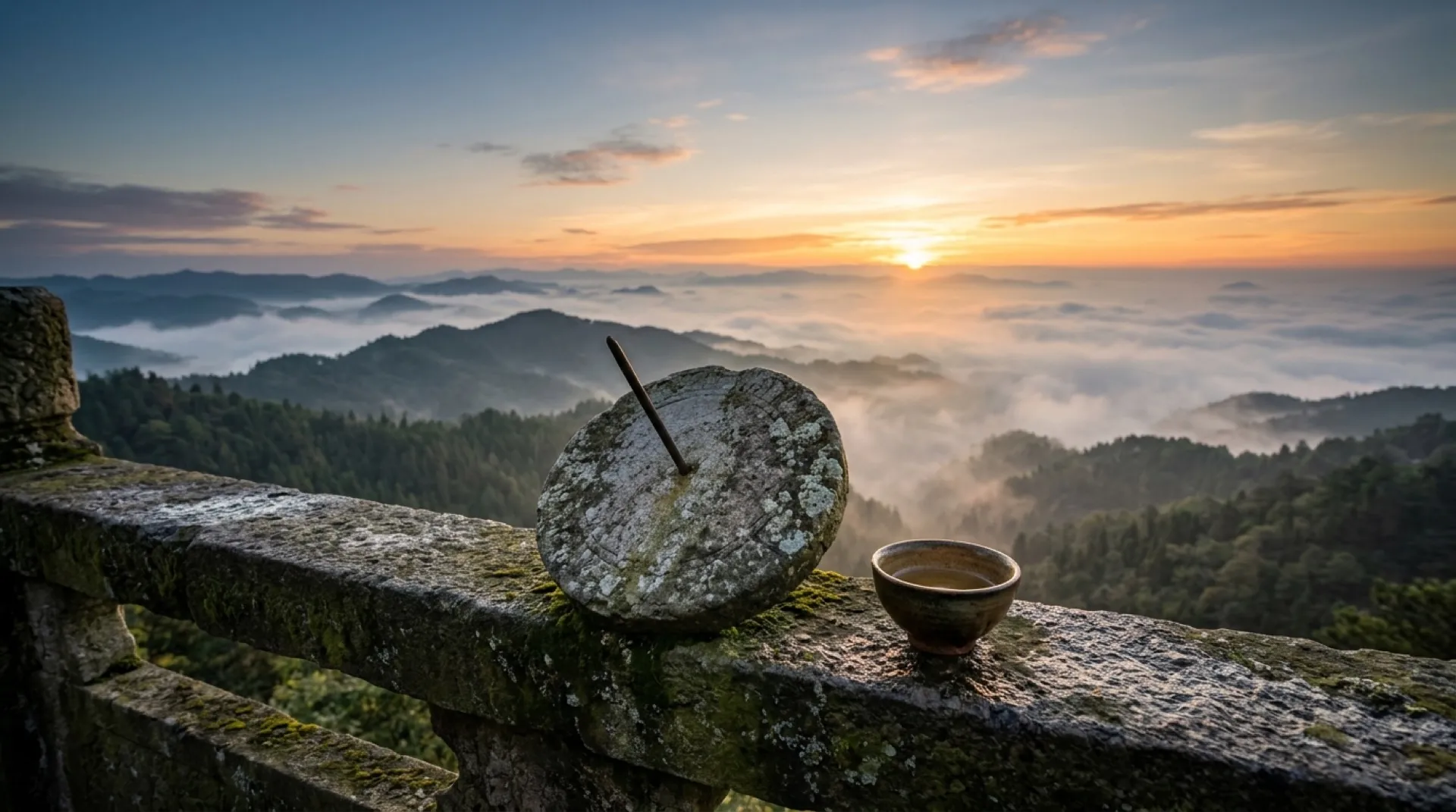
First light rising over the mountain valley: traditional twelve-hour nourishment aligns waking, work, and rest with the sun’s daily arc.
Through the day
Yin and Mao, 03:00–07:00: waking and clearing
The practice day begins before dawn. In the temples on Wudang Mountain the day is framed by a morning and an evening liturgy (zaowan gongke, 早晚功课), and the morning liturgy includes the Qingjing jing, the short classic of clarity and stillness. You do not need a temple to borrow the idea: rise, open a window, wash, and give the first few minutes to something quiet before you reach for a screen. Dawn on the mountain looks like this: sunrise at the Golden Summit, or a dawn walk for wild greens.
Chen and Si, 07:00–11:00: steady work
The morning is for the day’s main work, done steadily: a proper breakfast, study, the garden, the kitchen, whatever your duties are. Notice the word steadily. Morning energy is rising, and the temptation is to spend it all at once. A day at Danqing Ju, from the vegetable beds to the moonlit courtyard, shows what this pace looks like when it is lived rather than planned.
Wu, 11:00–13:00: a short rest at noon
At the top of the wheel yang is at its fullest and yin begins. A popular saying of Chinese health practice pairs a full night’s sleep around Zi with a short rest at Wu: the “midday-and-midnight sleep” (ziwu jiao, 子午觉). Keep it short and keep it optional. Ten or twenty quiet minutes after the midday meal is the idea, not a long sleep that leaves you heavy for the afternoon.
Wei and Shen, 13:00–17:00: afternoon practice
The afternoon is a good time for practice that needs a settled body: taijiquan, Baduanjin, calligraphy, a slow walk. It is also a time for tea. One of our Everyday dispatches is simply tea at the hour of Shen. Pay attention to how your energy feels now compared with the morning: many people find the afternoon better for careful, repeated work than for new effort.
You, Xu and Hai, 17:00–23:00: settling
From dusk the tide turns inward. The evening liturgy closes the temple day; a light supper, a quiet conversation and dimmer light follow. This is the natural home of sitting practice. If you are beginning, a few minutes of guarding the One or inner observation at You or Xu is plenty; the meditation guide shows where to start. Beginners often try to sit late at night, tired, and conclude that they cannot meditate. Try earlier, while you are still awake.
Zi and Chou, 23:00–03:00: deep rest
The wheel ends where it began, in the dark at the bottom, where yang is said to be born again. For most people the practice of these hours is simply sleep: going to bed regularly, before the night is far gone. Some inner-alchemy traditions sit at Zi itself; that is a practice to learn from a teacher, not to add to a busy life on your own.
The organ clock: a pacing tool, not a rule
You will often meet a second layer on this wheel: the “midday-midnight ebb and flow” (ziwu liuzhu, 子午流注), which assigns each double-hour to an organ and its channel. In the traditional table they run:
- 子 Zi (23:00–01:00): gallbladder
- 丑 Chou (01:00–03:00): liver
- 寅 Yin (03:00–05:00): lungs
- 卯 Mao (05:00–07:00): large intestine
- 辰 Chen (07:00–09:00): stomach
- 巳 Si (09:00–11:00): spleen
- 午 Wu (11:00–13:00): heart
- 未 Wei (13:00–15:00): small intestine
- 申 Shen (15:00–17:00): bladder
- 酉 You (17:00–19:00): kidneys
- 戌 Xu (19:00–21:00): pericardium
- 亥 Hai (21:00–23:00): triple burner
Use this as tradition used it: a heuristic for pacing rest, meals and quiet sitting, and a way of noticing your own rhythm. It is a correspondence system, not a discovery about when organs “switch on” or “repair”, and it is not a medical rule; there is no evidence that everyone must be asleep by a given hour for the liver to work. Shift work, caring for others, illness and age all change what a good day looks like. Our page on practices for nourishing life sets out where tradition and modern evidence meet and where they do not.
Reading it today
You will not live like a temple, and you do not need to. What the twelve hours teach is attention to rhythm:
- Follow the tide. Do demanding work while energy rises, and let the evening turn inward.
- Keep the turning points. Dawn, noon, dusk and midnight are good moments for a pause, a breath, a few quiet minutes.
- Be regular before you are strict. The classic asks first for “regular hours”, not for heroic ones.
To try: for one week, note the times when you feel most alert and most tired, without changing anything. At the end of the week, place them on the wheel and see which half of the day they fall in.
If you have a health condition, or sleep problems, speak to a doctor before changing your sleep or meals; tradition can shape a day, but it does not replace medical care.
To learn a daily morning qigong sequence in person with a teacher, see the Baduanjin workshop in Singapore.
Further on the site
- Taoist meditation: where to begin the evening practice.
- The Qingjing jing: the short classic recited in the morning liturgy.
- The twelve Earthly Branches: the names of the hours, and their place in the calendar.
- Everyday Wudang: dispatches from the mountain, hour by hour.
- The Six Healing Sounds, the Yijinjing and the Five-Animal Frolics: three methods to fit into the day.


