The Six Healing Sounds (Liuzijue)
六字诀:六种呼气的养生法
Of all the old breathing practices, this one asks the least of you: breathe in quietly through the nose, and breathe out slowly while shaping one of six sounds. That is the whole of the Six Healing Sounds (liuzijue, 六字诀). Before you try it, it helps to know where it comes from, how its famous organ pairings grew up, and what it can honestly be expected to do.

The oldest source
The earliest clear description is in the Yangxing yanming lu (养性延命录, “Records of Nourishing Nature and Extending Life”), traditionally attributed to the Taoist scholar Tao Hongjing (陶弘景, 456–536):
納氣有一,吐氣有六。納氣一者,謂吸也;吐氣六者,謂吹、呼、唏、呵、噓、呬,皆出氣也。
“There is one way of taking breath in, and six of letting it out. Taking in is the in-breath. The six ways of letting out are chui, hu, xi, he, xu and si; all of them are out-breaths.” Notice the balance: one in-breath, six out-breaths. The method lives in the exhale. In this early text the sounds are matched mostly to conditions to be eased, such as heat, wind or agitation, rather than to a fixed table of organs.
How the pairings settled
Over the following centuries the six sounds were tied to the organs. Buddhist meditation manuals of the Sui (a verse transmitted with Zhiyi’s Xiao zhiguan, 小止观) and the Tang physician Sun Simiao’s Qianjin yaofang (千金要方) both treat the sounds as a way of easing particular organs, and later writers set them inside the Five Phases. The pairing most books use today is that standard one. In 2003 the Health Qigong Management Centre of China’s General Administration of Sport published a modern routine, Health Qigong Liuzijue, that follows it.
A common mistake is to treat this table as ancient and fixed, or as anatomy. It is neither: the pairings changed over time, and they are a correspondence system, a way of organising attention, not a map of how organs respond to sound.
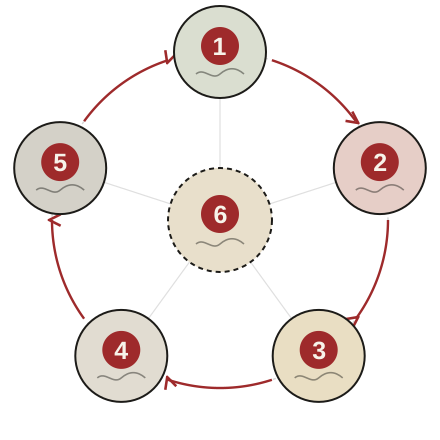
The six sounds in practice order, around the generating cycle of the Five Phases. A schematic drawing.
- 嘘 xū: liver, Wood, spring
- 呵 hē: heart, Fire, summer
- 呼 hū: spleen, Earth, late summer
- 呬 sī: lungs, Metal, autumn
- 吹 chuī: kidneys, Water, winter
- 嘻 xī: triple burner, the whole trunk
The six sounds
- 嘘 xū: liver (Wood, spring)
- 呵 hē: heart (Fire, summer)
- 呼 hū: spleen (Earth, late summer)
- 呬 sī: lungs (Metal, autumn)
- 吹 chuī: kidneys (Water, winter)
- 嘻 xī: triple burner
Look at the order: Wood, Fire, Earth, Metal, Water, and with them spring, summer, late summer, autumn and winter. It is the generating cycle of the Five Phases, each phase giving rise to the next, closed by the sixth sound for the whole trunk. Some teachers give extra time to the sound of the current season.
How to practise gently
Sit or stand upright and relaxed. Breathe in quietly through the nose. Breathe out slowly through the mouth, shaping the first sound, xu, softly enough that someone beside you would barely hear it. Let the out-breath be longer than the in-breath, but never forced. Repeat each sound a few times, then move to the next, in the order above. Traditional teaching describes the aim as “sound in the breath, not in the voice” (出声不出音): the breath carries the shape of the sound, but you are not singing it. Many teachers begin with a faint sound and let it become silent as the practice settles.
Beginners often push the breath out hard or hold it at the end. Do neither. If you feel light-headed, stop and breathe normally. Short sessions are enough; the evening, as the day turns inward, is a natural time for them.
To try: breathe out once silently, then once on a soft xu. Notice which out-breath is longer and steadier. That difference is most of what this practice teaches.

Standing breath practice by moving water at dawn: long, unforced exhalations paired with gentle abdominal awareness.
What it can and cannot do
The most plausible way the six sounds help is the long, controlled out-breath itself, which tends to slow and steady breathing, not sound travelling to an organ. They are a gentle way into breath awareness, and they pair well with movement practices such as Baduanjin. They are not a treatment: if you have a heart or lung condition, high blood pressure or are pregnant, ask your doctor before starting any breathing practice. Our page on qigong and the evidence sets out what research does and does not show.
To practise foundational qigong breath and posture in person with corrections, see the Baduanjin workshop in Singapore.
Unsure whether to begin with the Six Healing Sounds or a movement-led brocade routine? Compare all four classic sets in Choosing Your First Qigong Set or map a 15-minute beginner plan on Start Here.
Further on the site
- The Taoist sound tradition: chant, ritual music and the six sounds in context.
- Qigong: the wider family of breath and movement practices.
- Yin-yang and the Five Phases: the system behind the organ pairings.


