The Jingle Palace (净乐宫, Palace of Pure Joy) is the most unusual entry in the story of Wudang's temples: the building most often named as the first of the mountain's palaces is not on the mountain, and the original no longer exists. This page tells you what it was, and what you can actually visit.
What it was
The palace stood in the old city of Junzhou (均州), at the northern foot of Wudang Mountain, in what is now Danjiangkou. Sources describe it as built at the Ming emperor Yongle's command and as the first of the palaces; some count eight palaces and some nine, which is why you will see both “first of the eight” and “first of the nine”. It is also often nicknamed the “Little Forbidden City” (小故宫), a nickname for its imperial scale, not a historical title.
Sources differ on the dates, so this page gives no single year as settled. A frequent mistake is to quote one date as fact: treat any single year with caution. Sources also differ on its size, so this page gives no room count.
Tradition holds that Zhenwu was born here as a prince of the Jingle kingdom. That is the tradition’s account, not a documented fact, but it explains why the place stood first.
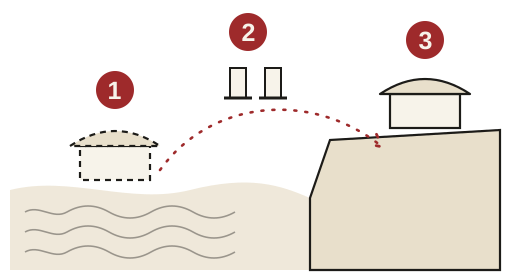
A schematic of what happened to the palace. It is not to scale and shows no places or distances.
- The original palace in old Junzhou, now under the reservoir water.
- The two great stone steles, carried to higher ground with more than 800 stone parts.
- The rebuilt Jingle Palace, a reconstruction built in the early 2000s and open to visitors since 2006.
What happened to it
The palace and the old city of Junzhou were drowned by the Danjiangkou Reservoir, built from 1958. Before the water rose, two great Ming stone steles, each carried on a stone tortoise (bixi, 赑屃), and more than 800 stone parts were moved to higher ground on the edge of Danjiangkou city.
What you can visit
A new Jingle Palace was built beside the reservoir in the early 2000s and opened to visitors in 2006, as part of the heritage-moving work for the South-to-North Water Diversion Project. It is a reconstruction, not the Yongle building. When you walk through it, you are looking at a copy shaped by the original plan and, in part, by the surviving stones. Ask of each part: is this old, or is it new?
To try: stand before the steles and notice that these, the stone parts that were carried away, are what actually link the new palace to the old one.
Further on the site
- The outlying palaces: the palaces beyond the central route.
- The central temple route: the order of the main palaces.
- The Xuanyue Gate: where the old Sacred Way begins.
- Temples and sacred sites: the full overview.



