The Xuanyue Gate (玄岳门) is the stone archway that stands at the beginning of the old pilgrim road up Wudang Mountain. Its formal name is the Zhishi Xuanyue archway (治世玄岳牌坊). Before you read about the temples higher up, learn to read this one structure: it tells you how the mountain wished to be entered.
What it is, and when it was built
It stands east of Wudang town, at the start of the old pilgrim road. It was ordered by imperial decree in the 31st year of the Jiajing reign (1552), and finished the next year; the Jiajing emperor himself bestowed the plaque.
A common mistake is to assume the gate belongs to the great Yongle building campaign of the early fifteenth century, because so much of the mountain does. It does not. It is a later, Jiajing-era addition to a mountain that the Ming court had already built up, and it was added to mark the way in. The gate is now one of China's nationally protected monuments, and it forms part of the Ancient Building Complex in the Wudang Mountains, inscribed on the UNESCO World Heritage List in 1994.
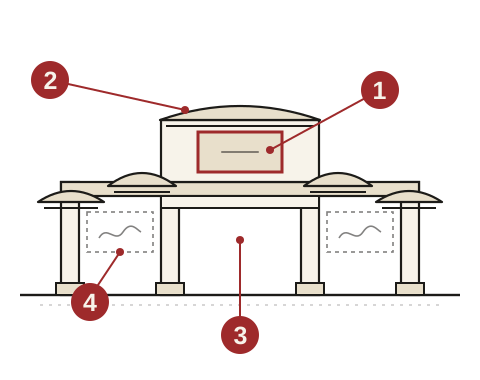
A schematic of the gate. It is not to scale and carries no measurements.
- The plaque with the four characters 治世玄岳, set in the centre.
- The five roofs: one high at the centre, one on each side of it, one at each end.
- Four pillars make three bays; the middle bay is the widest.
- Carved panels in the side bays (reported: dragons, phoenixes, cranes and figures).
How to read the structure
The Chinese description of the gate is “three bays, four pillars, five roofs” (三间四柱五楼). Count them against the drawing: four pillars make three openings, and five separate roofs step down from the centre to the ends. A frequent error in English summaries is to write “five bays” because of the five roofs; the roofs and the openings are different counts.
The whole gate is built of blue-grey stone, cut to imitate a timber building and joined with mortise and tenon, as a carpenter would join wood. Look closely at the brackets and beams: they are stone, but they follow the logic of timber. Published heights and widths differ from source to source, so this page gives none.
What the four characters say
The plaque reads 治世玄岳. 玄岳 (Xuanyue) is a name for the mountain itself; 治世 means to govern, or bring order to, the age. Read together, it is a statement of purpose: the mountain and its worship are tied to the good order of the realm. Accounts describe it as the emperor’s wish for a prosperous reign grounded in the Wudang tradition and in the worship of Zhenwu. We know the emperor gave the plaque, which tells you whose voice it is: an imperial one, speaking to the mountain, not the mountain speaking about itself.
Why it matters on the way up
Many roads have a first gate; this one is the threshold of a long walk. The old Sacred Way (古神道) began here, and the gate is the first of the architecture you meet on it. Stand a moment before passing through and notice how the stone, the plaque and the carved panels frame what lies behind it. Visitor accounts describe dragons, phoenixes, cranes and human figures on the carving; see which you can find.
To try: before you walk on, decide what you are leaving behind and what you hope to notice higher up. Say it silently, once. This is only a way of paying attention; it is not a rite from any source.
Further on the site
- The central temple route: how the palaces on the main road are ordered.
- Layout and architecture: how the buildings are planned.
- Yuanhe Guan: the first Taoist abbey on the road beyond the gate.
- Qiongtai: three halls on the south-east side of Tianzhu Peak.
- Temples and sacred sites: the full overview.



