Yuanhe Guan (元和观) is the first Taoist abbey you meet after passing the Xuanyue Gate on the old Sacred Way. Most visitors rush past it toward the famous palaces. Stop here instead and learn what a mountain abbey at the foot of the climb is for.
What it is
Reference sources describe it as the first Taoist temple on the old road in through the Xuanyue Gate. Its name uses the word guan (观), which marks a smaller temple than a gong (宫, palace); the great palaces higher up carry the other word. The abbey stands in a village that carries its name, Yuanhe Guan village, not far from the Yuzhen Palace; sources give different distances, so this page gives none.
How old it is
It began in the Yuan dynasty. It was rebuilt in the Ming, from Yongle 11 (1413) to Yongle 17 (1419), as part of the same imperial campaign that built the great palaces, and it was altered and repaired again after the Jiajing reign. A frequent mistake is to read the dates as “built in 1413”; they are the dates of a rebuilding on an older foundation.
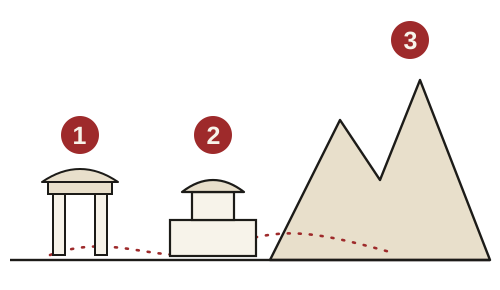
A schematic of the order of things on the old road. It is not to scale and shows no distances.
- The Xuanyue Gate (玄岳门).
- Yuanhe Guan (元和观), the first Taoist abbey on the old Sacred Way beyond the gate.
- The mountain, still ahead.
What survives
In the Yuan, Ming and Qing it was enlarged and added to. In the great hall stand Ming gilded-bronze figures of the six Jia spirits (六甲). The abbey belongs to the Ancient Building Complex in the Wudang Mountains, inscribed on the UNESCO World Heritage List in 1994.
Why it is worth a stop
Notice where it sits: right after the gate, before the real climb begins. A threshold is useful only if something waits just beyond it, and an abbey is a good thing to place there: a first place to rest, to settle and to change pace. See whether the layout of the courtyard and halls suggests that purpose to you.
To try: after the gate, walk slowly to the abbey instead of hurrying, and notice how your pace changes. This is a way of paying attention, not a rite from any source.
Further on the site
- The Xuanyue Gate: where the old Sacred Way begins.
- The central temple route: the order of the main palaces.
- Layout and architecture: how the buildings are planned.
- Temples and sacred sites: the full overview.