Qiongtai (琼台) is not one building but a group of three: the Upper, Middle and Lower Qiongtai (琼台上观, 中观, 下观). It lies on the south-east side of Tianzhu Peak, the highest point of Wudang Mountain, and this page keeps to what the published accounts agree on.
Three halls, one name
Guidebooks describe the Qiongtai complex as divided into an Upper, a Middle and a Lower hall. Beginners often treat “Qiongtai” as a single temple and wonder why different guides describe different buildings. They are describing different halls of the same group.
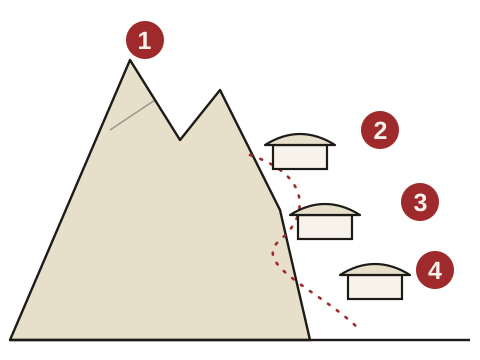
A schematic of the setting. It is not to scale and carries no heights or distances.
- Tianzhu Peak (天柱峰), the highest point of the mountain.
- Upper Qiongtai (上观): today mostly ruins.
- Middle Qiongtai (中观): the best preserved of the three.
- Lower Qiongtai (下观): reported to keep its main hall and a side hall.
From palace to guan
The accounts say that the three were together called Qiongtai Palace (琼台宫, gong) in the Yuan dynasty, and that the Ming dynasty changed the title to guan (观), the word you see in the names above. The words matter: gong usually means a larger, more formal Taoist palace and guan a smaller temple, so the change of title is itself a record of how the place was ranked.
What survives
The three halls have not fared equally. The Upper hall is largely ruins. The Middle hall (中观, also called “Ziyue Qiongtai”) is the best preserved of the three. To the right of its main hall, travel guides report a small stone hall from the Yuan dynasty: one bay square, about 18 square metres, with walls nearly a metre thick, holding a Zhenwu figure carved in blue stone. The main buildings you see today, such as the Hall of the Three Purities, are Qing rebuilding or Ming–Qing survivals, and the hall holds a Ming gilded-bronze figure of Zhenwu. The Lower hall is reported to keep its main hall and a side hall.
The complex was destroyed by fire in war in 1856 (Xianfeng 6) and partly rebuilt in the Guangxu reign (1875–1908). Sources give no firm dates for the earlier Ming work, so this page gives none.
Why it is worth a stop
Qiongtai sits on the way to the summit, and guidebooks describe it today as the end of one of the common routes up, where a cable car runs to the Golden Summit. If you are choosing between the walk and the cable car, remember that an upper, a middle and a lower hall mean a slope: this was a place built on the climb, not at the top of it. Notice how the three halls, one below another, turn a steep hillside into a series of resting places.
To try: at the Middle hall, stop before the next climb and look back down the way you came. Ask yourself what the three-part layout is helping you do: rest, gather yourself, prepare. It is a question, not an answer from any source.
Further on the site
- The Xuanyue Gate: where the old Sacred Way begins.
- The central temple route: the order of the main palaces.
- Layout and architecture: how the buildings are planned.
- Temples and sacred sites: the full overview.



