Chapter One: Tian Rui 天瑞
第一篇:天瑞
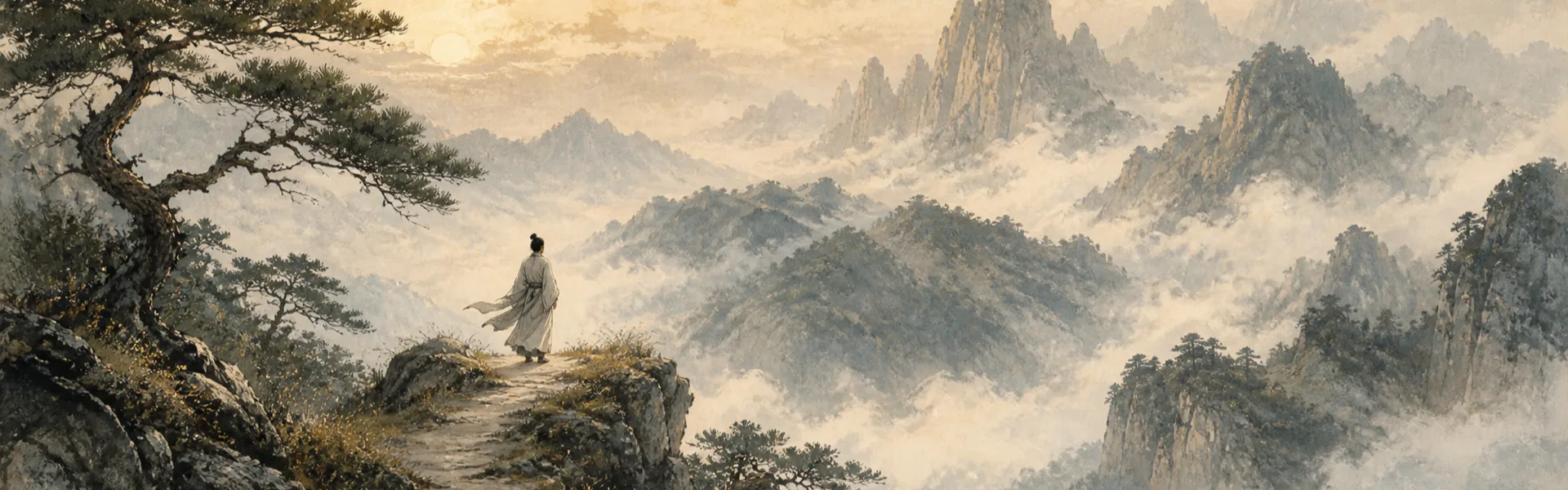
Tian Rui, “Heaven’s Signs,” opens the Liezi with a demanding question: if everything we meet is born, changes, and eventually disappears, what—if anything—stands behind that movement? The chapter answers through cosmology, stories, paradoxes, and humour rather than a single doctrine. Its recurring lesson is not that life is unreal or unimportant, but that no living form owns the larger process that brings it forth.
Read slowly. Each passage approaches transformation from a different angle: the beginning of the cosmos, the limits of human ability, ageing and death, anxious imagination, and the mistaken wish to possess what is only passing through our hands. The practical question throughout is simple: how can we care, choose, and act without demanding that change stop?
1. What Gives Birth Is Not Itself a Born Thing
Classical text
子列子居鄭圃,四十年人無識者。國君卿大夫眎之,猶衆庶也。國不足,將嫁於衛。弟子曰:「先生往無反期,弟子敢有所謁,先生將何以教?先生不聞壺丘子林之言乎?」子列子笑曰:「壺子何言哉?雖然,夫子嘗語伯昏瞀人。吾側聞之,試以告女。其言曰:有生不生,有化不化。不生者能生生,不化者能化化。生者不能不生,化者不能不化。故常生常化。常生常化者,無時不生,無時不化。陰陽爾,四時爾,不生者疑獨,不化者往復。往復,其際不可終;疑獨,其道不可窮。《黃帝書》曰:『谷神不死,是謂玄牝。玄牝之門,是謂天地之根。綿綿若存,用之不勤。』故生物者不生,化物者不化。自生自化,自形自色,自智自力,自消自息。謂之生化形色智力消息者,非也。」
English reading
Liezi had lived quietly near Zheng for forty years, little distinguished from an ordinary person. When hardship made him prepare to leave for Wei, his disciples asked for a final teaching. He recalled words heard from his teacher: there are living things, and there is that through which life arises; there are changing things, and there is that through which change occurs. What has been born cannot avoid living out its birth, and what has entered change cannot refuse transformation. Yin and yang, and the four seasons, are the visible rhythm of this ceaseless process.
The passage then echoes the image of the inexhaustible valley spirit: the source is not another object competing with the objects it produces. Things arise, take form and colour, gain capacities, decline, and rest through conditions larger than any separate controller. To name one isolated maker of every detail would miss the chapter’s point.
Plain-language meaning
You did not personally arrange all the conditions that made your life possible, and you cannot command every condition that will shape it. This need not make action meaningless. It puts action in proportion. We are participants in change, not its sole authors.
2. From the Formless to the Ten Thousand Things
Classical text
子列子曰:「昔者聖人因陰陽以統天地。夫有形者生於無形,則天地安從生?故曰:有太易,有太初,有太始,有太素。太易者,未見氣也;太初者,氣之始也;太始者,形之始也;太素者,質之始也。氣形質具而未相離,故曰渾淪。渾淪者,言萬物相渾淪而未相離也。視之不見,聽之不聞,循之不得,故曰易也。易無形埒,易變而爲一,一變而爲七,七變而爲九。九變者,究也,乃復變而爲一。一者,形變之始也。清輕者上爲天,濁重者下爲地,沖和氣者爲人;故天地含精,萬物化生。」
English reading
The sages understood heaven and earth through yin and yang. Yet if formed things emerge from the formless, where did heaven and earth themselves begin? The text describes four thresholds: Great Change, before energy is manifest; Great Beginning, when energy begins; Great Commencement, when form begins; and Great Simplicity, when material substance begins. Before these are separated, they are a blended whole beyond sight, sound, or grasp.
Change moves into unity, reaches completion, and returns to a new beginning. What is clear and light rises as heaven; what is turbid and heavy settles as earth; their balanced, open energy becomes human life. Heaven and earth hold their vital potency, and the ten thousand things are transformed into being.
Plain-language meaning
This is an ancient cosmological map, not a modern physics lesson. Its enduring insight is that visible results have invisible beginnings. A decision begins as a tendency; a habit begins as a repeated impulse; a conflict begins before anyone raises a voice. Wisdom notices the early, subtle stage while change is still easy to guide.
3. Nothing Has Every Ability
Classical text
子列子曰:「天地無全功,聖人無全能,萬物無全用。故天職生覆,地職形載,聖職教化,物職所宜。然則天有所短,地有所長,聖有所否,物有所通。何則?生覆者不能形載,形載者不能教化,教化者不能違所宜,宜定者不出所位。故天地之道,非陰則陽;聖人之教,非仁則義;萬物之宜,非柔則剛:此皆隨所宜而不能出所位者也。故有生者,有生生者;有形者,有形形者;有聲者,有聲聲者;有色者,有色色者;有味者,有味味者。生之所生者死矣,而生生者未嘗終;形之所形者實矣,而形形者未嘗有;聲之所聲者聞矣,而聲聲者未嘗發;色之所色者彰矣,而色色者未嘗顯;味之所味者嘗矣,而味味者未嘗呈:皆無爲之職也。能陰能陽,能柔能剛,能短能長,能員能方,能生能死,能暑能涼,能浮能沈,能宮能商,能出能沒,能玄能黃,能甘能苦,能羶能香。無知也,無能也,而無不知也,而無不能也。」
English reading
Heaven does not perform every task, the sage does not possess every skill, and no thing is useful for every purpose. Heaven covers and generates; earth supports and gives form; the sage teaches; each thing follows what suits its nature. Every capacity therefore includes a limit. The power that produces is not identical with the product, just as the condition that makes sound possible is not itself a sound.
The underlying process can appear as yin or yang, soft or hard, short or long, round or square, life or death, heat or cold. It has no personal knowledge or ability, yet nothing lies outside its transformations.
Plain-language meaning
A person, institution, or practice becomes distorted when it tries to serve every purpose. Maturity includes knowing both one’s function and one’s limit. In a team, family, or school, shared strength comes from fitting different capacities together—not from pretending one person should do everything.
4. The Skull and the Great Circulation
Classical text
子列子適衛,食於道,從者見百歲髑髏,攓蓬而指,顧謂弟子百豐曰:「唯予與彼知而未嘗生未嘗死也。此過養乎?此過歡乎?種有幾:若䵷爲鶉,得水爲㡭,得水土之際,則爲䵷蠙之衣。生於陵屯,則爲陵舄。陵舄得鬱栖,則爲烏足。烏足之根爲蠐螬,其葉爲胡蝶。胡蝶胥也,化而爲蟲,生竈下,其狀若脫,其名曰𪀊掇。𪀊掇千日,化而爲鳥,其名曰乾餘骨。乾餘骨之沫爲斯彌。斯彌爲食醯頤輅。食醯頤輅生乎食醯黃軦,食醯黃軦生乎九猷。九猷生乎瞀芮,瞀芮生乎腐蠸。羊肝化爲地皋,馬血之爲轉鄰也,人血之爲野火也。鷂之爲鸇,鸇之爲布穀,布穀久復爲鷂也,鷰之爲蛤也,田鼠之爲鶉也,朽瓜之爲魚也,老韭之爲莧也,老羭之爲猨也,魚卵之爲蟲。亶爰之獸自孕而生曰類。河澤之鳥視而生曰鶂。純雌其名大𦝫,純雄其名稺蜂。思士不妻而感,思女不夫而孕。后稷生乎巨蹟,伊尹生乎空桑。厥昭生乎濕。醯雞生乎酒。羊奚比乎不筍。久竹生青寧,青寧生程,程生馬,馬生人。人久入於機。萬物皆出於機,皆入於機。」
English reading
On the road to Wei, Liezi’s party encountered an old skull. He pointed to it and spoke of life and death as moments within a circulation that neither begins with one individual nor ends with another. The passage follows with an extraordinary catalogue of plants, insects, birds, animals, and legendary births changing into one another. Many names are archaic and their identifications uncertain; the list belongs to ancient natural lore, not modern biology.
Its philosophical claim is clearer than its zoology: forms enter a generative hinge, emerge in another condition, and eventually return. The skull is not used to deny grief. It interrupts the assumption that our present form is the measure of the whole process.
Plain-language meaning
Modern ecology offers a sober parallel: bodies become soil, soil nourishes plants, and life depends on circulation. We should not treat the old catalogue as science, but we can receive its reminder that nothing living is self-contained. Consumption, waste, burial, farming, and care for land all belong to one material world.
5. Returning to One’s Root
Classical text
《黃帝書》曰:「形動不生形而生影,聲動不生聲而生響,無動不生無而生有。」形,必終者也;天地終乎?與我偕終。終進乎?不知也。道終乎本無始,進乎本不久。有生則復於不生,有形則復於無形。不生者,非本不生者也;無形者,非本無形者也。生者,理之必終者也。終者不得不終,亦如生者之不得不生。而欲恆其生,畫其終,惑於數也。精神者,天之分;骨骸者,地之分。屬天清而散,屬地濁而聚。精神離形,各歸其真,故謂之鬼。鬼,歸也,歸其真宅。黃帝曰:「精神入其門,骨骸反其根,我尚何存?」
English reading
Movement produces a shadow; sound produces an echo; from the stirring of what is not yet present, something appears. Every form must eventually end. Whether heaven and earth end with us, or endure beyond any horizon we can know, the text refuses to claim certainty.
What is born returns beyond birth; what has form returns beyond form. Spirit belongs to the clear and dispersing aspect of heaven, while bones belong to the dense and gathering aspect of earth. At death, each returns to its own root. The Yellow Emperor asks: once these have returned, what separate “I” remains to be possessed?
Plain-language meaning
This passage does not settle the afterlife. It loosens the fantasy that a fixed self can be held forever. A practical response is to invest less in defending an image of oneself and more in the qualities, care, and consequences that continue through other lives.
6. The Four Great Changes of a Human Life
Classical text
人自生至終,大化有四:嬰孩也,少壯也,老耄也,死亡也。其在嬰孩,氣專志一,和之至也;物不傷焉,德莫加焉。其在少壯,則血氣飄溢,欲慮充起;物所攻焉,德故衰焉。其在老耄,則欲慮柔焉;體將休焉,物莫先焉。雖未及嬰孩之全,方於少壯,間矣。其在死亡也,則之於息焉,反其極矣。
English reading
Human life passes through four great transformations: infancy, youth, old age, and death. The infant’s energy is gathered and undivided. In youth, blood and energy overflow, desires and plans multiply, and the world presses strongly upon us. In old age, desire softens and the body turns towards rest. Death is the final repose, a return to the far end of the cycle.
Plain-language meaning
No stage should be judged only by the standards of another. Youth is not failed childhood, and old age is not failed youth. Each season has a different work: dependence and trust, expansion and responsibility, release and integration. Problems arise when we demand that one season continue after its conditions have changed.
7. Rong Qiqi’s Three Joys
Classical text
孔子遊於太山,見榮啓期行乎郕之野,鹿裘帶索,鼓琴而歌。孔子問曰:「先生所以樂,何也?」對曰:「吾樂甚多:天生萬物,唯人爲貴。而吾得爲人,是一樂也。男女之別,男尊女卑,故以男爲貴;吾既得爲男矣,是二樂也。人生有不見日月、不免襁褓者,吾既己行年九十矣,是三樂也。貧者士之常也,死者人之終也,處常得終,當何憂哉?」孔子曰:「善乎!能自寬者也。」
English reading
Confucius met Rong Qiqi walking in a rough deerskin, playing a lute and singing. Asked why he was joyful despite poverty, Rong named three gifts: being born human, being born male within the social hierarchy assumed by the story, and having lived to ninety when many die in infancy. Poverty, he said, is common and death is every person’s end; why turn the ordinary conditions of life into a private grievance?
The claim that men are superior to women records an ancient patriarchal assumption. Preserving it as part of the text does not make it a teaching to follow today. The lasting point is Rong’s ability to notice unearned gifts without waiting for perfect circumstances.
Plain-language meaning
Gratitude is strongest when it does not deny hardship. It does not say poverty, exclusion, or suffering should never be changed. It prevents what is painful from erasing everything that still supports life.
8. Lin Lei Sings While Gleaning
Classical text
林類年且百歲,底春被裘,拾遺穗於故畦,並歌並進。孔子適衛,望之於野。顧謂弟子曰:「彼叟可與言者,試往訊之!」子貢請行。逆之壠端,面之而歎曰:「先生曾不悔乎,而行歌拾穗?」林類行不留,歌不輟。子貢叩之不已,乃仰而應曰:「吾何悔邪?」子貢曰:「先生少不勤行,長不競時,老無妻子,死期將至,亦有何樂而拾穗行歌乎?」林類笑曰:「吾之所以爲樂,人皆有之,而反以爲憂。少不勤行,長不競時,故能壽若此。老無妻子,死期將至,故能樂若此。」子貢曰:「壽者人之情,死者人之惡。子以死爲樂,何也?」林類曰:「死之與生,一往一反。故死於是者,安知不生於彼?故吾知其不相若矣。吾又安知營營而求生非惑乎?亦又安知吾今之死不愈昔之生乎?」子貢聞之,不喻其意,還以告夫子。夫子曰:「吾知其可與言,果然,然彼得之而不盡者也。」
English reading
Nearly a hundred years old, Lin Lei walked through an old field gathering dropped grain and singing. Zigong saw only failure: Lin Lei had not pursued success, had no wife or children, and was close to death. Lin Lei replied that what others turn into anxiety had allowed him to live freely. Life and death are a going and a returning; how could he know that frantic efforts to preserve life were not themselves confusion?
Confucius judged that Lin Lei had grasped something real, but not the whole. Freedom from conventional ambition can be wise; it does not automatically answer every responsibility we have to others.
Plain-language meaning
A life cannot be measured only by career, property, marriage, or public recognition. Yet rejecting those measures should not become another rigid identity. Ask which expectations genuinely serve life and which ones merely keep you running.
9. Zigong Wishes to Rest
Classical text
子貢倦於學,告仲尼曰:「願有所息。」仲尼曰:「生無所息。」子貢曰:「然則賜息無所乎?」仲尼曰:「有焉耳。望其壙,睪如也,宰如也,墳如也,鬲如也,則知所息矣。」子貢曰:「大哉死乎!君子息焉,小人伏焉。」仲尼曰:「賜!汝知之矣。人胥知生之樂,未知生之苦;知老之憊,未知老之佚;知死之惡,未知死之息也。晏子曰:『善哉,古之有死也!仁者息焉,不仁者伏焉。』死也者,德之徼也。古者謂死人爲歸人。夫言死人爲歸人,則生人爲行人矣。行而不知歸,失家者也。一人失家,一世非之;天下失家,莫知非焉。有人去鄉土、離六親、廢家業、遊於四方而不歸者,何人哉?世必謂之爲狂蕩之人矣。又有人鍾賢世,矜巧能、修名譽、誇張於世而不知已者,亦何人哉?世必以爲智謀之士。此二者,胥失者也。而世與一不與一,唯聖人知所與,知所去。」
English reading
Weary of study, Zigong asked Confucius where he might rest. “In life there is no final rest,” came the answer; the grave marks that return. People know the pleasures of living but overlook its burden, know the weakness of age but overlook its release, and fear death without recognising its rest.
The ancients called the dead “those who have returned,” making the living “travellers.” The story criticises two kinds of homelessness: visibly abandoning one’s home and responsibilities, and endlessly pursuing talent, status, and reputation while never knowing when to stop. Society condemns the first and praises the second, but both can lose the way home.
Plain-language meaning
Rest is not only the absence of work. A person can take a holiday while remaining inwardly driven by comparison and reputation. Practise small returns before exhaustion forces them: finish the day, put down the role, let enough be enough, and remember the relationships for which the work was meant.
10. The Use of Emptiness
Classical text
或謂子列子曰:「子奚貴虛?」列子曰:「虛者無貴也。」子列子曰:「非其名也,莫如靜,莫如虛。靜也虛也,得其居矣;取也與也,失其所矣。事之破䃣而後有舞仁義者,弗能復也。」
English reading
Someone asked why Liezi valued emptiness. He answered that emptiness does not set itself up as valuable. Stillness and openness allow things to find their place; grasping and forced giving can displace them. Once a situation has been broken, performing benevolence and righteousness over the damage may not restore what was lost.
Plain-language meaning
Emptiness here is available attention, not blankness or apathy. Before offering advice, making a rule, or proving that you are helpful, leave enough space to see what the situation actually needs. Prevention often requires less display than repair.
11. Change Too Gradual to See
Classical text
粥熊曰:「運轉亡已,天地密移,疇覺之哉?故物損於彼者盈於此,成於此者虧於彼。損盈成虧,隨世隨死。往來相接,間不可省,疇覺之哉?凡一氣不頓進,一形不頓虧;亦不覺其成,亦不覺其虧。亦如人自世至老,貌色智態,亡日不異;皮膚爪髮,隨世隨落,非嬰孩時有停而不易也。間不可覺,俟至後知。」
English reading
The world turns without pause and heaven and earth shift in secret. What diminishes here fills elsewhere; what forms here wears away elsewhere. A breath does not advance all at once, and a body does not decline all at once. From birth to old age, appearance, colour, understanding, skin, nails, and hair change every day, yet the intervals are too small to notice. We recognise the transformation only afterwards.
Plain-language meaning
Many important changes are accumulations, not events: health, trust, skill, resentment, debt, and climate all grow through small movements. Do not wait for dramatic proof. Regular attention to direction is more useful than surprise at the final result.
12. The Man Who Feared the Sky Would Fall
Classical text
杞國有人憂天地崩墜,身亡所寄,廢寢食者;又有憂彼之所憂者,因往曉之,曰:「天,積氣耳,亡處亡氣。若屈伸呼吸,終日在天中行止,奈何憂崩墜乎?」其人曰:「天果積氣,日月星宿,不當墜耶?」曉之者曰:「日月星宿,亦積氣中之有光耀者;只使墜,亦不能有所中傷。」其人曰:「奈地壞何?」曉者曰:「地積塊耳,充塞四虛,亡處亡塊。若躇步跐蹈,終日在地上行止,奈何憂其壞?」其人舍然大喜,曉之者亦舍然大喜。長廬子聞而笑之曰:「虹蜺也,雲霧也,風雨也,四時也,此積氣之成乎天者也。山岳也,河海也,金石也,火木也,此積形之成乎地者也。知積氣也,知積塊也,奚謂不壞?夫天地,空中之一細物,有中之最巨者。難終難窮,此固然矣;難測難識,此固然矣。憂其壞者,誠爲大遠;言其不壞者,亦爲未是。天地不得不壞,則會歸於壞。遇其壞時,奚爲不憂哉?」子列子聞而笑曰:「言天地壞者亦謬,言天地不壞者亦謬。壞與不壞,吾所不能知也。雖然,彼一也,此一也。故生不知死,死不知生;來不知去,去不知來。壞與不壞,吾何容心哉?」
English reading
A man of Qi became unable to eat or sleep because he feared that heaven and earth would collapse. A friend reassured him with a theory: the sky is accumulated energy and the earth accumulated matter, so there is nowhere for either to fall. Both men relaxed. A third thinker laughed at their certainty, arguing that all compounded things may eventually break down. Liezi laughed in turn: confidently declaring that the cosmos will perish and confidently declaring that it will not are both beyond our knowledge.
Life does not know death from inside life, just as coming does not know going. Where knowledge cannot reach and no useful action follows, why give the mind unlimited room to torment itself?
Plain-language meaning
The story does not teach us to ignore real risk. It teaches proportion. Ask: Is the danger supported by evidence? Is it near enough to require a decision? Is there a useful action I can take? If all three answers are no, repeated worry is not preparation. If evidence and action are present, calm attention is better than dismissal.
13. What Do We Really Own?
Classical text
舜問乎烝曰:「道可得而有乎?」曰:「汝身非汝有也,汝何得有夫道?」舜曰:「吾身非吾有,孰有之哉?」曰:「是天地之委形也。生非汝有,是天地之委和也。性命非汝有,是天地之委順也。孫子非汝有,是天地之委蛻也。故行不知所往,處不知所持,食不知所以。天地強陽,氣也;又胡可得而有邪?」
English reading
Shun asked whether the Way could be acquired and possessed. The answer was sharp: if even your body is not finally yours, how could you own the Way? Body, life, temperament, and descendants are temporary formations entrusted by heaven and earth. They come through the movement and harmony of energy, not through personal command.
Plain-language meaning
Stewardship is a better model than ownership. You can care for a body without controlling its duration, guide a child without possessing that child’s future, and practise a tradition without turning it into private property. What is entrusted to us deserves care precisely because it cannot be kept forever.
14. Public and Private “Stealing”
Classical text
齊之國氏大富,宋之向氏大貧;自宋之齊,請其術。國氏告之曰:「吾善爲盜。始吾爲盜也,一年而給,二年而足,三年大穰。自此以往,施及州閭。」向氏大喜。喻其爲盜之言,而不喻其爲盜之道,遂踰垣鑿室,手目所及,亡不探也。未及時,以贓獲罪,沒其先居之財。向氏以國氏之謬己也,往而怨之。國氏曰:「若爲盜若何?」向氏言其狀。國氏曰:「嘻!若失爲盜之道至此乎?今將告若矣。吾聞天有時,地有利。吾盜天地之時利,雲雨之滂潤,山澤之產育,以生吾禾,殖吾稼,築吾垣,建吾舍。陸盜禽獸,水盜魚鼈,亡非盜也。夫禾稼、土木、禽獸、魚鼈,皆天之所生,豈吾之所有?然吾盜天而亡殃。夫金玉珍寶,穀帛財貨,人之所聚,豈天之所與?若盜之而獲罪,孰怨哉?」向氏大惑,以爲國氏之重罔己也,過東郭先生問焉。東郭先生曰:「若一身庸非盜乎?盜陰陽之和以成若生,載若形,況外物而非盜哉?誠然,天地萬物不相離也;仞而有之,皆惑也。國氏之盜,公道也,故亡殃;若之盜,私心也,故得罪。有公私者,亦盜也;亡公私者,亦盜也。公公私私,天地之德。知天地之德者,孰爲盜耶?孰爲不盜耶?」
English reading
A poor man asked a wealthy farmer for his method. The farmer said he was skilled at “stealing,” meaning that he took advantage of the seasons, rain, fertile land, plants, animals, and fish to produce food and shelter. The poor man understood only the word, broke into houses, and was punished. He had taken privately accumulated goods, while the farmer worked with opportunities open in nature.
Master Dongguo then deepens the puzzle: even our bodies “borrow” the harmony of yin and yang. Nothing is separate from heaven and earth, yet treating everything as “mine” creates confusion. The point is not that property or law is unreal. It is that private possession rests within a larger shared order that no individual created.
Plain-language meaning
Use common conditions without pretending you made them: soil, water, knowledge, language, public trust, and the labour of others. A fair livelihood receives from this shared world and returns value to it. Exploitation takes the benefit while hiding the debt.
The Chapter in Practice
Notice the early stage. Visible outcomes begin in subtle conditions. Attend to direction before a crisis becomes obvious.
Respect limits. No person or method is fit for every task. Ask what belongs to you and what requires another capacity.
Separate risk from imagined certainty. Investigate evidence, choose a useful response, and stop feeding questions that neither knowledge nor action can presently settle.
Practise stewardship. Body, skill, land, tradition, and relationship are entrusted conditions, not permanent possessions.
Return regularly. Rest, enoughness, and letting go are not failures of ambition; they keep ambition from becoming homelessness.
Questions for Reflection
Which change in your life is already under way, even if its result is not yet visible?
Where are you asking one person, practice, or institution to perform every function?
What worry deserves investigation, and what worry currently has neither evidence nor a useful action?
What in your care would be better treated as a trust rather than a possession?
Continue Reading
Return to the Liezi overview · Next: Chapter Two, Huang Di 黄帝 · Explore the Classical Library