Chapter Five: Tang Wen 汤问
第五篇:汤问
Tang Wen, “The Questions of King Tang,” moves through cosmic speculation, mythical geography, cultural difference, music, craft, training, and the uncertain boundary between nature and human invention. Its marvels are not a catalogue that modern readers must accept literally. They repeatedly unsettle the habit of treating familiar size, lifespan, custom, knowledge, or technology as the limit of what can exist.
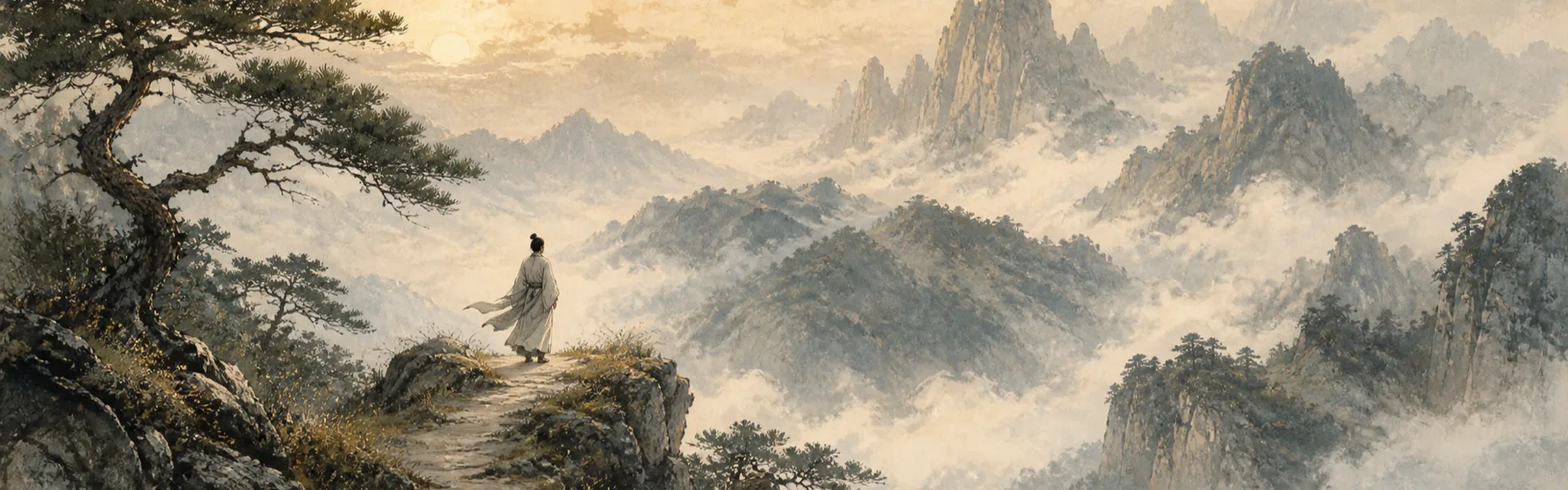
The chapter also contains several of the best-known stories associated with the Liezi: the Foolish Old Man moving the mountains, the children who defeat Confucius in debate, Boya and the listener Zhong Ziqi, and Jichang’s severe archery training. Read together, they ask a practical question: how can wonder enlarge the mind without replacing judgement? The answer is disciplined openness—admit what you do not know, test skill through patient foundations, and resist declaring something impossible merely because it lies outside your experience.
1. Beginnings without a Final Boundary
Classical text
殷湯問於夏革曰:「古初有物乎?」夏革曰:「古初無物,今惡得物?後之人將謂今之無物,可乎?」殷湯曰:「然則物無先後乎?」夏革曰:「物之終始,初無極已。始或爲終,終或爲始,惡知其紀?然自物之外,自事之先,朕所不知也。」殷湯曰:「然則上下八方有極盡乎?」革曰:「不知也。」湯固問。革曰:「無則無極,有則有盡,朕何以知之?然無極之外復無無極,無盡之中復無無盡。無極復無無極,無盡復無無盡。朕以是知其無極無盡也,而不知其有極有盡也。」湯又問曰:「四海之外奚有?」革曰:「猶齊州也。」湯曰:「汝奚以實之?」革曰:「朕東行至營,人民猶是也。問營之東,復猶營也。西行至豳,人民猶是也。問豳之西,復猶豳也。朕以是知四海、四荒、四極之不異是也。故大小相含,無窮極也。含萬物者,亦如含天地。含萬物也故不窮,含天地也故無極。朕亦焉知天地之表不有大天地者乎?亦吾所不知也。
English reading
King Tang asks whether things existed at the first beginning and whether the universe has an edge. Xia Ge does not manufacture certainty. If there were absolutely nothing, he asks, how could things now exist? Yet every beginning may be another ending, and he does not pretend to know what lies outside things or before events.
He reasons from the repeated extension of the known world: beyond one inhabited region, people report another. Larger wholes contain smaller worlds, and may themselves be contained. This does not prove a particular cosmology. It teaches intellectual proportion: reason as far as evidence allows, then state clearly where knowledge ends.
Practical meaning
A strong answer can include “I do not know.” Separate observation, inference, and imagination. Uncertainty becomes useful when it names the next question instead of filling the gap with false confidence.
2. A World Repaired yet Still Uneven
Classical text
然則天地亦物也。物有不足,故昔者女媧氏練五色石以補其闕,斷鼇之足以立四極。其後共工氏與顓頊爭爲帝,怒而觸不周之山,折天柱,絕地維,故天傾西北,日月辰星就焉;地不滿東南,故百川水潦歸焉。
English reading
Even heaven and earth are described as things with insufficiencies. Nüwa repairs the sky and supports the directions, but later conflict damages the cosmic structure again. The tilted heavens explain the apparent course of celestial bodies; the lower southeast explains the flow of rivers.
The myth joins repair and incompleteness. A restored world does not return to perfect symmetry. Life continues through a landscape carrying traces of damage.
Practical meaning
Repair does not always mean restoring the exact former condition. In a body, family, institution, or environment, good recovery may create a workable new balance while acknowledging lasting change.
3. The Five Islands and the Limits of Scale
Classical text
湯又問:「物有巨細乎?有修短乎?有同異乎?」革曰:「渤海之東不知幾億萬里,有大壑焉,實惟無底之谷,其下無底,名曰歸墟。八紘九野之水,天漢之流,莫不注之,而無增無減焉。其中有五山焉:一曰岱輿,二曰員嶠,三曰方壺,四曰瀛洲,五曰蓬萊。其山高下周旋三萬里,其頂平處九千里。山之中閒相去七萬里,以爲鄰居焉。其上臺觀皆金玉,其上禽獸皆純縞。珠玕之樹皆叢生,華實皆有滋味,食之皆不老不死。所居之人皆仙聖之種,一日一夕飛相往來者,不可數焉。而五山之根無所連箸,常隨潮波上下往還,不得蹔峙焉。仙聖毒之,訴之於帝。帝恐流於西極,失羣仙聖之居,乃命禺彊使巨鼇十五舉首而戴之。迭爲三番,六萬歲一交焉。五山始峙而不動。而龍伯之國有大人,舉足不盈數步而暨五山之所,一釣而連六鼇,合負而趣歸其國,灼其骨以數焉。於是岱輿員嶠二山流於北極,沈於大海,仙聖之播遷者巨億計。帝憑怒,侵減龍伯之國使阨,侵小龍伯之民使短。至伏羲神農時,其國人猶數十丈。從中州以東四十萬里得僬僥國,人長一尺五寸。東北極有人名曰諍人,長九寸。
English reading
The immense islands of immortals are secured on the backs of giant turtles. A person from an even larger country treats those turtles as a catch, unintentionally sending two islands adrift and displacing countless inhabitants. Elsewhere live peoples who are tiny by ordinary standards.
Scale changes moral perspective. What supports an entire world may look like a usable object to someone larger. The giant is not presented as purely evil; his ordinary action has catastrophic consequences because he does not perceive the lives dependent on what he takes.
Practical meaning
Before treating land, data, labour, or another living system as a resource, ask what smaller worlds depend on it. Power often causes harm not through hatred but through failure to notice another scale of consequence.
4. Vast Lives, Brief Lives, and Hidden Worlds
Classical text
荆之南有冥靈者,以五百歲爲春,五百歲爲秋。上古有大椿者,以八千歲爲春,八千歲爲秋。朽壤之上有菌芝者,生於朝,死於晦。春夏之月有蠓蚋者,因雨而生,見陽而死。終北之北有溟海者,天池也,有魚焉,其廣數千里,其長稱焉,其名爲鯤。有鳥焉,其名爲鵬,翼若垂天之雲,其體稱焉。世豈知有此物哉?大禹行而見之,伯益知而名之,夷堅聞而志之。江浦之間生麼蟲,其名曰焦螟,羣飛而集於蚊睫,弗相觸也。栖宿去來,蚊弗覺也。離朱子羽方晝拭眥揚眉而望之,弗見其形;䚦俞師曠方夜擿耳俛首而聽之,弗聞其聲。唯黃帝與容成子居空峒之上,同齋三月,心死形廢,徐以神視,塊然見之,若嵩山之阿;徐以氣聽,砰然聞之,若雷霆之聲。吳楚之國有大木焉,其名爲櫾,碧樹而冬生,實丹而味酸。食其皮汁,已憤厥之疾。齊州珍之,渡淮而北而化爲枳焉。鸜鵒不踰濟,貉踰汶則死矣,地氣然也。雖然,形氣異也,性鈞已,無相易已。生皆全已,分皆足已,吾何以識其巨細?何以識其修短?何以識其同異哉?」
English reading
One life experiences centuries as a season; another is born at dawn and dies by evening. The enormous Kun and Peng exceed ordinary sight, while tiny insects live unnoticed on a mosquito’s eyelashes. What appears vast or insignificant depends on the observer’s body, instruments, duration, and attention.
The passage also notices that plants and animals change or fail when moved across regions. Forms and vital conditions differ, but each life is complete according to its own share. The final questions therefore challenge the standards by which one creature declares another large, short-lived, strange, or deficient.
Practical meaning
Use comparison carefully. A human timescale, culture, body, or measure is not the only valid frame. Good inquiry changes scale and context before deciding what something is.
5. The Foolish Old Man Moves the Mountains
Classical text
太行、王屋二山,方七百里,高萬仞,本在冀州之南,河陽之北。北山愚公者,年且九十,面山而居,懲山北之塞,出入之迂也,聚室而謀曰:「吾與汝畢力平險,指通豫南,達于漢陰,可乎?」雜然相許。其妻獻疑曰:「以君之力,曾不能損魁父之丘,如太行、王屋何?且焉置土石?」雜曰:「投諸渤海之尾,隱土之北。」遂率子孫荷擔者三夫,叩石墾壤,箕畚運於渤海之尾。鄰人京城氏之孀妻有遺男,始齔,跳往助之。寒暑易節,始一反焉。河曲智叟笑而止之,曰:「甚矣,汝之不惠!以殘年餘力,曾不能毀山之一毛,其如土石何?」北山愚公長息曰:「汝心之固,固不可徹,曾不若孀妻弱子。雖我之死,有子存焉;子又生孫,孫又生子;子又有子,子又有孫,子子孫孫無窮匱也,而山不加增,何苦而不平?」河曲智叟亡以應。操蛇之神聞之,懼其不已也,告之於帝。帝感其誠,命夸蛾氏二子負二山,一厝朔東,一厝雍南。自此,冀之南,漢之陰,無隴斷焉。
English reading
At nearly ninety, the Foolish Old Man begins removing two mountains that obstruct his community. His wife raises practical questions, while the “Wise Old Man” mocks the entire purpose. The answer changes the timescale: one person’s remaining years are short, but generations can continue a finite task.
The gods finally move the mountains because they fear his persistence. The tale honours sustained collective effort, yet it also distinguishes constructive doubt from contempt. His wife asks where the earth will go; that question helps the project. The mocker only uses difficulty to justify doing nothing.
Practical meaning
For a problem larger than one lifetime, define a direction that others can continue, a method that survives leadership changes, and a way to measure small gains. Persistence needs logistics; otherwise it becomes waste.
6. Kua Fu Pursues the Sun
Classical text
夸父不量力,欲追日影,逐之於隅谷之際,渴欲得飲,赴飲河渭。河渭不足,將走北飲大澤。未至,道渴而死。棄其杖,尸膏肉所浸,生鄧林,鄧林彌廣數千里焉。
English reading
Kua Fu tries to catch the sun without measuring his strength. Neither great river satisfies his thirst, and he dies before reaching the northern marsh. Yet the staff he drops and the substance of his body produce a vast forest.
The story does not reduce ambition to simple failure. The goal exceeds one body, but the effort leaves conditions from which later life can grow.
Practical meaning
Bold aims require honest estimates of energy, distance, water, time, and support. If the goal may outlive you, design the work so that what remains becomes shelter or knowledge for those who follow.
7. What Even a Sage Cannot Contain
Classical text
大禹曰:「六合之間,四海之內,照之以日月,經之以星辰,紀之以四時,要之以太歲。神靈所生,其物異形,或夭或壽,唯聖人能通其道。」夏革曰:「然則亦有不待神靈而生,不待陰陽而形,不待日月而明,不待殺戮而夭,不待將迎而壽,不待五穀而食,不待繒纊而衣,不待舟車而行,其道自然,非聖人之所通也。」
English reading
Yu proposes a vast ordered cosmos whose diverse lives can be understood by the sage. Xia Ge answers that there may also be forms of life and order that do not depend on the known causes—spirit, yin and yang, sunlight, grain, cloth, or vehicles—and are not encompassed even by a sage.
The correction prevents the highest human title from becoming a claim to total knowledge. Reality is not obliged to fit the best available framework.
Practical meaning
Treat every model as a tool with a domain, not as the whole of reality. Expertise is strongest when it can identify conditions it does not yet explain.
8. The Land of the Utmost North
Classical text
禹之治水土也,迷而失塗,謬之一國。濱北海之北,不知距齊州幾千萬里。其國名曰終北,不知際畔之所齊限,無風雨霜露,不生鳥獸、蟲魚、草木之類。四方悉平,周以喬陟。當國之中有山,山名壺領,狀若甔甀。頂有口,狀若員環,名曰滋穴。有水湧出,名曰神瀵,臭過蘭椒,味過醪醴。一源分爲四埒,注於山下。經營一國,亡不悉徧。土氣和,亡札厲。人性婉而從物,不競不爭;柔心而弱骨,不驕不忌;長幼儕居,不君不臣;男女雜游,不媒不聘;緣水而居,不耕不稼;土氣溫適,不織不衣;百年而死,不夭不病。其民孳阜亡數,有喜樂,亡衰老哀苦。其俗好聲,相攜而迭謠,終日不輟音。飢惓則飲神瀵,力志和平。過則醉,經旬乃醒。沐浴神瀵,膚色脂澤,香氣經旬乃歇。周穆王北遊過其國,三年忘歸。既反周室,慕其國,𢠵然自失,不進酒肉,不召嬪御者,數月乃復。管仲勉齊桓公因遊遼口,俱之其國,幾尅舉。隰朋諫曰:「君舍齊國之廣,人民之衆,山川之觀,殖物之阜,禮義之盛,章服之美,妖靡盈庭,忠良滿朝。肆咤則徒卒百萬,視撝則諸侯從命,亦奚羨於彼而棄齊國之社稷,從戎夷之國乎?此仲父之耄,柰何從之?」桓公乃止,以隰朋之言告管仲。仲曰:「此固非朋之所及也。臣恐彼國之不可知之也。齊國之富奚戀?隰朋之言奚顧?」
English reading
The Utmost North is imagined without harsh weather, labour competition, government hierarchy, marriage contracts, illness, or premature death. A fragrant spring provides food, well-being, and song. King Mu stays three years and grieves when he returns.
Guan Zhong later wants to visit, but an adviser praises the wealth, ritual, beauty, army, and authority already possessed by Qi. The disagreement reveals two measures of prosperity: accumulation and control on one side, ease and freedom from rivalry on the other. The story does not give a plan for a literal utopia; it makes ordinary ambition visible by contrast.
Practical meaning
When evaluating success, include time, health, trust, freedom from unnecessary competition, and the ability to enjoy life—not only possessions and reach. An imagined alternative can expose costs that a familiar system hides.
9. Customs Differ, yet Each Feels Natural
Classical text
南國之人祝髮而裸,北國之人鞨巾而裘,中國之人冠冕而裳。九土所資,或農或商,或田或漁,如冬裘夏葛,水舟陸車。默而得之,性而成之。越之東有輒沐之國,其長子生,則鮮而食之,謂之宜弟。其大父死,負其大母而棄之,曰:「鬼妻不可以同居處。」楚之南有炎人之國,其親戚死,㱙其肉而棄之,然後埋其骨,迺成爲孝子。秦之西有儀渠之國者,其親戚死,聚祡積而焚之。燻則煙上,謂之登遐,然後成爲孝子。此上以爲政,下以爲俗,而未足爲異也。
English reading
Clothing, work, transport, family ritual, burial, and ideas of filial conduct vary with region. People usually acquire these patterns silently until custom feels like nature. The examples are deliberately disturbing: what one group calls proper another may find unthinkable.
The passage does not require moral approval of every practice. It warns that disgust alone cannot explain why a custom exists or establish a sound judgement. Understanding context and evaluating harm are separate tasks, both necessary.
Practical meaning
When encountering an unfamiliar practice, first describe it accurately and learn its meaning to participants. Then assess consent, suffering, power, and consequence. Cultural humility is not moral surrender; it improves the quality of moral reasoning.
10. Two Children Question Confucius
Classical text
孔子東游,見兩小兒辯鬬,問其故。一兒曰:「我以日始出時去人近,而日中時遠也。」一兒以日初出遠,而日中時近也。一兒曰:「日初出大如車蓋,及日中則如盤盂,此不爲遠者小而近者大乎?」一兒曰:「日初出滄滄涼涼,及其日中如探湯,此不爲近者熱而遠者涼乎?」孔子不能決也。兩小兒笑曰:「孰爲汝多知乎?」
English reading
One child argues that the rising sun looks larger and must therefore be nearer. The other says noon is hotter and must therefore be nearer. Each uses a real observation with an incomplete explanation. Confucius cannot decide and does not pretend otherwise.
The children’s laughter overturns reputation: a famous teacher can still meet a question he cannot answer. The dignity of the scene lies in admitting the limit.
Practical meaning
Conflicting evidence often means the model is incomplete, not that observation is useless. Record the facts, identify hidden variables, and invite better measurement. “I cannot yet decide” is a responsible conclusion.
11. Zhan He Fishes through Balance
Classical text
均,天下之至理也,連於形物亦然。均髮均縣,輕重而髮絕,髮不均也。均也,其絕也莫絕。人以爲不然,自有知其然者也。詹何以獨繭絲爲綸,芒鍼爲鉤,荆篠爲竿,剖粒爲餌,引盈車之魚於百仞之淵、汩流之中,綸不絕,鉤不伸,竿不橈。楚王聞而異之,召問其故。詹何曰:「臣聞先大夫之言,蒲且子之弋也,弱弓纖繳,乘風振之,連雙鶬於青雲之際。用心專,動手均也。臣因其事,放而學釣,五年始盡其道。當臣之臨河持竿,心無雜慮,唯魚之念;投綸沈鉤,手無輕重,物莫能亂。魚見臣之鉤餌,猶沈埃聚沫,吞之不疑。所以能以弱制彊,以輕致重也。大王治國誠能若此,則天下可運於一握,將亦奚事哉?」楚王曰:「善。」
English reading
Zhan He lands a huge fish with silk, a fine needle, a slender rod, and a tiny bait. The materials survive because attention and movement remain balanced. He trained for five years until the hand added neither excess force nor hesitation, and the bait appeared harmless to the fish.
The king accepts this as a lesson in government: a light instrument can guide a great weight when feedback remains continuous and force is proportioned. Yet the fishing image also reminds us that skilful influence may conceal the hook.
Practical meaning
Build systems sensitive enough to detect strain before breaking. In leadership, use steady attention and small corrections rather than alternating neglect and force. Also ask who benefits from “smooth” influence and who may be caught by it.
12. Bian Que Exchanges Two Hearts
Classical text
魯公扈、趙齊嬰二人有疾,同請扁鵲求治。扁鵲治之。既同愈,謂公扈、齊嬰曰:「汝曩之所疾,自外而干府藏者,固藥石之所已。今有偕生之疾,與體偕長,今爲汝攻之,何如?」二人曰:「願先聞其驗。」扁鵲謂公扈曰:「汝志彊而氣弱,故足於謀而寡於斷。齊嬰志弱而氣彊,故少於慮而傷於專。若換汝之心,則均於善矣。」扁鵲遂飲二人毒酒,迷死三日,剖胷探心,易而置之;投以神藥,既悟如初。二人辭歸。於是公扈反齊嬰之室,而有其妻子,妻子弗識。齊嬰亦反公扈之室,有其妻子,妻子亦弗識。二室因相與訟,求辨於扁鵲。扁鵲辨其所由,訟乃已。
English reading
One patient plans well but cannot decide; the other acts forcefully without enough reflection. Bian Que exchanges their hearts to balance their temperaments. On waking, each returns to the household belonging to the body of the other, revealing that memory, attachment, and identity have followed the heart rather than appearance.
This is philosophical fiction, not medical history. It asks whether a person is located in body, memory, temperament, relationship, or recognition—and shows how changing one element disrupts the whole social identity.
Practical meaning
Do not reduce people to appearance or one trait. Decisions about identity and care should consider continuity of memory, agency, relationships, and the person’s own account. Balance reflection with action through practice, not fantasies of simply replacing a personality.
13. Shi Wen’s Music Reaches the Seasons
Classical text
匏巴鼓琴而鳥舞魚躍,鄭師文聞之,棄家從師襄游。柱指鈞弦,三年不成章。師襄曰:「子可以歸矣。」師文舍其琴,歎曰:「文非弦之不能鈞,非章之不能成。文所存者不在弦,所志者不在聲。內不得於心,外不應於器,故不敢發手而動弦。且小假之,以觀其後。」無幾何,復見師襄。師襄曰:「子之琴何如?」師文曰:「得之矣。請嘗試之。」於是當春而叩商弦以召南呂,涼風忽至,草木成實。及秋而叩角弦以激夾鍾,溫風徐迴,草木發榮。當夏而叩羽弦以召黃鐘,霜雪交下,川池暴沍。及冬而叩徵弦以激蕤賓,陽光熾烈,堅冰立散。將終,命宮而總四弦,則景風翔,慶雲浮,甘露降,澧泉涌。師襄乃撫心高蹈曰:「微矣,子之彈也!雖師曠之清角,鄒衍之吹律,亡以加之。彼將挾琴執管而從子之後耳。」
English reading
For three years Shi Wen produces no finished piece. He can tune strings and form melodies, but refuses to perform because inner intention and instrument do not yet answer one another. When the connection matures, mythic music calls opposite seasons and finally brings all tones into harmony.
The wonders express more than technical accuracy. Skill becomes transformative when intention, timing, material, and the wider pattern meet. His long silence was not absence of work; it was refusal to substitute a correct surface for an unformed centre.
Practical meaning
Learn technique, but also ask what the work is for and whether the medium carries that intention. Do not confuse delay with depth, however: set occasions to test the work, receive feedback, and decide whether further waiting is still useful.
14. Xue Tan Learns How Far a Voice Can Reach
Classical text
薛譚學謳於秦青,未窮青之技,自謂盡之,遂辭歸。秦青弗止,餞於郊衢,撫節悲歌,聲振林木,響遏行雲。薛譚乃謝求反,終身不敢言歸。秦青顧謂其友曰:「昔韓娥東之齊,匱糧,過雍門,鬻歌假食。既去而餘音繞梁欐,三日不絕,左右以其人弗去。過逆旅,逆旅人辱之。韓娥因曼聲哀哭,一里老幼悲愁,垂涕相對,三日不食,遽而追之。娥還,復爲曼聲長歌。一里老幼喜躍抃舞,弗能自禁,忘向之悲也,乃厚賂發之。故雍門之人至今善歌哭,放娥之遺聲。」
English reading
Xue Tan believes he has completed his training until his teacher’s farewell song shakes the trees and seems to stop the clouds. He returns without being forced. The story of Han E then describes a voice whose sorrow and joy continue through a whole community after the singer has gone.
Art is measured not only by control of sound but by the quality of attention and feeling it awakens. Xue Tan’s error was not confidence itself; it was declaring completion before encountering the true range of the craft.
Practical meaning
Before calling yourself finished, seek examples that expand your standard. A good teacher may reveal the distance without humiliating the student. Powerful communication also carries responsibility because emotion spreads beyond the speaker’s intention.
15. Boya and the Listener Zhong Ziqi
Classical text
伯牙善鼓琴,鍾子期善聽。伯牙鼓琴,志在登高山,鍾子期曰:「善哉!峩峩兮若泰山!」志在流水,鍾子期曰:「善哉!洋洋兮若江河!」伯牙所念,鍾子期必得之。伯牙游於泰山之陰,卒逢暴雨,止於巖下,心悲,乃援琴而鼓之,初爲霖雨之操,更造崩山之音。曲每奏,鍾子期輒窮其趣。伯牙乃舍琴而嘆曰:「善哉,善哉,子之聽夫!志想象猶吾心也。吾於何逃聲哉?」
English reading
Boya’s playing carries mountains, flowing water, rain, and collapsing rock. Zhong Ziqi hears not merely the notes but the direction of the musician’s mind. Boya’s final amazement is that no intention can hide inside sound from such a listener.
The story celebrates listening as an equal art. Understanding is not passive reception; it requires enough attention, imagination, and knowledge to meet what another person is expressing without replacing it with one’s own story.
Practical meaning
Listen for structure, feeling, and purpose, then check your understanding in words the other person can correct. Being deeply heard is rare; make it less rare for others.
16. Yan Shi’s Artificial Performer
Classical text
周穆王西巡狩,越崑崙,不至弇山。反還,未及中國,道有獻工人名偃師,穆王薦之,問曰:「若有何能?」偃師曰:「臣唯命所試。然臣已有所造,願王先觀之。」穆王曰:「日以俱來,吾與若俱觀之。」越日偃師謁見王。王薦之,曰:「若與偕來者何人邪?」對曰:「臣之所造能倡者。」穆王驚視之,趣步俯仰,信人也。巧夫顉其頤,則歌合律;捧其手,則舞應節。千變萬化,惟意所適。王以爲實人也,與盛姬內御並觀之。技將終,倡者瞬其目而招王之左右侍妾。王大怒,立欲誅偃師。偃師大懾,立剖散倡者以示王,皆傅會革、木、膠、漆、白、黑、丹、青之所爲。王諦料之,內則肝、膽、心、肺、脾、腎、腸、胃,外則筋骨、支節、皮毛、齒髮,皆假物也,而無不畢具者,合會復如初見。王試廢其心,則口不能言;廢其肝,則目不能視;廢其腎,則足不能步。穆王始悅而歎曰:「人之巧乃可與造化者同功乎?」詔貳車載之以歸。夫班輸之雲梯,墨翟之飛鳶,自謂能之極也。弟子東門賈禽滑釐聞偃師之巧以告二子,二子終身不敢語藝,而時執規矩。
English reading
Yan Shi presents an artificial performer so convincing that King Mu treats it as a person and becomes jealous when it flirts. Taken apart, it contains constructed counterparts of organs, bones, skin, and hair; removing different inner components disables speech, sight, or walking. Reassembled, it performs again.
The marvel makes imitation difficult to separate from life by appearance alone. It also humbles celebrated inventors, who return to their measuring tools rather than continue boasting. The tale anticipates modern questions about machines without settling them: resemblance, function, inner organization, intention, and moral status are not identical.
Practical meaning
Judge a system by more than impressive output. Ask how it is made, which capacities are simulated, where agency lies, who is accountable, and how people may be deceived by lifelike behaviour. Wonder should lead to closer examination.
17. Jichang’s Archery and the Corruption of Mastery
Classical text
甘蠅,古之善射者,彀弓而獸伏鳥下,弟子名飛衛,學射於甘蠅,而巧過其師。紀昌者,又學射於飛衛。飛衛曰:「爾先學不瞬,而後可言射矣。」紀昌歸,偃臥其妻之機下,以目承牽挺。二年之後,雖錐末倒眥,而不瞬也。以告飛衛,飛衛曰:「未也,必學視而後可。視小如大,視微如著,而後告我。」昌以氂懸虱於牖,南面而望之。旬日之間,浸大也;三年之後,如車輪焉。以覩餘物,皆丘山也。乃以燕角之弧、朔蓬之簳射之,貫虱之心,而懸不絕。以告飛衛,飛衛高蹈拊膺曰:「汝得之矣!」紀昌既盡衛之術,計天下之敵己者,一人而已,乃謀殺飛衛。相遇於野,二人交射,中路矢鋒相觸,而墜於地,而塵不揚。飛衛之矢先窮,紀昌遺一矢。既發,飛衛以棘刺之端扞之,而無差焉。於是二子泣而投弓,相拜於塗,請爲父子;尅臂以誓,不得告術於人。
English reading
Jichang spends years on foundations before shooting: remaining unblinking, then learning to perceive the tiny as large and the subtle as distinct. His final shot pierces a louse without breaking the hair that suspends it. The training shows how extraordinary performance grows from attention rather than from hurried repetition of the final act.
Mastery then becomes rivalry. Jichang tries to kill the only equal he can imagine; teacher and student meet arrows in mid-air before reconciliation. Their oath to hide the art is not a clean moral solution. Technique without ethical formation has made excellence dangerous.
Practical meaning
Break complex skill into trainable perceptions and stable fundamentals. At the same time, define responsibility before power grows. A teacher who transmits dangerous ability must also cultivate restraint, accountability, and purposes beyond defeating rivals.
18. Zaofu Learns to Guide from the Centre
Classical text
造父之師曰泰豆氏。造父之始從習御也,執禮甚卑,泰豆三年不告。造父執禮愈謹,乃告之曰:「古詩言:『良弓之子,必先爲箕;良冶之子,必先爲裘。』汝先觀吾趣。趣如吾,然後六轡可持,六馬可御。」造父曰:「唯命所從。」泰豆乃立木爲塗,僅可容足;計步而置,履之而行。趣走往還,無跌失也。造父學之,三日盡其巧。泰豆歎曰:「子何其敏也?得之捷乎!凡所御者,亦如此也。曩汝之行,得之於足,應之於心。推於御也,齊輯乎轡銜之際,而急緩乎脣吻之和,正度乎胷臆之中,而執節乎掌握之間。內得於中心,而外合於馬志,是故能進退履繩而旋曲中規矩,取道致遠而氣力有餘,誠得其術也。得之於銜,應之於轡;得之於轡,應之於手;得之於手,應之於心,則不以目視,不以策驅;心閑體正,六轡不亂,而二十四蹄所投無差,迴旋進退,莫不中節,然後輿輪之外可使無餘轍,馬蹄之外可使無餘地,未嘗覺山谷之嶮,原隰之夷,視之一也。吾術窮矣,汝其識之!」
English reading
Before touching the reins, Zaofu learns to run across a path of narrow wooden steps. Foot and mind must answer one another. The teacher then extends the same relation through a chain: horse’s mouth, bit, reins, hand, and centred mind. When each link transmits without confusion, guidance no longer depends on staring or whipping.
The image of effortless control rests on demanding preparation and sensitivity to the horses’ own intention. The driver does not simply impose a route; inner steadiness meets the movement of other living bodies.
Practical meaning
Before coordinating a complex system, master the feedback path. Reduce delay and distortion between signal, hand, decision, and response. Guidance becomes lighter when the leader is centred and can feel what the whole team is doing.
19. Three Swords That Cannot Kill
Classical text
魏黑卵以暱嫌殺丘邴章,丘邴章之子來丹謀報父之讐。丹氣甚猛,形甚露,計粒而食,順風而趨。雖怒,不能稱兵以報之。恥假力於人,誓手劍以屠黑卵。黑卵悍志絕衆,力抗百夫;節骨皮肉,非人類也,延頸承刀,披胸受矢,鋩鍔摧屈,而體無痕撻。負其材力,視來丹猶雛鷇也。來丹之友申他曰:「子怨黑卵至矣,黑卵之易子過矣,將奚謀焉?」來丹垂涕曰:「願子爲我謀。」申他曰:「吾聞衛孔周其祖得殷帝之寶劍,一童子服之,卻三軍之衆,奚不請焉?」來丹遂適衛,見孔周,執僕御之禮,請先納妻子,後言所欲。孔周曰:「吾有三劍,唯子所擇;皆不能殺人,且先言其狀。一曰含光,視之不可見,運之不知有。其所觸也,泯然無際,經物而物不覺。二曰承影,將旦昧爽之交,日夕昏明之際,北面而察之,淡淡焉若有物存,莫識其狀。其所觸也,竊竊然有聲,經物而物不疾也。三曰宵練,方晝則見影而不見光,方夜見光而不見形。其觸物也,騞然而過,隨過隨合,覺疾而不血刃焉。此三寶者,傳之十三世矣,而無施於事。匣而藏之,未嘗啓封。」來丹曰:「雖然,吾必請其下者。」孔周乃歸其妻子,與齋七日。晏陰之間,跪而授其下劍,來丹再拜受之以歸。來丹遂執劍從黑卵。時黑卵之醉偃於牖下,自頸至腰三斬之,黑卵不覺。來丹以黑卵之死,趣而退。遇黑卵之子於門,擊之三下,如投虛。黑卵之子方笑曰:「汝何蚩而三招予?」來丹知劍之不能殺人也,歎而歸。黑卵既醒,怒其妻曰:「醉而露我,使我嗌疾而腰急。」其子曰:「疇昔來丹之來,遇我於門,三招我,亦使我體疾而支彊。彼其厭我哉!」
English reading
Laidan seeks revenge on the almost invulnerable Heiluan. He obtains the least of three inherited swords, each marvellous yet explicitly unable to kill. The blade seems to pass through bodies, causing stiffness but no wound. Laidan’s imagined victory dissolves when his enemies remain alive.
The tale turns the language of ultimate weapons inside out. Their highest wonder is not killing power but the separation of contact from destruction. Laidan hears the warning, yet desire selects only the possibility that supports revenge.
Practical meaning
Strong emotion narrows how instructions are heard. Before using any powerful tool, restate its limits and purpose in your own words. In conflict, look for interventions that interrupt harm without creating an irreversible new injury.
20. The Sword and Cloth beyond Familiar Experience
Classical text
周穆王大征西戎,西戎獻錕鋙之劍,火浣之布。其劍長尺有咫,練鋼赤刃,用之切玉如切泥焉。火浣之布,浣之必投於火,布則火色,垢則布色;出火而振之,皓然疑乎雪。皇子以爲無此物,傳之者妄。蕭叔曰:「皇子果於自信,果於誣理哉!」
English reading
Western peoples present a blade said to cut jade like clay and cloth cleaned by fire. A prince dismisses the report because he has never known such materials. Xiao Shu answers that the prince is too certain of himself and therefore too ready to accuse reality of falsehood.
The chapter ends with an epistemic warning. An extraordinary claim is not proved by being extraordinary, but unfamiliarity is not disproof. Investigation belongs between gullibility and denial.
Practical meaning
For surprising claims, neither share immediately nor reject immediately. Ask for provenance, repeatable demonstration, material explanation, and independent confirmation. Curiosity and standards belong together.
The Chapter in Practice
State the edge of knowledge. Mark what is observed, inferred, imagined, and still unknown.
Change scale before judging. Look across different lifespans, communities, bodies, and levels of consequence.
Pair persistence with design. Make long work measurable, transferable, and sustainable.
Train foundations before spectacle. Perception, balance, and feedback usually precede advanced performance.
Develop ethics alongside ability. Mastery without restraint can turn teacher and student into enemies.
Investigate the marvellous. Avoid both automatic belief and automatic dismissal.
Questions for Reflection
Where are you treating the limits of your experience as the limits of reality?
Which large task needs a plan that another generation or team can continue?
What hidden community or smaller system bears the cost of one of your ordinary choices?
Which foundational perception should you train before attempting a more advanced technique?
What evidence would move you from wonder or disbelief toward a responsible conclusion?
Continue Reading
Previous: Chapter Four, Zhong Ni 仲尼 · Liezi overview · Next: Chapter Six, Li Ming 力命 · Classical Library