Chapter Four: Zhong Ni 仲尼
第四篇:仲尼
Zhong Ni, “Confucius,” presents fifteen conversations about learning, wisdom, silence, reputation, leadership, and the limits hidden inside every strength. Confucius appears less as a fixed spokesman than as a figure who revises his own words, refuses easy claims to sainthood, and values the ability to return from an excellence that has become one-sided.
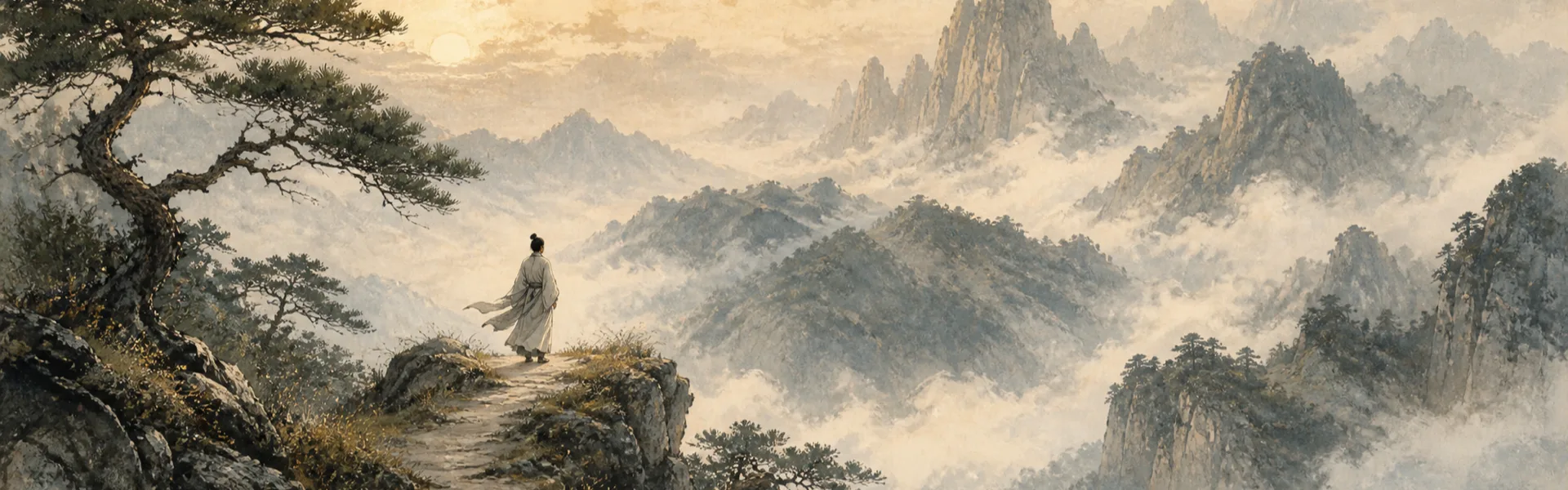
The chapter repeatedly distinguishes living understanding from performance. Eloquence must include the capacity for silence, courage the capacity to yield, dignity the capacity to join others, and knowledge the humility not to force an answer. Its modern value lies in this balance: develop ability fully, but do not become trapped inside the identity of being able.
1. The Larger Worry within “Knowing Destiny”
Classical text
仲尼閒居,子貢入侍,而有憂色。子貢不敢問,出告顏回,顏回援琴而歌。孔子聞之,果召回入,問曰:「若奚獨樂?」回曰:「夫子奚獨憂?」孔子曰:「先言爾志。」曰:「吾昔聞之夫子曰:『樂天知命故不憂。』回所以樂也。」孔子愀然有閒,曰:「有是言哉?汝之意失矣。此吾昔日之言爾,請以今言爲正也。汝徒知樂天知命之無憂,未知樂天知命有憂之大也。今告若其實:修一身,任窮達,知去來之非我,亡變亂於心慮,爾之所謂樂天知命之無憂也。曩吾修《詩》《書》,正禮樂,將以治天下,遺來世,非但修一身,治魯國而已,而魯之君臣日失其序,仁義益衰,情性益薄。此道不行一國與當年,其如天下與來世矣?吾始知《詩》《書》、禮樂無救於治亂,而未知所以革之之方,此樂天知命者之所憂。雖然,吾得之矣。夫樂而知者,非古人之所謂樂知也。無樂無知,是真樂真知,故無所不樂,無所不知,無所不憂,無所不爲。《詩》《書》、禮樂,何棄之有?革之何爲?」顏回北面拜手曰:「回亦得之矣。」出告子貢。子貢茫然自失,歸家淫思七日,不寢不食,以至骨立。顏回重往喻之,乃反丘門,弦歌誦書,終身不輟。
English reading
Yan Hui thought that accepting heaven and knowing destiny should remove worry. Confucius corrected his own earlier saying. Personal equanimity is only one level: a person may accept what cannot be controlled and still feel a larger responsibility when education, ritual, or moral language no longer helps society. The difficulty is to care without believing one inherited method must save every age.
Confucius then goes further. True joy and knowledge are not possessions labelled “joy” and “knowledge.” When one stops clinging to those identities, nothing lies outside concern or action, yet concern no longer hardens into anxious ownership. The classics need not be discarded, nor mechanically defended; they can be used without making them absolute.
Practical meaning
Acceptance is not indifference. Separate what you cannot control from what still deserves care. When a valued method fails, neither repeat it blindly nor reject the whole tradition. Preserve the purpose, examine present conditions, and adapt the form.
2. Kengsangzi and Perception without Fixed Channels
Classical text
陳大夫聘魯,私見叔孫氏。叔孫氏曰:「吾國有聖人。」曰:「非孔丘邪?」曰:「是也。」「何以知其聖乎?」叔孫氏曰:「吾常聞之顏回曰:『孔丘能廢心而用形。』」陳大夫曰:「吾國亦有聖人,子弗知乎?」曰:「聖人孰謂?」曰:「老聃之弟子有亢倉子者,得聃之道,能以耳視而目聽。」魯侯聞之大驚,使上卿厚禮而致之。亢倉子應聘而至,魯侯卑辭請問之。亢倉子曰:「傳之者妄。我能視聽不用耳目,不能易耳目之用。」魯侯曰:「此增異矣。其道奈何?寡人終願聞之。」亢倉子曰:「我體合於心,心合於氣,氣合於神,神合於無。其有介然之有,唯然之音,雖遠在八荒之外,近在眉睫之內,來干我者,我必知之。乃不知是我七孔四支之所覺,心腹六藏之所知,其自知而已矣。」魯侯大悅。他日以告仲尼,仲尼笑而不答。
English reading
A rumour said Kengsangzi could see with his ears and hear with his eyes. He rejected the spectacle: he did not exchange the functions of the senses. Rather, body joined mind, mind joined vital energy, energy joined spirit, and spirit opened into emptiness. Perception arrived as a unified knowing before he assigned it to one organ or another.
Confucius heard the report and only smiled. The story prevents a subtle experience from becoming a public performance or a new claim to status.
Practical meaning
Expert perception often integrates many signals at once: posture, tone, timing, context, memory, and direct sensation. It may feel immediate, but it should not be turned into supernatural certainty. Keep intuition open to verification.
3. Who Can Be Called a Sage?
Classical text
商太宰見孔子曰:「丘聖者歟?」孔子曰:「聖則丘何敢,然則丘博學多識者也。」商太宰曰:「三王聖者歟?」孔子曰:「三王善任智勇者,聖則丘弗知。」曰:「五帝聖者歟?」孔子曰:「五帝善任仁義者,聖則丘弗知。」曰:「三皇聖者歟?」孔子曰:「三皇善任因時者,聖則丘弗知。」商太宰大駭,曰:「然則孰者爲聖?」孔子動容有閒,曰:「西方之人有聖者焉,不治而不亂,不言而自信,不化而自行,蕩蕩乎民無能名焉。丘疑其爲聖,弗知真爲聖歟?真不聖歟?」商太宰嘿然心計曰:「孔丘欺我哉!」
English reading
Asked whether he was a sage, Confucius claimed only broad learning. Asked about famous rulers, he named their strengths—using courage and intelligence, practising benevolence and justice, responding to the times—but would not turn strength into final sainthood.
He imagined a person whose order did not depend on control, whose trust did not depend on speech, and whose influence could not be named, then still refused certainty. The official assumed he was being evasive because he wanted a clear rank. Confucius protected “sage” from becoming a label attached to reputation.
Practical meaning
Titles compress complex people into a single judgement. Name demonstrated capacities precisely instead: wise in what situation, trustworthy under what conditions, harmful in what way? Respect becomes more reliable when it does not require perfection.
4. Every Strength Needs Its Opposite
Classical text
子夏問孔子曰:「顏回之爲人奚若?」子曰:「回之仁賢於丘也。」曰:「子貢之爲人奚若?」子曰:「賜之辯賢於丘也。」曰:「子路之爲人奚若?」子曰:「由之勇賢於丘也。」曰:「子張之爲人奚若?」子曰:「師之莊賢於丘也。」子夏避席而問曰:「然則四子者何爲事夫子?」曰:「居!吾語汝。夫回能仁而不能反,賜能辯而不能訥,由能勇而不能怯,師能莊而不能同。兼四子之有以易吾,吾弗許也。此其所以事吾而不貳也。」
English reading
Confucius said Yan Hui surpassed him in benevolence, Zigong in eloquence, Zilu in courage, and Zizhang in dignity. Why, then, were they his students? Each excellence lacked the freedom to turn back: benevolence could not reverse course, eloquence could not be silent, courage could not admit fear, and dignity could not blend with others.
Confucius would not exchange his capacity to move between modes for all four fixed excellences combined. Maturity is not the maximum quantity of a virtue; it is the ability to use and release it appropriately.
Practical meaning
For your strongest trait, train the complementary movement. A helper must say no, a speaker must listen, a brave person must recognise risk, and a disciplined leader must sometimes join without leading.
5. Nanguozi and the Meaning of Silence
Classical text
子列子既師壺丘子林,友伯昏瞀人,乃居南郭。從之處者,日數而不及。雖然,子列子亦微焉。朝朝相與辯,無不聞。而與南郭子連牆二十年,不相謁請;相遇於道,目若不相見者。門之徒役以爲子列子與南郭子有敵不疑。有自楚來者,問子列子曰:「先生與南郭子奚敵?」子列子曰:「南郭子貌充心虛,耳無聞,目無見,口無言,心無知,形無惕。往將奚爲?雖然,試與汝偕往。」閱弟子四十人同行。見南郭子,果若欺魄焉,而不可與接。顧視子列子,形神不相偶,而不可與羣。南郭子俄而指子列子之弟子末行者與言,衎衎然若專直而在雄者。子列子之徒駭之,反舍,咸有疑色。子列子曰:「得意者無言,進知者亦無言。用無言爲言亦言,無知爲知亦知。無言與不言,無知與不知,亦言亦知。亦無所不言,亦無所不知;亦無所言,亦無所知。如斯而已,汝奚妄駭哉?」
English reading
Liezi lived beside Nanguozi for twenty years without formal visits, and disciples assumed hostility. When they finally went together, Nanguozi seemed empty and unreachable, then suddenly spoke warmly and confidently with the least prominent disciple. The group was shocked because they had turned silence into a fixed personality.
Liezi explained that fulfilled understanding does not need words, but deliberately using silence as a message is already another kind of speech. Not knowing can also become a performed knowledge. Genuine freedom is not attachment to speaking or silence, knowing or not knowing.
Practical meaning
Silence is not automatically wisdom, and speech is not automatically shallowness. Ask what the situation serves. Sometimes clarity requires words; sometimes listening; sometimes admitting that a question is not yet ready.
6. Liezi’s Nine Years of Training
Classical text
子列子學也,三年之後,心不敢念是非,口不敢言利害,始得老商一眄而已。五年之後,心更念是非,口更言利害,老商始一解顏而笑。七年之後,從心之所念,更無是非;從口之所言,更無利害,夫子始一引吾並席而坐。九年之後,橫心之所念,橫口之所言,亦不知我之是非利害歟,亦不知彼之是非利害歟,外內進矣。而後眼如耳,耳如鼻,鼻如口,口無不同。心凝形釋,骨肉都融,不覺形之所倚,足之所履,心之所念,言之所藏。如斯而已,則理無所隱矣。
English reading
This condensed account repeats the stages behind Liezi’s freedom. After three years he restrained the rush to judge; after five years distinctions returned without mastering him; after seven years thought and speech moved beyond fixed oppositions; after nine years self and other, inner and outer, no longer divided experience.
The senses are described as mutually open and the body as released. The point is not literal sensory exchange. Perception, thought, speech, and action no longer fight for separate control, so the pattern of the situation becomes unobscured.
Practical meaning
Development can pass through restraint before freedom. First interrupt habitual reaction; then allow discernment to return with less attachment; finally act without constant self-monitoring. Skipping the disciplined stage often turns “spontaneity” into impulse.
7. Outer Travel and Inner Observation
Classical text
初,子列子好游。壺丘子曰:「禦寇好游,游何所好?」列子曰:「游之樂所玩無故。人之游也,觀其所見;我之游也,觀其所變。游乎游乎!未有能辨其游者。」壺丘子曰:「禦寇之游固與人同歟,而曰固與人異歟?凡所見,亦恆見其變。玩彼物之無故,不知我亦無故。務外游,不知務內觀。外游者,求備於物;內觀者,取足於身。取足於身,游之至也;求備於物,游之不至也。」於是列子終身不出,自以爲不知游。壺丘子曰:「游其至乎!至游者,不知所適;至觀者,不知所眂。物物皆游矣,物物皆觀矣,是我之所謂游,是我之所謂觀也。故曰:游其至矣乎,游其至矣乎!」
English reading
Liezi loved travelling because he watched things change rather than merely collecting sights. Huzi challenged even this refined identity: while observing the instability of the world, Liezi had forgotten that the observer was also changing. Outer travel seeks completion from objects; inner observation discovers sufficiency without needing every new object.
Liezi then stopped travelling and thought he no longer knew how. Huzi called this the highest travel: not attachment to staying home, but freedom from needing a destination or a special observer. Every encounter can become travel when neither place nor identity is fixed.
Practical meaning
Travel can deepen attention or become consumption. Alongside photographs and destinations, notice what the journey reveals about your expectations, discomfort, privilege, and habits. Inner observation should enrich contact with the world, not become an excuse to avoid it.
8. Longshu’s “Illness” of Detachment
Classical text
龍叔謂文摯曰:「子之術微矣。吾有疾,子能已乎?」文摯曰:「唯命所聽。然先言子所病之證。」龍叔曰:「吾鄉譽不以爲榮,國毀不以爲辱;得而不喜,失而弗憂;視生如死,視富如貧;視人如豕,視吾如人。處吾之家,如逆旅之舍;觀吾之鄉,如戎蠻之國。凡此衆疾,爵賞不能勸,刑罰不能威,盛衰、利害不能易,哀樂不能移。固不可事國君,交親友,御妻子,制僕隸。此奚疾哉?奚方能已之乎?」文摯乃命龍叔背明而立,文摯自後向明而望之。既而曰:「嘻!吾見子之心矣,方寸之地虛矣。幾聖人也!子心六孔流通,一孔不達。今以聖智爲疾者,或由此乎!非吾淺術所能已也。」
English reading
Longshu reported that praise did not delight him, blame did not shame him, gain and loss did not move him, and rank or punishment could not control him. Yet this also left him unable to serve, relate to friends, care for family, or guide dependants. Was this liberation or illness?
The physician saw a mind almost open like a sage’s, but with one passage blocked. Detachment had loosened social manipulation but had not completed compassion and participation. Near-wisdom can still become one-sided.
Practical meaning
Emotional non-reactivity is not sufficient if it removes care, responsibility, or connection. Healthy equanimity makes relationship more spacious; numbness makes relationship unavailable. The difference appears in conduct, not only inner calm.
9. Life, Death, and What Counts as “Natural”
Classical text
無所由而常生者,道也。由生而生,故雖終而不亡,常也。由生而亡,不幸也。有所由而常死者,亦道也。由死而死,故雖未終而自亡者,亦常也。由死而生,幸也。故無用而生謂之道,用道得終謂之常;有所用而死者亦謂之道,用道而得死者亦謂之常。季梁之死,楊朱望其門而歌;隨梧之死,楊朱撫其尸而哭。隸人之生,隸人之死,衆人且歌,衆人且哭。
English reading
The passage distinguishes processes that continue according to their conditions from events interrupted or unexpectedly restored. “Natural” does not mean emotionally easy, and “fortunate” does not mean permanent. Life and death both belong to patterns larger than personal preference.
Yang Zhu sang at one friend’s death and wept over another. Ordinary people also celebrate births and mourn deaths. No single outward emotion proves understanding; response belongs to the particular relationship and event.
Practical meaning
Do not prescribe one correct grief. Some people cry, some become quiet, some tell stories, and some feel relief mixed with sorrow. Support safe, honest mourning without turning philosophical acceptance into a demand for emotional sameness.
10. The Last Intensification before Loss
Classical text
目將眇者,先睹秋毫;耳將聾者,先聞蚋飛;口將爽者,先辨淄澠;鼻將窒者,先覺焦朽;體將僵者,先亟犇佚,心將迷者,先識是非,故物不至者則不反。
English reading
The text claims that a faculty may become unusually sharp before failing: the eye notices fine hairs, the ear tiny insects, taste subtle waters, smell faint decay, the body rushes before stiffening, and the confused mind becomes most certain of right and wrong.
This is a philosophical warning, not a dependable medical rule. Extremes can announce instability, and excessive certainty may be an early sign that flexible judgement is weakening.
Practical meaning
Sudden sensory or cognitive changes deserve medical attention. In discussion, also notice when increasing uncertainty produces harder claims and sharper divisions. Pause before treating intensity as accuracy.
11. Who Serves Whom?
Classical text
鄭之圃澤多賢,東里多才。圃澤之役有伯豐子者,行過東里,遇鄧析。鄧析顧其徒而笑曰:「爲若舞,彼來者奚若?」其徒曰:「所願知也。」鄧析謂伯豐子曰:「汝知養養之義乎?受人養而不能自養者,犬豕之類也;養物而物爲我用者,人之力也。使汝之徒食而飽,衣而息,執政之功也。長幼羣聚而爲牢藉庖廚之物,奚異犬豕之類乎?」伯豐子不應。伯豐子之從者越次而進曰:「大夫不聞齊魯之多機乎?有善治土木者,有善治金革者,有善治聲樂者,有善治書數者,有善治軍旅者,有善治宗廟者,羣才備也。而無相位者,無能相使者。而位之者無知,使之者無能,而知之與能爲之使焉。執政者,迺吾之所使,子奚矜焉?」鄧析無以應,目其徒而退。
English reading
Deng Xi mocked workers as animals fed and directed by rulers. One follower answered that society contains many specialised abilities—building, metalwork, music, writing, military affairs, ritual—and no one expert coordinates every other skill. The official without those abilities depends on the knowledgeable and capable as much as they depend on administration.
Authority had mistaken coordination for creation. The reply does not deny leadership; it locates leadership within mutual dependence.
Practical meaning
Managers should not confuse control of resources with ownership of value. Make labour, expertise, maintenance, and care visible. Good coordination serves the people whose abilities make the system real.
12. Gongyibo’s Strength Is Known because It Is Restrained
Classical text
公儀伯以力聞諸侯,堂谿公言之於周宣王,王備禮以聘之。公儀伯至,觀形,懦夫也。宣王心惑而疑曰:「女之力何如?」公儀伯曰:「臣之力能折春螽之股,堪秋蟬之翼。」王作色曰:「吾之力能裂犀兕之革,曳九牛之尾,猶憾其弱。女折春螽之股,堪秋蟬之翼,而力聞天下,何也?」公儀伯長息退席,曰:「善哉王之問也!臣敢以實對。臣之師有商丘子者,力無敵於天下,而六親不知,以未嘗用其力故也。臣以死事之。乃告臣曰:『人欲見其所不見,視人所不窺;欲得其所不得,修人所不爲。故學眎者先見輿薪,學聽者先聞撞鐘。夫有易於內者無難於外。於外無難,故名不出其一家。』今臣之名聞於諸侯,是臣違師之教,顯臣之能者也。然則臣之名不以負其力者也,以能用其力者也,不猶愈於負其力者乎?」
English reading
Gongyibo was famous for strength but looked weak. Asked for a demonstration, he said he could break a grasshopper’s leg or bear the weight of a cicada wing. The king, who could tear hide and drag oxen, was offended.
Gongyibo explained that his teacher was unmatched precisely because he never needed to use strength and remained unknown even to family. Training begins with what is obvious before reaching what others overlook; when mastery is easy inside, the outside offers no occasion for display. Gongyibo’s fame already showed he had fallen short, though using force with fine control was still better than merely carrying force.
Practical meaning
Power is shown by precision, proportion, and restraint. In martial practice, leadership, speech, or technology, the question is not only what you can do but whether you can use the minimum required—or choose not to use it.
13. Gongsun Long and the Seduction of Paradox
Classical text
中山公子牟者,魏國之賢公子也,好與賢人游,不恤國事,而悅趙人公孫龍。樂正子輿之徒笑之。公子牟曰:「子何笑牟之悅公孫龍也?」子輿曰:「公孫龍之爲人也,行無師,學無友,佞給而不中,漫衍而無家,好怪而妄言,欲惑人之心,屈人之口,與韓檀等肄之。」公子牟變容曰:「何子狀公孫龍之過歟?請聞其實。」子輿曰:「吾笑龍之詒孔穿,言『善射者能令後鏃中前括,發發相及,矢矢相屬,前矢造準而無絕落,後矢之括猶銜弦,視之若一焉。』孔穿駭之。龍曰:『此未其妙者。逢蒙之弟子曰鴻超,怒其妻而怖之。引烏號之弓,綦衛之箭,射其目。矢來注眸子而眶不睫,矢隧地而塵不揚。』是豈智者之言與?」公子牟曰:「智者之言固非愚者之所曉。後鏃中前括,鈞後於前。矢注眸子而眶不睫,盡矢之勢也。子何疑焉?」樂正子輿曰:「子,龍之徒,焉得不飾其闕?吾又言其尤者。龍誑魏王曰:『有意不心。有指不至。有物不盡。有影不移。髮引千鈞。白馬非馬。孤犢未嘗有母。』其負類反倫,不可勝言也。」公子牟曰:「子不諭至言而以爲尤也,尤其在子矣。夫無意則心同;無指則皆至;盡物者常有;影不移者,說在改也;髮引千鈞,勢至等也;白馬非馬,形名離也;孤犢未嘗有母,非孤犢也。」樂正子輿曰:「子以公孫龍之鳴皆條也。設令發於餘竅,子亦將承之。」公子牟默然良久,告退,曰:「請待餘日,更謁子論。」
English reading
Prince Mou admired Gongsun Long’s paradoxes: arrows appearing as one continuous line, a white horse “not a horse,” a hair supporting enormous weight, and other claims defended through distinctions of name, form, perspective, and conditions. Ziyu argued that clever speech had become detached from guidance, friendship, and practical centre.
The debate does not simply settle each paradox. It shows how loyalty to a brilliant speaker can make followers explain every claim, even when the speaker’s purpose is to defeat opponents rather than clarify reality.
Practical meaning
Wordplay can reveal hidden assumptions, but it can also exhaust attention without improving judgement. Ask what a distinction changes, what evidence would count against it, and whether the speaker accepts correction. Cleverness without accountability becomes a closed game.
14. Yao Hears the Children’s Song
Classical text
堯治天下五十年,不知天下治歟、不治歟,不知億兆之願戴己歟、不願戴己歟,顧問左右,左右不知;問外朝,外朝不知;問在野,在野不知。堯乃微服游於康衢,聞兒童謠曰:「立我蒸民,莫匪爾極。不識不知,順帝之則。」堯喜問曰:「誰教爾爲此言?」童兒曰:「我聞之大夫。」問大夫,大夫曰:「古詩也。」堯還宮,召舜,因禪以天下。舜不辭而受之。
English reading
After fifty years of rule, Yao did not know whether the country was truly well governed or whether people genuinely supported him. Advisers and officials could not answer. In disguise, he heard children singing that the people followed order without consciously naming the ruler’s rule.
Yao was pleased, yet he did not turn the song into proof of permanent personal greatness. He returned and transferred authority to Shun. The story joins listening outside official channels with willingness to leave office.
Practical meaning
Leaders need evidence not filtered by those who benefit from pleasing them. Use independent feedback, direct observation, and clear succession. The ability to hand over responsibility is part of governing well.
15. Guan Yin on Responding like Water, Mirror, and Echo
Classical text
關尹喜曰:「在己無居,形物其箸。其動若水,其靜若鏡,其應若響。故其道若物者也,物自違道,道不違物。善若道者,亦不用耳,亦不用目,亦不用力,亦不用心。欲若道而用視聽形智以求之,弗當矣。瞻之在前,忽焉在後;用之彌滿六虛,廢之莫知其所;亦非有心者所能得遠,亦非無心者所能得近。唯默而得之而性成之者得之。知而亡情,能而不爲,真知真能也。發無知,何能情?發不能,何能爲?聚塊也,積塵也,雖無爲而非理也。」
English reading
The Way does not settle into a private position. Moving, it resembles water; still, a mirror; responding, an echo. Things may depart from the Way, but the Way does not refuse things. It cannot be captured by straining sight, hearing, force, or deliberate thought.
True knowing does not cling emotionally to being the knower; true ability does not rush to perform. Yet blank ignorance and incapacity are not wisdom. A heap of earth also does nothing. Non-forcing is responsive capacity without compulsive interference, not lifeless passivity.
Practical meaning
Practise clear response: receive accurately like a mirror, adapt like water, answer proportionately like an echo. Do not manufacture action to prove engagement, and do not call avoidance “non-action.”
The Chapter in Practice
Balance every excellence. Train silence with speech, caution with courage, flexibility with dignity, and boundaries with care.
Keep tradition alive through adaptation. Preserve purpose while changing forms that no longer meet present conditions.
Test intuition and reputation. Integrated perception can be valuable without becoming unquestionable authority.
Build honest feedback around influence. Admiration without correction weakens both leaders and followers.
Distinguish equanimity from numbness. Inner calm should increase the capacity to relate and respond.
Use the minimum effective force. Precision and restraint reveal more mastery than spectacle.
Questions for Reflection
Which of your strengths becomes a weakness when you cannot set it down?
What inherited method needs adaptation rather than blind defence or total rejection?
Who can give you information that is not filtered through admiration or fear?
Does your calm make you more available to others, or less?
Where could you achieve the purpose with less force, display, or argument?
Continue Reading
Previous: Chapter Three, Zhou Mu Wang 周穆王 · Liezi overview · Next: Chapter Five, Tang Wen 汤问 · Classical Library