Chapter Two: Huang Di 黄帝
第二篇:黄帝
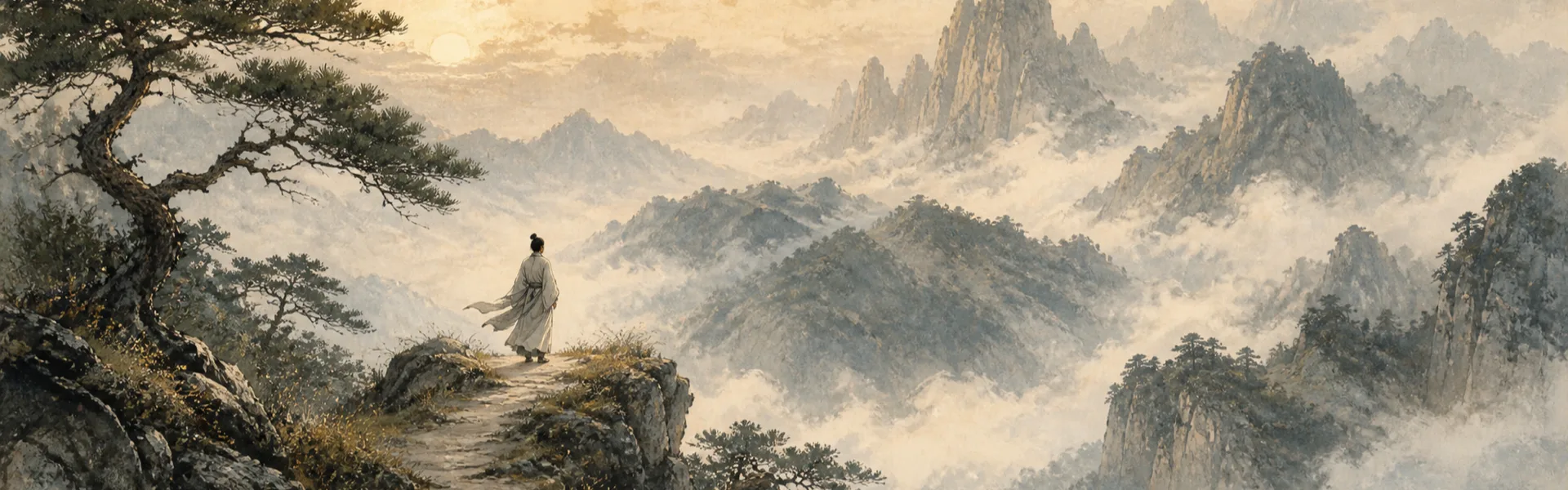
Huang Di, “The Yellow Emperor,” gathers nineteen stories about mastery without strain. Its figures include an emperor who exhausts himself by trying to control everything, a student who wants the result before undergoing the training, archers and boatmen whose skill fails under pressure, people who move through water or fire without inner conflict, and teachers who cannot be reduced to appearances.
The chapter’s marvellous events are best read as philosophical images rather than instructions to seek supernatural powers. Again and again, the text asks what happens when attention is divided by fear, reward, reputation, or self-display. Its answer is practical: develop the conditions, practise until action becomes settled, respect the nature of the situation, and stop forcing the self into the centre of every movement.
1. The Yellow Emperor Dreams of Huaxu
Classical text
黃帝即位十有五年,喜天下戴己,養正命,娛耳目,供鼻口,焦然肌色皯黣,昏然五情爽惑。又十有五年,憂天下之不治,竭聰明,進智力,營百姓,焦然肌色皯黣,昏然五情爽惑。黃帝乃喟然讚曰:「朕之過淫矣。養一己其患如此,治萬物其患如此。」於是放萬機,舍宮寢,去直侍,徹鐘懸,減廚膳,退而閒居大庭之館,齋心服形,三月不親政事。晝寢而夢,遊於華胥氏之國。華胥氏之國在弇州之西,台州之北,不知斯齊國幾千萬里,蓋非舟車足力之所及,神游而已。其國無師長,自然而已。其民無嗜慾,自然而已。不知樂生,不知惡死,故無夭殤;不知親己,不知疏物,故無愛憎;不知背逆,不知向順,故無利害,都無所愛惜,都無所畏忌。入水不溺,入火不熱。斫撻無傷痛,指擿無痟癢。乘空如履實,寢虛若處牀。雲霧不硋其視,雷霆不亂其聽,美惡不滑其心,山谷不躓其步,神行而已。黃帝既寤,怡然自得,召天老、力牧、太山稽,告之曰:「朕閒居三月,齋心服形,思有以養身治物之道,弗獲其術。疲而睡,所夢若此。今知至道不可以情求矣,朕知之矣,朕得之矣,而不能以告若矣!」又二十有八年,天下大治,幾若華胥氏之國,而帝登假。百姓號之,二百餘年不輟。
English reading
For fifteen years the Yellow Emperor delighted in being honoured and exhausted himself satisfying the senses. For another fifteen he worried that the realm was not governed well enough and exhausted himself trying to manage everyone. Pleasure centred on the self and control directed at the world produced the same result: a darkened face, confusion, and depletion.
He withdrew for three months, simplified his surroundings, settled the mind, and dreamed of Huaxu—a country without imposed rulers or compulsive desires, where people did not divide life from death, self from other, or advantage from harm. On waking, he understood that the highest way could not be seized through anxious intention. He governed for another twenty-eight years, and order arose with far less forcing.
Practical meaning
Overindulgence and overcontrol can be two forms of the same self-preoccupation. When effort produces only more agitation, reduce stimulation, step back from constant intervention, and ask which processes can work without your hand on them every moment.
2. The Spirit Person of Mount Gushe
Classical text
列姑射山在海河洲中,山上有神人焉,吸風飲露,不食五穀;心如淵泉,形如處女;不偎不愛,仙聖爲之臣;不畏不怒,愿慤爲之使;不施不惠,而物自足;不聚不歛,而己無愆。陰陽常調,日月常明,四時常若,風雨常均,字育常時,年穀常豐;而土無札傷,人無夭惡,物無疵厲,鬼無靈響焉。
English reading
On Mount Gushe lives a spirit person who breathes wind and drinks dew. The mind is deep as a spring and the appearance unspoiled. Without demanding affection, giving orders, displaying charity, collecting wealth, or storing power, this person’s surroundings remain balanced: seasons arrive properly, rain is even, crops grow, and living beings are not needlessly harmed.
The portrait is deliberately idealised. It imagines influence that comes not from command but from complete inner order. Nothing is advertised as benevolence, yet nothing is deprived.
Practical meaning
The strongest contribution is sometimes the atmosphere created by a settled person: fewer unnecessary demands, less emotional turbulence, and decisions that allow others to function. Do not confuse visible activity with actual nourishment.
3. Liezi Learns to Ride the Wind
Classical text
列子師老商氏,友伯高子,進二子之道,乘風而歸。尹生聞之,從列子居,數月不省舍。因閒請蘄其術者,十反而十不告。尹生懟而請辭,列子又不命。尹生退。數月,意不已,又往從之。列子曰:「汝何去來之頻?」尹生曰:「曩章戴有請於子,子不我告,固有憾於子。今復脫然,是以又來。」列子曰:「曩吾以汝爲達,今汝之鄙至此乎?姬!將告汝所學於夫子者矣。自吾之事夫子友若人也,三年之後,心不敢念是非,口不敢言利害,始得夫子一眄而已。五年之後,心庚念是非,口庚言利害,夫子始一解顏而笑。七年之後,從心之所念,庚無是非;從口之所言,庚無利害,夫子始一引吾并席而坐。九年之後,橫心之所念,橫口之所言,亦不知我之是非利害歟,亦不知彼之是非利害歟,亦不知夫子之爲我師、若人之爲我友,內外進矣。而後眼如耳,耳如鼻,鼻如口,無不同也。心凝形釋,骨肉都融;不覺形之所倚,足之所履,隨風東西,猶木葉幹殼。竟不知風乘我邪?我乘風乎?今女居先生之門,曾未浹時,而懟憾者再三。女之片體將氣所不受,汝之一節將地所不載。履虛乘風,其可幾乎?」尹生甚怍,屏息良久,不敢復言。
English reading
After long study with Lao Shang and friendship with Bogao, Liezi was said to return riding the wind. Yin Sheng wanted the technique. He stayed only a few months, asked repeatedly, received no answer, became resentful, left, and then returned.
Liezi explained his own training. After three years he stopped rushing to judge right and wrong or profit and loss; only then did his teacher glance at him. After five years distinctions could arise without possessing him, and his teacher smiled. After seven years thought and speech moved without being trapped by opposing labels, and he was invited to sit beside the teacher. After nine years he no longer organised experience around himself, teacher, friend, advantage, or harm. Perception and body became one undivided responsiveness, like a leaf moving with wind. Yin Sheng wanted this freedom while remaining full of grievance at every delay.
Practical meaning
Advanced results rest on changes that may look unrelated to the result. A student who wants the impressive technique but resents the discipline has not yet entered the work. Measure progress by reduced reactivity, steadier attention, and greater responsiveness—not only by visible feats.
4. Keeping the Vital Energy Whole
Classical text
列子問關尹曰:「至人潛行不空,蹈火不熱,行乎萬物之上而不慄。請問何以至於此?」關尹曰:「是純氣之守也,非智巧果敢之列。姬!魚語女。凡有貌像聲色者,皆物也。物與物何以相遠也?夫奚足以至乎先?是色而已。則物之造乎不形,而止乎無所化。夫得是而窮之者,焉得而正焉?彼將處乎不深之度,而藏乎無端之紀,游乎萬物之所終始。壹其性,養其氣,含其德,以通乎物之所造。夫若是者,其天守全,其神無郤,物奚自入焉?夫醉者之墜於車也,雖疾不死。骨節與人同,而犯害與人異,其神全也。乘亦弗知也,墜亦弗知也。死生驚懼不入乎其胸,是故遌物而不慴。彼得全於酒而猶若是,而況得全於天乎?聖人藏於天,故物莫之能傷也。」
English reading
Liezi asks how the perfected person can move through danger without trembling. Guan Yin answers that it is not cleverness, daring, or a special trick. It is the keeping of vital energy whole. All visible and audible forms belong to the same field of things; none reaches the formless source before the others.
When nature is unified, energy nourished, and virtue held without gaps, external events find no divided place through which to seize the mind. Guan Yin compares this to a drunken passenger who falls from a cart without stiffening in terror. The example is not praise of intoxication; it illustrates how fear and resistance can magnify injury. The sage’s wholeness comes from accord with nature rather than dulled awareness.
Practical meaning
Under pressure, first reduce internal fragmentation. Breathe, feel the body, and meet the actual event instead of simultaneously fighting the event, imagining every consequence, and defending an identity. Wholeness does not make danger unreal, but it improves response.
5. The Archer Above the Abyss
Classical text
列禦寇爲伯昏無人射,引之盈貫,措杯水其肘上,發之,鏑矢復沓,方矢復寓。當是時也,猶象人也。伯昏無人曰:「是射之射,非不射之射也。當與汝登高山,履危石,臨百仞之淵,若能射乎?」於是無人遂登高山,履危石,臨百仞之淵,背逡巡,足二分垂在外,揖禦寇而進之。禦寇伏地,汗流至踵。伯昏無人曰:「夫至人者,上闚青天,下潛黃泉,揮斥八極,神氣不變。今汝怵然有恂目之志,爾於中也殆矣夫!」
English reading
Lie Yukou demonstrated extraordinary archery: he drew the bow fully with a cup of water balanced on his elbow and released one arrow as another was placed. Bohun Wuren replied that this was “shooting with shooting,” not the shooting that no longer depended on displaying the act.
He led Liezi to a cliff, stood with part of his feet beyond the edge, and invited him forward. Liezi dropped to the ground, sweating. His technique was real, but its centre depended on a protected setting. When fear entered, the person and the skill separated.
Practical meaning
Competence in rehearsal is not yet reliability under pressure. Training should gradually include uncertainty, consequence, and recovery—without reckless exposure. The goal is not to feel nothing, but to keep access to skill when feeling changes.
6. Shangqiu Kai and Undivided Trust
Classical text
范氏有子曰子華,善養私名,舉國服之;有寵於晉君,不仕而居三卿之右。目所偏視,晉國爵之;口所偏肥,晉國黜之。游其庭者侔於朝。子華使其俠客以智鄙相攻,彊弱相凌。雖傷破於前,不用介意。終日夜以此爲戲樂,國殆成俗。禾生、子伯,范氏之上客,出行,經坰外,宿於田更商丘開之舍。中夜,禾生、子伯二人相與言子華之名勢,能使存者亡,亡者存;富者貧,貧者富。商丘開先窘於飢寒,潛於牖北聽之。因假糧荷畚之子華之門。子華之門徒皆世族也,縞衣乘軒,緩步闊視。顧見商丘開年老力弱,面目黎黑,衣冠不檢,莫不眲之。既而狎侮欺詒,攩㧙挨抌,亡所不爲。商丘開常無慍容,而諸客之技單,憊於戲笑。遂與商丘開俱乘高臺,於衆中漫言曰:「有能自投下者賞百金。」衆皆競應。商丘開以爲信然,遂先投下,形若飛鳥,揚於地,𩨒骨無䃣。范氏之黨以爲偶然,未詎怪也,因復指河曲之淫隈曰:「彼中有寶珠,泳可得也。」商丘開復從而泳之。既出,果得珠焉。衆昉同疑。子華昉令豫肉食衣帛之次。俄而范氏之藏大火,子華曰:「若能入火取錦者,從所得多少賞若。」商丘開往無難色,入火往還,埃不漫,身不焦。范氏之黨以爲有道,乃共謝之曰:「吾不知子之有道而誕子,吾不知子之神人而辱子。子其愚我也,子其聾我也,子其盲我也。敢問其道。」商丘開曰:「吾亡道。雖吾之心,亦不知所以。雖然,有一於此,試與子言之。曩子二客之宿吾舍也,聞譽范氏之勢,能使存者亡,亡者存;富者貧,貧者富。吾誠之無二心,故不遠而來。及來,以子黨之言皆實也,唯恐誠之之不至,行之之不及,不知形體之所措,利害之所存也。心一而已。物亡迕者,如斯而已。今昉知子黨之誕我,我內藏猜慮,外矜觀聽,追幸昔日之不焦溺也,怛然內熱,惕然震悸矣。水火豈復可近哉?」自此之後,范氏門徒路遇乞兒馬醫,弗敢辱也,必下車而揖之。宰我聞之,以告仲尼。仲尼曰:「汝弗知乎?夫至信之人,可以感物也。動天地,感鬼神,橫六合,而無逆者,豈但履危險,入水火而已哉?商丘開信僞物猶不逆,況彼我皆誠哉?小子識之!」
English reading
Zihua’s powerful household treated cruelty as entertainment. An impoverished old man, Shangqiu Kai, heard exaggerated stories of Zihua’s power and believed them without reservation. The retainers mocked him, promised rewards for leaping from a tower, diving into dangerous water, and entering a burning storehouse. Taking every statement as true, he acted without hesitation and emerged unharmed. Once they confessed the deception, doubt entered him; remembering the dangers, he trembled and could no longer approach water or fire.
The tale deliberately stretches beyond ordinary probability. Its subject is the bodily effect of a mind with no competing intention. Confucius’ closing comment contrasts wholehearted trust with the retainers’ manipulation. The story does not license obedience to abusers; their behaviour is plainly condemned.
Practical meaning
Commitment improves performance, but trust must be ethically placed. In modern life, pair wholehearted practice with careful choice of teacher, method, and environment. Undivided attention is powerful; blind submission to dishonest people is dangerous.
7. Liang Yang Tames Tigers
Classical text
周宣王之牧正有役人梁鴦者,能養野禽獸,委食於園庭之內,雖虎狼鵰鶚之類,無不柔馴者。雄雌在前,孳尾成羣,異類雜居,不相搏噬也。王慮其術終於其身,令毛丘園傳之。梁鴦曰:「鴦,賤役也,何術以告爾?懼王之謂隱於爾也,且一言我養虎之法。凡順之則喜,逆之則怒,此有血氣者之性也。然喜怒豈妄發哉?皆逆之所犯也。夫食虎者,不敢以生物與之,爲其殺之之怒也;不敢以全物與之,爲其碎之之怒也。時其飢飽,達其怒心。虎之與人異類,而媚養己者,順也;故其殺之,逆也。然則吾豈敢逆之使怒哉?亦不順之使喜也。夫喜之復也必怒,怒之復也常喜,皆不中也。今吾心無逆順者也,則鳥獸之視吾,猶其儕也。故游吾園者,不思高林曠澤;寢吾庭者,不願深山幽谷,理使然也。」
English reading
Liang Yang could care for wild animals so that tigers, wolves, eagles, and other creatures lived without attacking one another. Asked for his secret, he said he understood the conditions that aroused them. He did not feed a tiger live prey and stimulate the anger of killing, nor give it a whole carcass and stimulate the violence of tearing. He knew its hunger and fullness.
More deeply, he did not manipulate the animals through alternating pleasure and anger. Excessive pleasing eventually produces frustration, while opposition can turn again into dependence. Because his own mind did not press either pattern, the animals treated him as part of their environment rather than as a threat or source of excitement.
Practical meaning
Regulation comes before control. With animals, children, students, or teams, understand triggers, timing, capacity, and recovery. Constant reward and punishment create volatility; predictable conditions and a non-reactive relationship support steadier behaviour.
8. The Boatman and the Weight of Reward
Classical text
顏回問乎仲尼曰:「吾嘗濟乎觴深之淵矣,津人操舟若神。吾問焉,曰:『操舟可學邪?』曰:『可。能游者可教也,善游者數能。乃若夫沒人,則未嘗見舟而謖操之者也。』吾問焉,而不告。敢問何謂也?」仲尼曰:「𧮒!吾與若玩其文也久矣,而未達其實,而固且道與。能游者可教也,輕水也;善游者之數能也,忘水也。乃若夫沒人之未嘗見舟也而謖操之也,彼視淵若陵,視舟之覆猶其車卻也。覆卻萬物方陳乎前而不得入其舍。惡往而不暇?以瓦摳者巧,以鉤摳者憚,以黃金摳者惛。巧一也,而有所矜,則重外也。凡重外者拙內。」
English reading
Yan Hui saw a ferryman handle a boat with astonishing ease. The ferryman said swimmers learn quickly because they take water lightly; skilled swimmers become capable because they forget the water; a diver can handle the boat without prior instruction because deep water feels no more threatening than dry land.
Confucius adds an example of a game played for stakes. With a clay tile as the prize, the player is skilful. With a valuable buckle, the hand grows tense. With gold, the same skill becomes confused. Nothing changed in the technique; attachment to the external result divided the mind.
Practical meaning
Prepare for high-stakes moments by practising the task and your relationship to consequence. Use simulations, gradual exposure, and routines that return attention to the next action. When the prize fills the mind, the skill loses room to operate.
9. The Swimmer at Lüliang
Classical text
孔子觀於呂梁,懸水三十仞,流沫三十里,黿鼉魚鼈之所不能游也,見一丈夫游之,以爲有苦而欲死者也,使弟子並流而承之。數百步而出,被髮行歌,而游於棠行。孔子從而問之,曰:「呂梁懸水三十仞,流沫三十里,黿鼉魚鼈所不能游。向吾見子道之,以爲有苦而欲死者,使弟子並流將承子。子出而被髮行歌,吾以子爲鬼也。察子,則人也。請問蹈水有道乎?」曰:「亡,吾無道。吾始乎故,長乎性,成乎命,與齎俱入,與汩偕出。從水之道而不爲私焉,此吾所以道之也。」孔子曰:「何謂始乎故,長乎性,成乎命也?」曰:「吾生於陵而安於陵,故也;長於水而安於水,性也;不知吾所以然而然,命也。」
English reading
Confucius saw a man enter the violent waters at Lüliang, where even aquatic animals could not easily swim. Thinking it a suicide attempt, he sent disciples downstream. The man emerged singing. Asked for his method, he said he entered with the downward current and came out with the rising flow, following the water without imposing a private plan.
He had been born on land and was at ease on land through familiarity; he grew up in water and was at ease in water through developed nature; after long practice he acted without knowing exactly how, which he called destiny. What looks spontaneous is built from environment, repeated adaptation, and embodied learning.
Practical meaning
Do not imitate the danger; study the process. Begin with safe familiarity, practise until perception changes, and learn the forces already present. Effective movement works with timing and direction instead of opposing the strongest current head-on.
10. Catching Cicadas with an Undivided Mind
Classical text
仲尼適楚,出於林中,見痀僂者承蜩,猶掇之也。仲尼曰:「子巧乎!有道邪?」曰:「我有道也。五六月,纍垸二而不墜,則失者錙銖;纍三而不墜,則失者十一;纍五而不墜,猶掇之也。吾處也若橜株駒,吾執臂若槁木之枝,雖天地之大、萬物之多,而唯蜩翼之知。吾不反不側,不以萬物易蜩之翼,何爲而不得?」孔子顧謂弟子曰:「用志不分,乃疑於神,其痀僂丈人之謂乎!」丈人曰:「汝逢衣徒也,亦何知問是乎?修汝所以,而後載言其上。」
English reading
Confucius met a hunchbacked elder catching cicadas as easily as picking them up. The man had trained for months by balancing pellets on the end of his pole: first two, then three, then five without dropping them. He steadied his lower body like a rooted stump and held his arm like a dry branch. Though heaven and earth were vast, his awareness contained only the cicada’s wing.
Confucius praised undivided intention. The elder sharply reminded him that elegant words are secondary: cultivate the actual basis first, then speak about it.
Practical meaning
Concentration is trained through progressive difficulty and stable mechanics. Reduce variables, establish posture, repeat accurately, and increase demand only when the earlier level is reliable. Description cannot replace embodied work.
11. The Gulls That Would Not Come Down
Classical text
海上之人有好漚鳥者,每旦之海上,從漚鳥游,漚鳥之至者百住而不止。其父曰:「吾聞漚鳥皆從汝游,汝取來,吾玩之。」明日之海上,漚鳥舞而不下也。故曰:至言去言,至爲無爲。齊智之所知,則淺矣。
English reading
A man went to the shore each morning and gulls gathered around him by the hundreds. His father asked him to catch one. The next morning, although he acted outwardly as before, the gulls circled above and would not descend. His concealed intention had changed the relationship.
The story says that the deepest communication is not confined to speech, and the finest action is not forced action. Intelligent calculation sees only the surface when motive is already expressed through timing, posture, and attention.
Practical meaning
Trust is sensitive to hidden agendas. People and animals often detect instrumental attention even when the words are friendly. If you want genuine contact, meet the other without immediately turning the relationship into a means.
12. The Man Who Walked Through Stone and Fire
Classical text
趙襄子率徒十萬狩於中山,藉芿燔林,扇赫百里。有一人從石壁中出,隨煙燼上下。衆謂鬼物。火過,徐行而出,若無所經涉者。襄子怪而留之。徐而察之,形色七竅,人也;氣息音聲,人也。問:「奚道而處石?奚道而入火?」其人曰:「奚物而謂石?奚物而謂火?」襄子曰:「而嚮之所出者,石也;而嚮之所涉者,火也。」其人曰:「不知也。」魏文侯聞之,問子夏曰:「彼何人哉?」子夏曰:「以商所聞夫子之言,和者大同於物,物無得傷閡者,游金石,蹈水火,皆可也。」文侯曰:「吾子奚不爲之?」子夏曰:「刳心去智,商未之能。雖然,試語之有暇矣。」文侯曰:「夫子奚不爲之?」子夏曰:「夫子能之而能不爲者也。」文侯大說。
English reading
During a vast hunt and forest fire, a man appeared from a stone cliff and walked through the smoke and flames without disturbance. Asked his method, he did not even recognise “stone” and “fire” as fixed categories in the way his questioners did. Zixia explained that complete harmony with things leaves no obstruction, but admitted that he could describe this better than he could embody it.
Asked why Confucius did not perform such wonders, Zixia answered that the master could refrain from doing what he could do. This closing turn is essential: genuine capacity does not need spectacle.
Practical meaning
Do not test spiritual maturity through dangerous stunts. The more reliable sign is freedom from the need to prove capacity. Knowing when not to demonstrate a power may reveal more discipline than the demonstration itself.
13. The Shaman Jixian Meets Master Hu
Classical text
有神巫自齊來處於鄭,命曰季咸,知人死生、存亡、禍福、壽夭,期以歲、月、旬、日,如神。鄭人見之,皆避而走。列子見之而心醉,而歸以告壺丘子,曰:「始吾以夫子之道爲至矣,則又有至焉者矣。」壺子曰:「吾與汝無其文,未既其實,而固得道與?衆雌而無雄,而又奚卵焉?而以道與世抗,必信矣。夫故使人得而相汝。嘗試與來,以予示之。」明日,列子與之見壺子。出而謂列子曰:「譆!子之先生死矣,弗活矣,不可以旬數矣。吾見怪焉,見濕灰焉。」列子入,涕泣沾衿,以告壺子。壺子曰:「向吾示之以地文,罪乎不誫不止,是殆見吾杜德幾也。嘗又與來!」明日,又與之見壺子。出而謂列子曰:「幸矣,子之先生遇我也,有瘳矣。灰然有生矣,吾見杜權矣。」列子入告壺子。壺子曰:「向吾示之以天壤,名實不入,而機發於踵,此爲杜權。是殆見吾善者幾也。嘗又與來!」明日,又與之見壺子。出而謂列子曰:「子之先生坐不齋,吾無得而相焉。試齋,將且復相之。」列子入告壺子。壺子曰:「向吾示之以太沖莫眹,是殆見吾衡氣幾也。鯢旋之潘爲淵,止水之潘爲淵,流水之潘爲淵,濫水之潘爲淵,沃水之潘爲淵,氿水之潘爲淵,雍水之潘爲淵,汧水之潘爲淵,肥水之潘爲淵,是爲九淵焉。嘗又與來!」明日,又與之見壺子。立未定,自失而走。壺子曰:「追之!」列子追之而不及,反以報壺子,曰:「已滅矣,已失矣,吾不及也。」壺子曰:「向吾示之以未始出吾宗。吾與之虛而猗移,不知其誰何,因以爲茅靡,因以爲波流,故逃也。」然後列子自以爲未始學而歸,三年不出,爲其妻爨,食狶如食人,於事無親,雕瑑復朴,塊然獨以其形立,㤋然而封戎,壹以是終。
English reading
Jixian, a celebrated shaman, claimed to read death, fortune, and lifespan with exact dates. Liezi was captivated and thought he had found someone beyond his own teacher, Huzi. Huzi showed the shaman a different configuration on each visit: stillness like damp ashes, returning vitality, an ungraspable balance, and finally a state with no fixed presentation. Jixian could interpret each limited appearance, but when nothing stable was offered for prediction, he fled.
Liezi realised that fascination with signs had mistaken surfaces for the source. He withdrew for three years, cooked for his wife, fed pigs with the same care he would give people, ceased favouring one task over another, and returned carved cleverness to simplicity.
Practical meaning
A confident reading of your current state is not ownership of your future. Be cautious with people who turn partial observations into absolute predictions. The corrective is ordinary practice: care for daily tasks, reduce performance, and become less easily captured by impressive claims.
14. Liezi Becomes a Person Others Gather Around
Classical text
子列子之齊,中道而反,遇伯昏瞀人。伯昏瞀人曰:「奚方而反?」曰:「吾驚焉。」「惡乎驚?」「吾食於十漿,而五漿先饋。」伯昏瞀人曰:「若是,則汝何爲驚己?」曰:「夫內誠不解,形諜成光,以外鎮人心,使人輕乎貴老,而𩐎其所患。夫漿人特爲食羹之貨,多餘之贏;其爲利也薄,其爲權也輕,而猶若是。而況萬乘之主,身勞於國,而智盡於事;彼將任我以事,而效我以功,吾是以驚。」伯昏瞀人曰:「善哉觀乎!汝處己,人將保汝矣。」無幾何而往,則戶外之屨滿矣。伯昏瞀人北面而立,敦杖蹙之乎頤。立有閒,不言而出。賓者以告列子。列子提履徒跣而走,暨乎門,問曰:「先生既來,曾不廢藥乎?」曰:「已矣。吾固告汝曰,人將保汝,果保汝矣。非汝能使人保汝,而汝不能使人無汝保也。而焉用之感也?感豫出異。且必有感也,搖而本身,又無謂也。與汝遊者,莫汝告也。彼所小言,盡人毒也。莫覺莫悟,何相孰也。」
English reading
Travelling toward Qi, Liezi turned back after five of ten drink sellers offered him refreshment before he asked. He feared that an unresolved inner display was attracting reverence; if ordinary vendors already treated him as special, rulers might burden him with office and achievement.
Bohun warned that people would soon gather around him—and found Liezi’s doorway full of shoes. Liezi had not deliberately demanded followers, yet he had not ceased giving off the difference that invited them. Worse, admirers offered only small flattering words and no honest correction. A circle that always confirms the teacher poisons both teacher and students.
Practical meaning
Influence creates responsibility even when it was not planned. Leaders need people who can disagree, name blind spots, and resist turning the person into a symbol. If everyone around you is impressed, your feedback system is failing.
15. Laozi Corrects Yang Zhu
Classical text
楊朱南之沛,老聃西遊於秦,邀於郊。至梁而遇老子。老子中道仰天而歎曰:「始以汝爲可教,今不可教也。」楊朱不答。至舍,進涫漱巾櫛,脫履戶外,膝行而前,曰:「向者夫子仰天而歎曰:『始以汝爲可教,今不可教。』弟子欲請夫子辭,行不閒,是以不敢。今夫子閒矣,請問其過。」老子曰:「而睢睢而盱盱,而誰與居?大白若辱,盛德若不足。」楊朱蹵然變容曰:「敬聞命矣。」其往也,舍迎將家,公執席,妻執巾櫛;舍者避席,煬者避竈。其反也,舍者與之爭席矣。
English reading
Laozi met Yang Zhu and sighed that someone once teachable had become unteachable. Yang did not defend himself on the road. At the inn he served his teacher, removed his shoes, approached humbly, and asked for the fault.
Laozi said Yang’s proud gaze made companionship impossible. The purest whiteness appears soiled; abundant virtue appears insufficient—it does not insist on announcing itself. Before the correction, innkeepers rushed to serve Yang and other guests surrendered their places. Afterwards, people treated him as one person among others and competed naturally for a seat. Losing ceremonial deference was evidence of progress.
Practical meaning
If your presence makes everyone manage your importance, learning becomes difficult. Notice whether people relax enough to be ordinary around you. Approachability is not loss of dignity; it is freedom from demanding confirmation.
16. The Beautiful and the Unattractive Concubines
Classical text
楊朱過宋,東之於逆旅。逆旅人有妾二人,其一人美,其一人惡,惡者貴而美者賤。楊子問其故。逆旅小子對曰:「其美者自美,吾不知其美也;其惡者自惡,吾不知其惡也。」楊子曰:「弟子記之!行賢而去自賢之行,安往而不愛哉?」
English reading
At an inn, Yang Zhu found that the conventionally beautiful concubine was treated poorly while the less attractive one was valued. A servant explained that the beautiful woman was constantly conscious of her beauty, so others no longer experienced it as beautiful; the other was conscious of her lack, so her manner did not impose it on anyone.
Yang told his students: practise what is worthy while letting go of the pose of being worthy, and affection will not be difficult to find.
Practical meaning
A strength becomes tiring when it is used to demand rank. Skill, intelligence, beauty, wealth, or spirituality can remain attractive when they serve the situation instead of continually asking to be recognised.
17. Softness and Strength
Classical text
天下有常勝之道,有不常勝之道。常勝之道曰柔,常不勝之道曰彊。二者亦知,而人未之知。故上古之言:彊,先不己若者;柔,先出於己者。先不己若者,至於若己,則殆矣。先出於己者,亡所殆矣。以此勝一身若徒,以此任天下若徒,謂不勝而自勝,不任而自任也。粥子曰:「欲剛,必以柔守之;欲彊,必以弱保之。積於柔必剛,積於弱必彊。觀其所積,以知禍福之鄉。彊勝不若己,至於若己者剛;柔勝出於己者,其力不可量。」老聃曰:「兵彊則滅,木彊則折。柔弱者生之徒,堅彊者死之徒。」
English reading
There is a way that repeatedly wins—softness—and a way that cannot keep winning—rigid strength. Force succeeds first against what is weaker; when it meets equal force, it becomes endangered. Softness begins by mastering one’s own response, so its capacity is not limited by the opponent’s weakness.
To preserve firmness, guard it with flexibility; to preserve strength, protect it with the ability to yield. Armies that rely only on force are destroyed, and rigid trees break. What remains flexible belongs to life; what can no longer bend approaches death.
Practical meaning
Softness is adaptive strength, not passive submission. In conflict, keep boundaries while varying method, timing, and position. A rigid plan needs the world to remain weaker than the plan; a flexible one can learn.
18. Human and Animal Minds
Classical text
狀不必童而智童,智不必童而狀童。聖人取童智而遺童狀,衆人近童狀而疏童智。狀與我童者,近而愛之;狀與我異者,疏而畏之。有七尺之骸,手足之異,戴髮含齒,倚而趣者,謂之人,而人未必無獸心。雖有獸心,以狀而見親矣。傅翼戴角,分牙布爪,仰飛伏走,謂之禽獸,而禽獸未必無人心。雖有人心,以狀而見疏矣。庖犧氏、女媧氏、神農氏、夏后氏,蛇身人面,牛首虎鼻,此有非人之狀,而有大聖之德。夏桀、殷紂、魯桓、楚穆,狀貌七竅,皆同於人,而有禽獸之心。而衆人守一狀以求至智,未可幾也。黃帝與炎帝戰於阪泉之野,帥熊、羆、狼、豹、貙、虎爲前驅,鵰、鶡、鷹、鳶爲旗幟,此以力使禽獸者也。堯使夔典樂,擊石拊石,百獸率舞;《簫韶》九成,鳳皇來儀,此以聲致禽獸者也。然則禽獸之心,奚爲異人?形音與人異,而不知接之之道焉。聖人無所不知,無所不通,故得引而使之焉。禽獸之智有自然與人童者,其齊欲攝生,亦不假智於人也。牝牡相偶,母子相親;避平依險,違寒就溫;居則有羣,行則有列;小者居內,壯者居外;飲則相攜,食則鳴羣。太古之時,則與人同處,與人並行。帝王之時,始驚駭散亂矣。逮於末世,隱伏逃竄,以避患害。今東方介氏之國,其國人數數解六畜之語者,蓋偏知之所得。太古神聖之人,備知萬物情態,悉解異類音聲。會而聚之,訓而受之,同於人民。故先民會鬼神魑魅,次達八方人民,末聚禽獸蟲蛾。言血氣之類心智不殊遠也。神聖知其如此,故其所教訓者無所遺逸焉。
English reading
Similarity of appearance does not guarantee similarity of mind, and difference of form does not prove difference of intelligence. Ordinary people draw close to bodies like their own and fear unfamiliar forms. Yet a human appearance can conceal a predatory mind, while animals display attachment, protection, cooperation, migration, shelter-seeking, and communication.
The passage uses legendary rulers with mixed human-animal forms and tyrants with ordinary human bodies to challenge judgement by appearance. It then imagines an early age of communication across species. Its ancient stories are not zoological evidence, but its ethical direction is clear: other living beings have their own perception and social order; human inability to understand them does not prove they lack mind.
Practical meaning
Replace projection with observation. Learn an animal’s actual behaviour, needs, signals, and habitat rather than treating it as a human symbol or an unfeeling object. The same discipline applies across human differences: unfamiliar appearance is not evidence of inferior understanding.
19. Three in the Morning, Four in the Evening
Classical text
宋有狙公者,愛狙,養之成羣,能解狙之意,狙亦得公之心。損其家口,充狙之欲。俄而匱焉,將限其食。恐衆狙之不馴於己也,先誑之曰:「與若芧,朝三而暮四,足乎?」衆狙皆起而怒。俄而曰:「與若芧,朝四而暮三,足乎?」衆狙皆伏而喜。物之以能鄙相籠,皆猶此也。聖人以智籠羣愚,亦猶狙公之以智籠衆狙也。名實不虧,使其喜怒哉!
English reading
A keeper of monkeys could no longer afford their usual food. He proposed three chestnuts in the morning and four in the evening; the monkeys became angry. He changed the wording to four in the morning and three in the evening; they were delighted. The total remained seven, but the order changed their response.
The story is often used to mock the monkeys, but it also exposes the keeper’s manipulation. People can be governed through framing while the underlying reality remains unchanged. Intelligence easily becomes a way of enclosing those who see only the immediate presentation.
Practical meaning
When offered a plan, compare totals, timing, risk, and who benefits. Framing matters because timing can genuinely matter, but a more pleasing presentation is not automatically a better outcome. Ethical communication clarifies both name and reality instead of exploiting the gap.
The Chapter in Practice
Reduce divided attention. Fear, reward, reputation, and self-display can separate a person from an existing skill.
Build spontaneity through conditions. Familiarity, progressive practice, mechanics, and feedback come before effortless action.
Work with the nature of the situation. Understand currents, triggers, timing, and limits before adding force.
Keep trust ethical. Wholehearted commitment is valuable only when the teacher, method, and relationship deserve it.
Let strength remain flexible. Firm purpose survives by changing method rather than hardening against every change.
Look beyond presentation. Test predictions, reputations, frames, and appearances against their actual effects.
Questions for Reflection
Where does concern for the result interfere with a skill you already possess?
Which “effortless” ability in your life was actually built through long familiarity?
Where are reward and punishment creating more volatility instead of better regulation?
Who can give you honest correction when admiration begins to gather around you?
What proposal in your life needs its name, total, timing, and real effect compared more carefully?
Continue Reading
Previous: Chapter One, Tian Rui 天瑞 · Liezi overview · Next: Chapter Three, Zhou Mu Wang 周穆王 · Classical Library