Old Trees at Wudang: Living Heritage, Age and Care
武当古树:活态遗产、树龄与守护
At Wudang, an old tree may stand beside a stair, wall or temple court for generations. Its trunk can feel like a direct witness to history, but appearance alone cannot tell us when it began to grow, who planted it or whether it is the same age as the building beside it. Reading a living monument requires both attention and restraint.
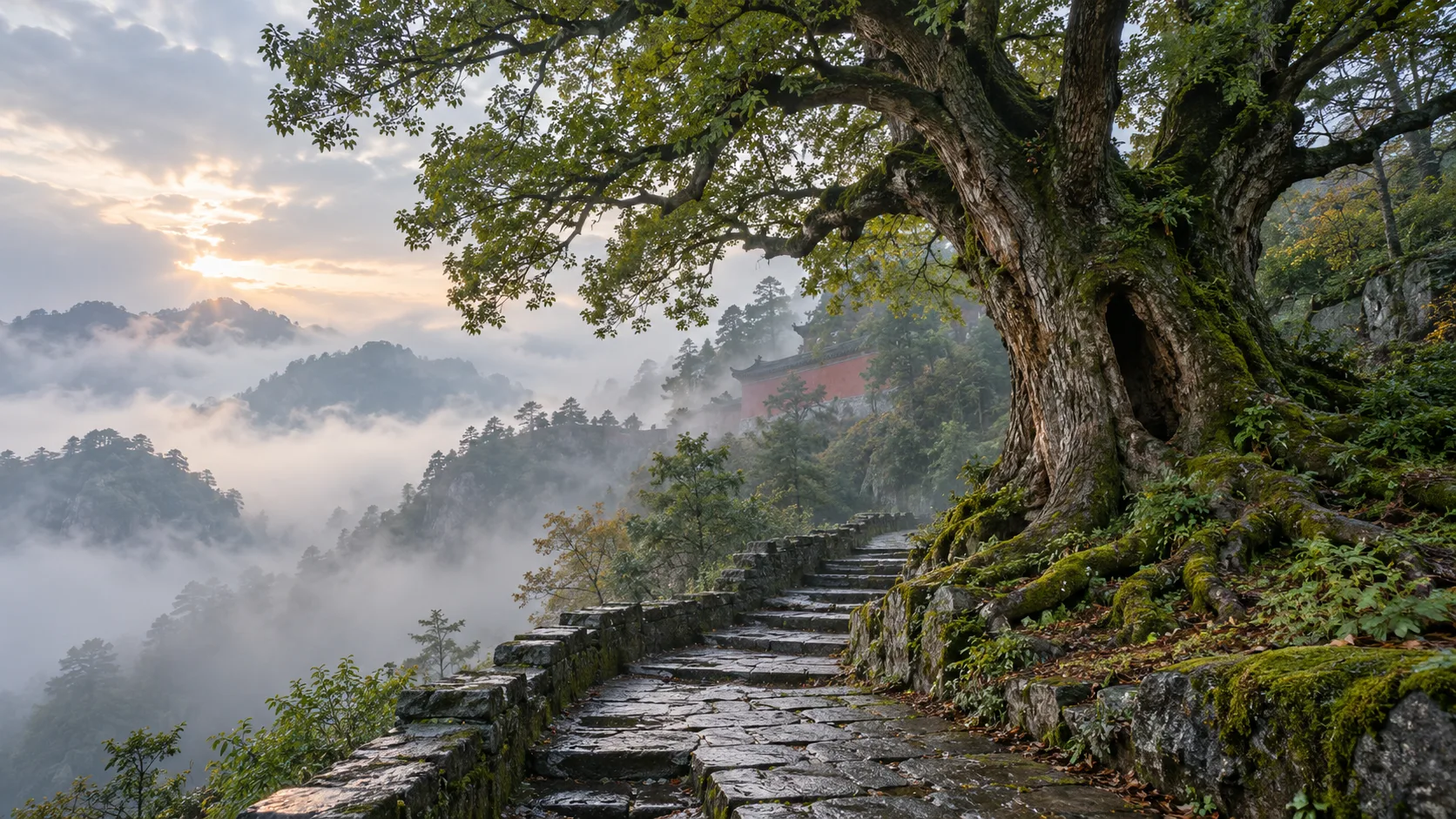
This guide treats trees as part of Wudang’s natural landscape and as living neighbours of built heritage. It explains what “old tree” means in Chinese protection rules, why records matter, and how visitors can look closely without turning a venerable tree into a legend or a prop.
Begin with the record, not the silhouette
“Old” has a legal threshold
China’s national regulations define an old tree as one more than 100 years old. They divide protected trees into three age grades: 100–299 years, 300–499 years and 500 years or more. A “famous tree” is defined by historical, cultural, scientific, landscape or commemorative value and receives the highest protection regardless of age. These categories are administrative tools for care; they are not a ranking of spiritual worth.
A label summarizes a larger file
A trunk’s width, hollows or twisted crown may suggest long life, but species, slope, wind, soil and past damage all affect form. National census guidance calls for tree-by-tree records covering age, location, ownership, condition and historical or cultural information, with technical checks and quality control. A protection label is therefore the visible edge of a file—not an invitation to estimate age from size alone.
Wudang’s reported age range needs attribution
Wudang’s official tourism site describes a group of old trees around the summit and reports recorded ages from just over 100 years to 621 years. It also names several species in the group. These figures are useful as an account of the site’s records, but they should remain attributed to that source rather than becoming claims that every large summit tree is six centuries old.
Read tree and building as separate histories
Neighbourhood does not prove a shared date
A tree beside an old wall may predate the present masonry, be younger than it, or have survived several campaigns of repair. The inscription of Wudang’s ancient building complex as World Heritage does not automatically date each nearby tree or make every specimen part of the inscribed fabric. Compare labels, gazetteers, photographs, maintenance records and building chronology before joining two histories together.
Roots and masonry occupy the same ground
Roots need air, water and permeable soil; paths and foundations need stability and drainage. As both change, a root may lift paving, while compacted ground or an altered drain may stress the tree. The answer is not to treat either the tree or the structure as an obstacle. China’s 2025 regulations specifically call for joint measures when old-tree protection overlaps cultural-relic protection.
Stories matter, but they are not planting records
Communities often remember a tree through a ruler, monk, traveller or sacred event. Such associations can be important cultural evidence even when the planter is unknown. State clearly whether a story is an oral tradition, a later gazetteer entry, an inscription or a contemporary archive. Respect grows when different kinds of evidence are named rather than blended.

Protection begins below the visible trunk
The root zone is part of the monument
A tree is not protected if only its bark is admired. National rules prohibit damaging acts including root excavation, bark stripping, excessive pruning, hard impermeable surfacing, carving, climbing and attaching objects. Barriers and mulched or permeable ground may look modest, but they protect the soil volume that keeps crown and trunk alive.
Visitor pressure can change soil and vegetation
A 2015 field study in Wudang scenic areas found that tourism activity was associated in the sampled zones with denser soil, reductions in several soil-fertility measures, altered plant-community composition and lower vegetation cover. The study does not diagnose every path or every tree. It does show why managers monitor foot traffic, drainage and ground condition rather than waiting for a dramatic branch failure.
Care is repeated, not finished
Old trees are living organisms, so their condition changes with weather, pests, water and nearby work. The national system calls for regular inspection, daily maintenance and updated archives. Supports, lightning protection, drainage work or pruning should be read as dated interventions, not evidence that a tree is artificial or untouched. On steep ground near Tianzhu Peak, care must respond to both mountain exposure and heavy visitation.
A six-step practice for visitors
Move from observation to evidence
Read the label first. Note the recorded species, age or grade and the responsible authority without adding details that are not shown.
Look at the whole tree. Observe crown, trunk, roots and surrounding slope before focusing on one hollow or dramatic branch.
Separate dates. Check the tree record and the building history independently; proximity does not make them contemporaries.
Notice the protection zone. Barriers, permeable ground, drainage and supports can reveal what managers are trying to safeguard.
Leave no attachment. Do not carve, climb, tie ribbons, hang objects or step across barriers for a photograph.
Test the story. Compare oral tradition with labels, inscriptions, gazetteers and reliable research before repeating a named planter or exact age.
Look without adding a mark
Pause at the edge of the protected ground and change your viewing distance. The crown shows exposure; the trunk records growth and injury; the root zone reveals the conditions of continued life. Then place the tree within the wider route using our guide to how Wudang’s landscape shaped its temples and routes. The best close reading leaves no physical trace.
Sources and limits. This guide distinguishes official records, field research and cultural memory. It does not assign a date, species or planter to an unlabelled tree. The generated photographs are conceptual and do not depict a real Wudang tree, archive or conservation intervention.
Further reading: State Council, Regulations on the Protection of Old and Famous Trees; National Forestry and Grassland Administration, national census methods and records; Wudang Mountain official site, reported summit old-tree group; Forestry Resources Management, study of tourism and Wudang’s ecological environment.