Mist at Wudang: Weather, Visibility and the Art of Mountain Looking
武当云雾:天气、能见度与观山之道
Anyone who spends a few days on Wudang learns that the mountain is rarely seen all at once. Low cloud hides a ridge, opens a ravine, flattens distance and then gives the peaks back in layers. A temple roof seems to float; a stair climbs into white and ends. For visitors this changing visibility is one of the most memorable things about the mountain, and for Taoist and literary tradition clouds and mist have long carried meaning of their own.
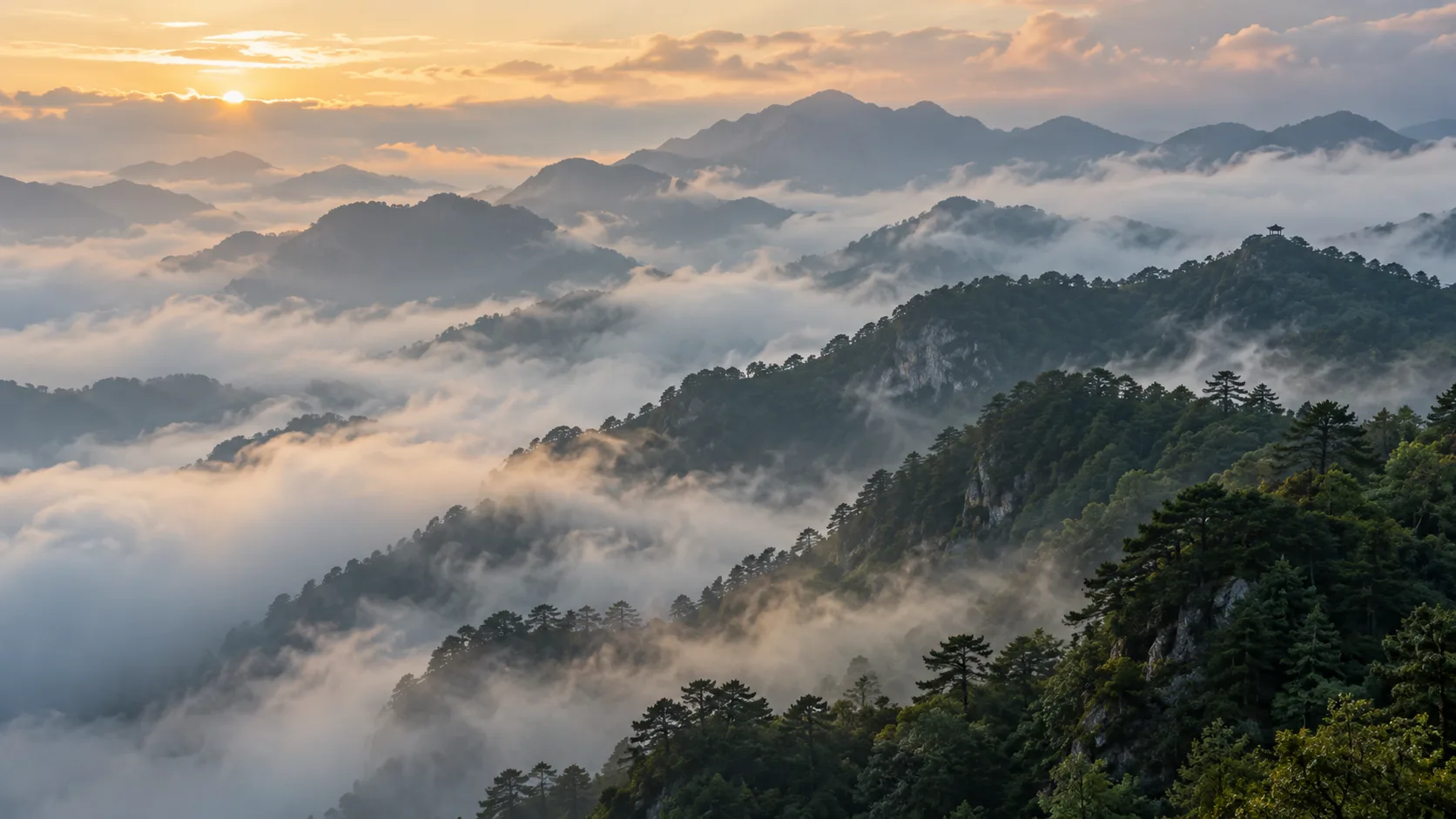
This page explains how mountain mist forms, how it changes the experience of Wudang’s temples and routes, what clouds have meant in Taoist thought and Chinese painting, and how to look, photograph and walk well when the view closes in. For the terrain itself, begin with Wudang’s natural landscape.
How mountain mist forms
Cloud at eye level
Fog is cloud in contact with the ground. On a mountain it forms in a few familiar ways. Moist air pushed up a slope cools as it rises, and its water vapour condenses into low cloud that wraps the upper ridges; meteorologists call this upslope fog. On calm, clear nights the opposite happens: cool air drains down into valleys, and moisture condenses there, leaving ravines filled with white at dawn while the heights stand clear. Rain on a warm, wooded slope adds its own moisture, and after a shower vapour can rise from the forest in drifting bands.
These are general processes found on mountains everywhere. Any single view at Wudang may come from one of them, a mix, or ordinary cloud passing low over the range, and a photograph alone rarely tells which.
Fog, mist, haze and a sea of clouds
Travel writing uses these words loosely, but meteorologists separate them. Fog and mist are both made of tiny water droplets; fog is the thicker of the two and cuts visibility further. Haze is different: it comes from dust, smoke or other fine particles in dry air rather than from water. A “sea of clouds” (云海) is what you see when you stand above the top of a cloud layer, so that the valleys below look flooded and the higher peaks rise like islands. That view depends on being high enough and on the cloud being low enough, which is why it can appear from a summit one morning and not at all the next.
Terrain makes the theatre
Wudang’s temples sit among steep peaks, cliffs and ravines, and that broken terrain is what makes its mist so changeable. One valley can be full while the next ridge is clear; an exposed summit, a wooded shoulder and a sheltered courtyard can offer quite different conditions at the same moment. The guides to the 72 Peaks, 36 Cliffs and 24 Streams name the forms; mist decides, hour by hour, which of them can be seen together.
Mist among Wudang’s temples
Summit and valley
The highest point of the range is Tianzhu Peak, crowned by the Golden Summit and its Golden Hall (金殿), the gilded bronze hall of 1416 built under the Yongle emperor. Because it is the highest point, it is where visitors most often climb above the cloud, and also where they most often climb into it. Conditions on the summit can differ completely from those at the foot of the mountain or on the middle routes, so a clear morning below says little about the view above, and the reverse.
Buildings as a sequence
The Yongle-era building programme of the early fifteenth century placed palaces, halls and gates along routes that climb through ravines and along cliffs. The Ancient Building Complex in the Wudang Mountains, inscribed as a UNESCO World Heritage site in 1994, is valued precisely for this setting of buildings among the mountains. In clear weather the eye can take in a whole complex. In mist it becomes a sequence of thresholds: a gate, a wall, the edge of a roof, a stair, then blankness. At the Purple Cloud Palace (紫霄宫), set against a wooded slope, or at South Cliff (南岩), where halls cling to the rock face, the buildings appear one by one as you approach. The guide to landscape, temples and routes explains how this physical relationship works.
It is tempting to say the temples were designed for this effect. The builders certainly chose dramatic sites, and the experience of approach mattered to them, but there is no need to claim a plan for mist. It is enough to notice how low visibility reveals the order of a route that a full panorama hides.
Wet stone, dripping eaves
Mist is also water. It darkens stone steps, beads on pine needles, runs off tiled roofs and gathers in courtyard drains. The page on how water leaves a Wudang temple follows that water from eaves to slope, and from ravine to reservoir traces it down the mountain toward the Danjiangkou Reservoir. The damp air also shapes the vegetation; reading Wudang’s forests explains how the woodland changes with height.
Clouds in Taoist thought and imagination
Immortals and wandering clouds
Clouds run through Taoist imagery. Immortals are pictured riding clouds and mounting mist (腾云驾雾), and the Zhuangzi describes a spirit being who rides the clouds and roams beyond the four seas. Itinerant Taoists who travel from mountain to mountain are said to “wander like clouds” (云游), and the old phrase “clouds and water” (云水) describes a life without fixed attachment, moving the way clouds drift and water flows. On a mountain long associated with Zhenwu, the Perfected Warrior, and with generations of hermits and practitioners, these images feel close at hand.
Seen and unseen
The Tao Te Ching (Dao De Jing) describes the Dao as something one looks at and does not see, listens for and does not hear. Mist offers a simple, physical version of that idea: the mountain is still there, whole, while only part of it can be seen. Many visitors find that a hidden peak changes the quality of their attention. They begin to notice the edge of a cloud bank, the colour of wet stone, the sound of water and voices carried from far below.
Reading names with care
Some Wudang names draw on the language of sky and cloud; the 霄 of Purple Cloud Palace, 紫霄, refers to the high heavens. Such names place a building in a cosmic order, but they are not weather reports, and no single key turns every patch of mist into one Taoist message. A liturgical text, a poem, an inscription and a modern caption each do different work, and each is best read in its own context.
Mist in Chinese landscape painting
Blank space that builds distance
Chinese landscape painting (山水) does not simply copy what the eye sees. Ink wash, brushwork and unpainted paper together create a sense of distance and movement. Pale or empty passages, the “left blank” (留白), often read as mist or cloud: they separate near hills from far ones, join scenes that would otherwise sit apart, and slow the eye. The Song painter Guo Xi described three kinds of distance, high, deep and level, and mist is one of the painter’s main tools for showing all three. The site’s guide to shanshui painting explains foreground, middle ground, far distance and the role of empty space.
A painting is not a map
A painted mountain can combine observation, inherited brush conventions, imagined terrain and literary memory, and may fold several viewpoints into one scroll. It should not be used to identify an unnamed Wudang peak or temple. Still, standing on Wudang in drifting cloud is one of the best ways to understand why painters valued mist: it really does turn a mountain into near, middle and far planes.
Looking, photographing and walking in mist
A photograph is a moment
A sea of clouds photographed from the Golden Summit may be entirely genuine and still give a misleading idea of the mountain. Season, time of day, lens, exposure and the minutes before and after the shutter all matter, and repeated images online can make a rare morning look routine. Describe what a picture shows: “mist filled the lower valleys that morning” is truer than “Wudang is always wrapped in cloud.”
How to look when the view closes
Low visibility rewards patience. Stay in one place for a while and watch the same direction; cloud can thin and return within minutes. Use partial clues to rebuild scale: the size of a pine, the pitch of a roof, the width of a path. Notice what clear weather hides: the rhythm of a stair, the line of dripping eaves, the moment a roofline returns. A hidden peak is not an empty view.
Safety comes before the view
Mountain weather can change faster than a visitor’s plan. Mist hides landmarks and makes wet steps, road traffic and exposed edges harder to judge. Check the current local forecast and site notices before you set out, follow closures and staff instructions, keep to marked routes, carry a warm layer and slow down on wet stone. Never cross a barrier or step to an edge for a clearer view; a missed photograph is better than a fall.
On the mountain
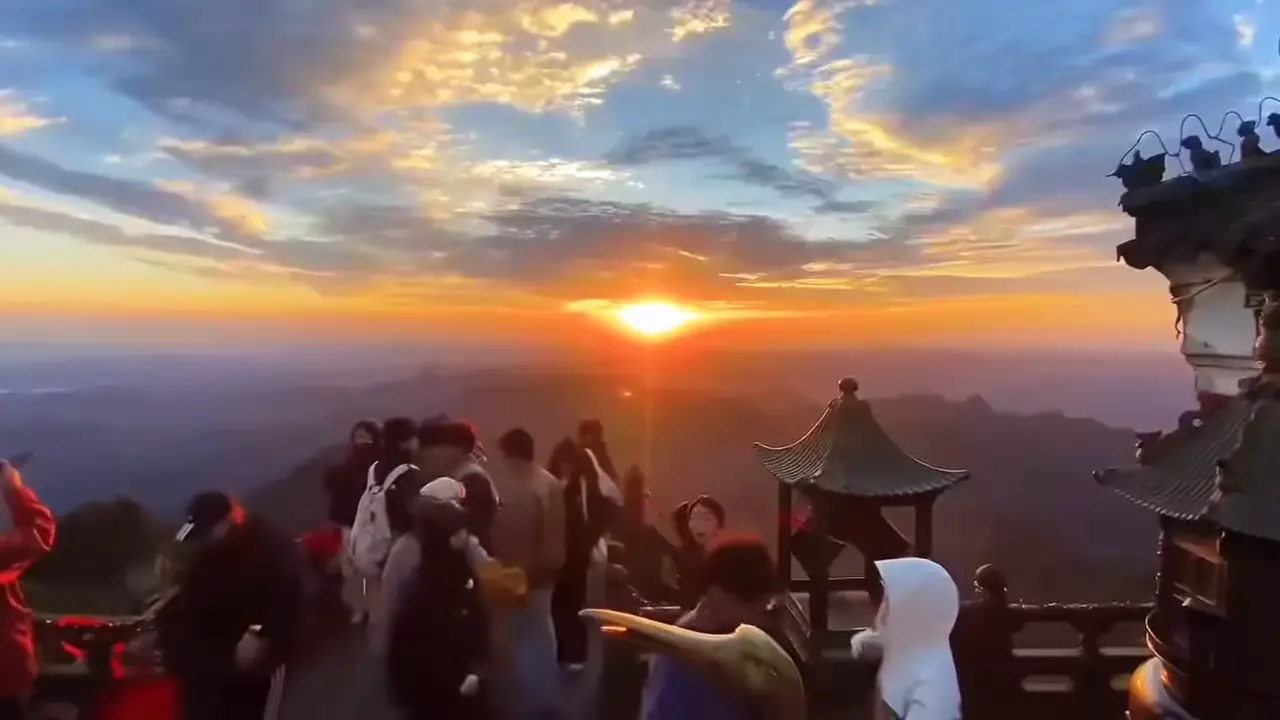
Our own posts from Wudang catch these conditions as they happen. A Sea of Clouds · 19 September 2026 shows the valleys filled with cloud below the peaks, and Sunrise at the Golden Summit, 5 October 2026 shows dawn from the summit terrace, crowded with early risers. Mist also shapes life lower down: the damp mornings that keep the slopes green are part of the story of wild edible plants at Wudang. Whether you arrive to a clear sky or a white wall, the mountain is there either way, and part of visiting it is learning to see it in pieces.