The Taishang Laojun shuo chang qingjing jing (太上老君说常清静经), usually shortened to the Qingjing jing (清静经), “Classic of Clarity and Stillness” (also translated “Purity and Stillness”), is one of the shortest scriptures in the Taoist canon and one of the most recited. Its core runs to only a few hundred characters. Quanzhen Taoists, including those at Wudang, chant it every morning as part of their daily liturgy.
It is presented as words of the deified Laozi and is generally dated to the Tang dynasty, when Taoist thinkers of the Twofold Mystery (Chongxuan, 重玄) school were working out a language of emptiness close to Buddhism’s. A commentary is attributed to Du Guangting (850–933), and Quanzhen masters of the following centuries, among them Hou Shanyuan and Li Daochun, wrote their own. In a few lines it gathers the Tao Te Ching (Dao De Jing) on the nameless Tao, a cosmology of the clear and the turbid, a method of looking inward, and a diagnosis of how the mind loses its way. This page gives the core text in six sections, each with an English reading. The received text closes with short testimonies attributed to immortals, including Ge Xuan, on the merit of reciting it; they are not reproduced here.
1. The Tao has no form
Classical text
老君曰:大道無形,生育天地;大道無情,運行日月;大道無名,長養萬物;吾不知其名,強名曰道。
English reading
Laozi says: the great Tao has no form, yet it brings forth heaven and earth. It has no feelings, yet it moves the sun and moon. It has no name, yet it nourishes all things. I do not know its name; if I must name it, I call it the Tao.
The opening echoes chapter 25 of the Tao Te Ching, where Laozi also says he does not know the name of what he describes. The point is set down first: what is about to be called clarity and stillness is not a mood but the character of the Tao itself.
2. Clear and turbid, moving and still
Classical text
夫道者:有清有濁,有動有靜;天清地濁,天動地靜;男清女濁,男動女靜;降本流末,而生萬物。清者濁之源,動者靜之基;人能常清靜,天地悉皆歸。
English reading
The Tao has the clear and the turbid, the moving and the still. Heaven is clear and earth is turbid; heaven moves and earth is still. Male is clear and female turbid, male moves and female is still. Descending from the root and flowing out to the branches, it gives rise to the ten thousand things. The clear is the source of the turbid; movement rests on stillness. If a person can be constantly clear and still, heaven and earth return to them entirely.
The pairs are the cosmology of the time, the same correlations of yin and yang found throughout Chinese thought. The line about men and women places them on that map; it is a statement about yin and yang, not about the worth of people, and modern teachers usually read it that way. The key sentence is the last: clarity and stillness are not added to the world from outside. They are its source, and a person who returns to them is in step with everything.
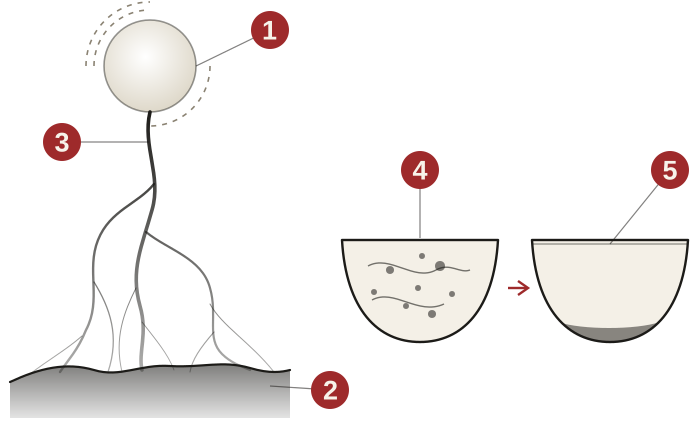
Clear and turbid, moving and still, as the Qingjing jing describes them in the cosmos and in the heart-mind. A schematic drawing.
- Heaven: clear and moving
- Earth: turbid and still
- “Descending from the root, flowing to the branches”: the Tao giving rise to the ten thousand things
- The heart-mind stirred by desire, like muddied water
- The same water left alone: it settles, and becomes clear and still
3. Why the heart-mind is not still
Classical text
夫人神好清,而心擾之;人心好靜,而欲牽之。常能遣其欲,而心自靜;澄其心而神自清。自然六欲不生,三毒消滅。所以不能者,為心未澄,欲未遣也。
English reading
The human spirit loves clarity, but the heart-mind disturbs it. The heart-mind loves stillness, but desires pull it away. If you can always send desires away, the heart-mind becomes still of itself; settle the heart-mind, and the spirit becomes clear of itself. Then the six desires do not arise and the three poisons are dissolved. Those who cannot do this have not yet settled the heart-mind or sent their desires away.
The image is water. Stirred, it is cloudy; left alone, the mud sinks and it clears without effort. Nothing needs to be added to make the mind clear. The “six desires” and “three poisons” are terms the scripture shares with Buddhist teaching of its time, a sign of how closely the two traditions lived together.
4. Three observations, and true stillness
Classical text
能遣之者,內觀其心,心無其心;外觀其形,形無其形;遠觀其物,物無其物。三者既悟,唯見於空。觀空亦空,空無所空;所空既無,無無亦無;無無既無,湛然常寂。寂無所寂,欲豈能生?欲既不生,即是真靜。真常應物,真常得性;常應常靜,常清靜矣。
English reading
For those who can send desires away: look inward at the heart-mind, and the heart-mind has no fixed heart-mind; look outward at the body, and the body has no fixed form; look far out at things, and things have no fixed thing. When all three are understood, only emptiness is seen. Look at emptiness, and it too is empty; when emptiness has nothing left to empty, even “nothing” is gone. Then there is a deep, constant calm. In that calm there is nothing to be calm about; how could desire arise? When desire no longer arises, that is true stillness. The true and constant responds to things and keeps its nature; always responding, always still, it is always clear and still.
This is the passage our page on Inner Observation builds on. Notice the last line: true stillness is not withdrawal. It still “responds to things”. Clarity and stillness are meant to be lived, not hidden away.
5. Entering the true Tao
Classical text
如此清靜,漸入真道;既入真道,名為得道,雖名得道,實無所得;為化眾生,名為得道;能悟之者,可傳聖道。
English reading
Clear and still like this, you gradually enter the true Tao. Having entered it, you are said to have attained the Tao; but though it is called attainment, in truth nothing is gained. It is only for the sake of teaching others that it is called attaining the Tao. Those who understand this may pass on the sacred Tao.
The same humility appears in Sima Chengzhen’s Zuowang lun: the last stage has a grand name, but nothing new is acquired. What changes is that what was always there is no longer covered over.
6. Why people lose the Tao
Classical text
老君曰:上士無爭,下士好爭;上德不德,下德執德;執著之者,不明道德。眾生所以不得真道者,為有妄心;既有妄心,即驚其神;既驚其神,即著萬物;既著萬物,即生貪求;既生貪求,即是煩惱;煩惱妄想,憂苦身心;便遭濁辱,流浪生死,常沉苦海,永失真道。真常之道,悟者自得;得悟道者,常清靜矣。
English reading
Laozi says: the highest people do not contend; lesser people love to contend. The highest virtue does not cling to virtue; lesser virtue holds on to it. Those who cling do not understand the Tao and its virtue. People fail to reach the true Tao because they have a deluded heart-mind. With a deluded heart-mind, the spirit is startled; startled, it fastens on things; fastened on things, it craves; craving brings vexation; vexation and false thinking trouble body and mind. Then come defilement and disgrace, wandering through life and death, sinking in a sea of suffering, losing the true Tao for ever. The true and constant Tao is found by those who awaken to it; those who awaken are always clear and still.
The chain reads like a diagnosis: a small agitation becomes attachment, attachment becomes craving, craving becomes distress. Its opening lines echo chapter 38 of the Tao Te Ching on “highest virtue”. The way out is the same as the way in: return to clarity and stillness.
Reading it today
The Qingjing jing is short enough to learn by heart, and that is how it has always been used: recited, not only read. Three ideas carry over most easily into daily life.
- Clarity is the natural state. Like water, the mind clears when it is no longer stirred. The work is less adding calm than ceasing to agitate.
- Desire is the stirring hand. Not every wish is a fault, but constant wanting keeps the water cloudy. Noticing it is the first step to setting it down.
- Stillness still responds. The scripture’s ideal is not withdrawal but a calm that meets the world without being thrown by it.
For practice, the sitting methods in our meditation series put these ideas to work: Taoist Meditation, Guarding the One and Inner Observation.
Further in the library
- The Classical Library: the complete texts collected on this site.
- The Tao Te Ching: the book the Qingjing jing quotes and builds on.
- The Quanzhen order: the tradition that recites it every morning.
- The Yinfu Jing: the other short classic of inner cultivation, read by strategists too.
- The Huangting Jing: the meditation poem that maps the body as a landscape of palaces and spirits.
- The Wuzhen Pian: Zhang Boduan’s poems of inner alchemy, where stillness meets the elixir.
- The Cantong Qi: the oldest book of the elixir, where the Book of Changes, Huang-Lao and the furnace meet.