INTERNAL MARTIAL FOUNDATIONS · 内家拳筑基

Wudang vs Shaolin: Internal and External Chinese Martial Traditions Compared 武当与少林:内家与外家武术传统的源流、劲法与修习比较

Moving past cinema tropes: what Huang Zongxi’s 1669 distinction actually meant, how internal spiral mechanics differ from external muscular training, and how a beginner chooses where to start.

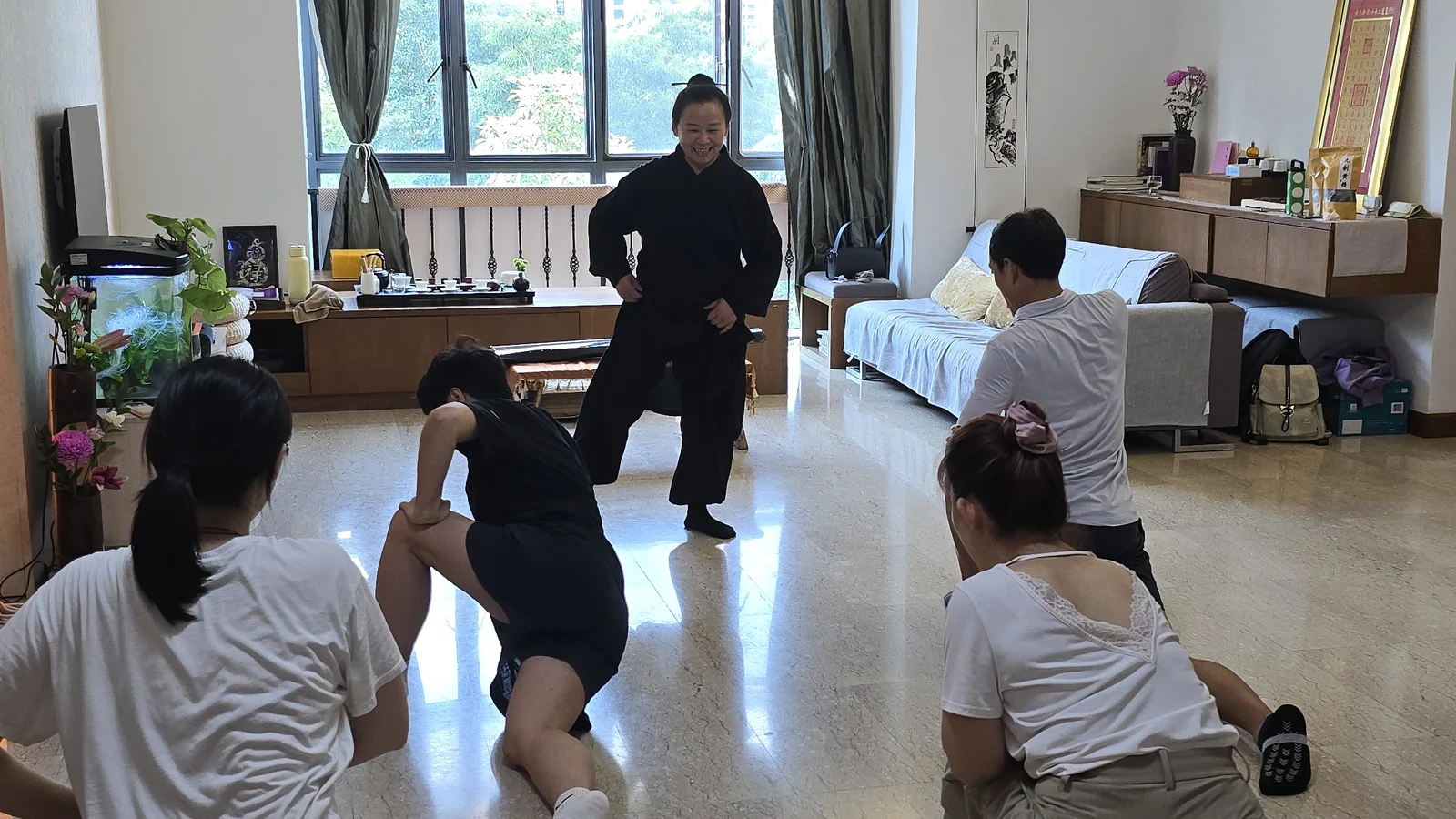
A Wudang taijiquan lesson in a sunlit room: students seen from behind kneel into deep lunges to open the hips while a teacher in black Taoist-style clothing stands in a wide stance, smiling, with an ink-painting scroll on the wall behind.

Newcomers to Chinese martial arts almost always hear the proverb “Northern brilliance belongs to Shaolin; southern reverence belongs to Wudang” (北崇少林,南尊武当). Popular novels and films turn that pairing into a rivalry between two sealed monasteries. When you study the historical texts and step onto the training floor yourself, a much richer picture appears: Wudang and Shaolin represent two complementary entry doors into body cultivation—one starting from visible athletic frame and decisive outward power, the other starting from quiet alignment, breath regulation, and yielding responsiveness rooted in the Tao Te Ching (Dao De Jing).

1. Where the “Internal vs External” Distinction Actually Came From (1669)

Before you repeat legends as settled history, anchor the earliest surviving written text that pairs Shaolin and the “Internal School” (内家, Neijia): the scholar Huang Zongxi’s (黄宗羲, 1610–1695) 1669 inscription Epitaph for Wang Zhengnan (《王征南墓志铭》). In that essay, Huang writes:

“Shaolin is famous throughout the world for martial vigour; yet it excels primarily at striking outward, which leaves an opening that another person can exploit. What is called the Internal School overcomes movement through stillness (以静制动); a striker is turned off balance the moment they commit their force. Thus Shaolin is distinguished as ‘external’ and this lineage as ‘internal,’ originating with Zhang Sanfeng of the Song.”

A careful practitioner-scholar reads Huang Zongxi on two levels at once. Historically, Ming and Qing martial lineages cross-pollinated far more than sectarian stories admit—for instance, the late-Ming sinew-lengthening manual Yijinjing (Sinew-Changing Classic) carries a 1624 preface written by a Taoist author of Tiantai attributing its legend to Bodhidharma at Shaolin. Technically, however, Huang’s distinction points to a real training difference that you feel in your shoulders and knees during your very first week of practice.

2. Training Order: From Outside In vs From Inside Out

Why do teachers still distinguish an external (外家) syllabus from a Wudang internal (内家) syllabus? Notice the sequence in which a beginner’s body is educated:

  • External conditioning (筋骨皮 → 气力): Classical northern long-fist and Shaolin basics begin by building muscular endurance, deep athletic stances, brisk linear speed, leaping coordination, and clear percussive force. In later years, seasoned external practitioners soften their effort and cultivate breath, moving “from the outer frame inward.”
  • Wudang internal cultivation (松静调息 → 整劲): In Wudang Taijiquan, standing meditation (Zhan Zhuang), and Wudang swordsmanship (the Chinese jian), you begin by subtracting habitual muscular bracing. Guided by Chapter 43 and Chapter 76 of the Tao Te Ching (“what is alive is supple and resilient”), you learn first to drop the breath, unlock the hip joints (kua 胯), align the spine, and let connected whole-body force (song and rooting jin) emerge gradually without joint strain.

3. Philosophical Horizon: Chan Discipline and Taoist Nourishing of Life

The architectural settings of both mountains reflect their daily rhythms. On Wudang Mountain—whose ancient Taoist temple complexes across Zixiao Palace, Nanyan Palace, and the Golden Summit form a UNESCO World Heritage Site—movement training grew alongside liturgy, the Qingjing Jing, the Huangting Jing, and Taoist nourishing-life (Yangsheng) practice.

Because the Taoist ideal prizes long-term vitality over short-term athletic peaking (Tao Te Ching Chapter 55: “things that grow over-rigid quickly age”), Wudang training is designed so a person in their forties, sixties, or seventies can refine balance, joint mobility, and calm attention without colliding bone against bone.

4. Which Path Fits Your Goals Today?

Rather than asking “which style wins in a novel,” ask what your body and schedule actually need right now:

  1. If you sit at a desk, carry neck and shoulder tension, or want sustainable lifelong mobility: Begin with Wudang Tai Chi for Beginners or a fifteen-minute classical Qigong routine such as Baduanjin or Liuzijue.
  2. If you want structured in-person corrections without travelling immediately to Hubei: Wudang.Org shares practice between Wudang Mountain and our Singapore base, where beginners can step into a weekend Baduanjin workshop or the Tai Chi Retreat Camp in Singapore, or explore all four beginner doorways on Start Here.

Safety note: Traditional internal martial arts support balance, posture awareness, and general wellbeing; they are not a medical treatment or a substitute for orthopaedic or cardiovascular care. Always keep knees aligned with the toes and consult a qualified physician if you have existing joint or heart conditions.

Seeker’s Q&A · Frequently Asked Questions

Who first wrote down the distinction between Shaolin as “external” and Wudang as “internal”?

The scholar Huang Zongxi (1610–1695) formulated the classic written distinction in his 1669 Epitaph for Wang Zhengnan (王征南墓志铭), contrasting Shaolin’s outward striking vigour with the Internal School’s principle of overcoming motion through stillness (以静制动).


Is Wudang internal martial arts suitable for stiff beginners or older adults?

Yes. Because Wudang Taijiquan and Qigong begin by releasing chronic shoulder and hip tension, keeping stances at a comfortable height, and coordinating unforced nasal breathing rather than high-impact jumps, beginners of varied ages can progress safely at their own pace.

How does the Tao Te Ching shape Wudang martial training?

Principles from the Tao Te Ching—such as suppleness preserving life (Chapter 76), gathering breath to reach softness (Chapter 10), and water yielding around stone without losing continuity (Chapters 8 and 78)—translate directly into relaxed rooting, curved waist-led movement, and non-collision in partner practice.
