Shanshui: How to Read Chinese Landscape Painting
山水画:怎样读懂中国山水
Shanshui literally joins the words for mountain and water, but it does not name one fixed look or one timeless philosophy. Across many centuries, painters used the subject in court commissions, religious settings, scholar networks, travel records and commercial studios.
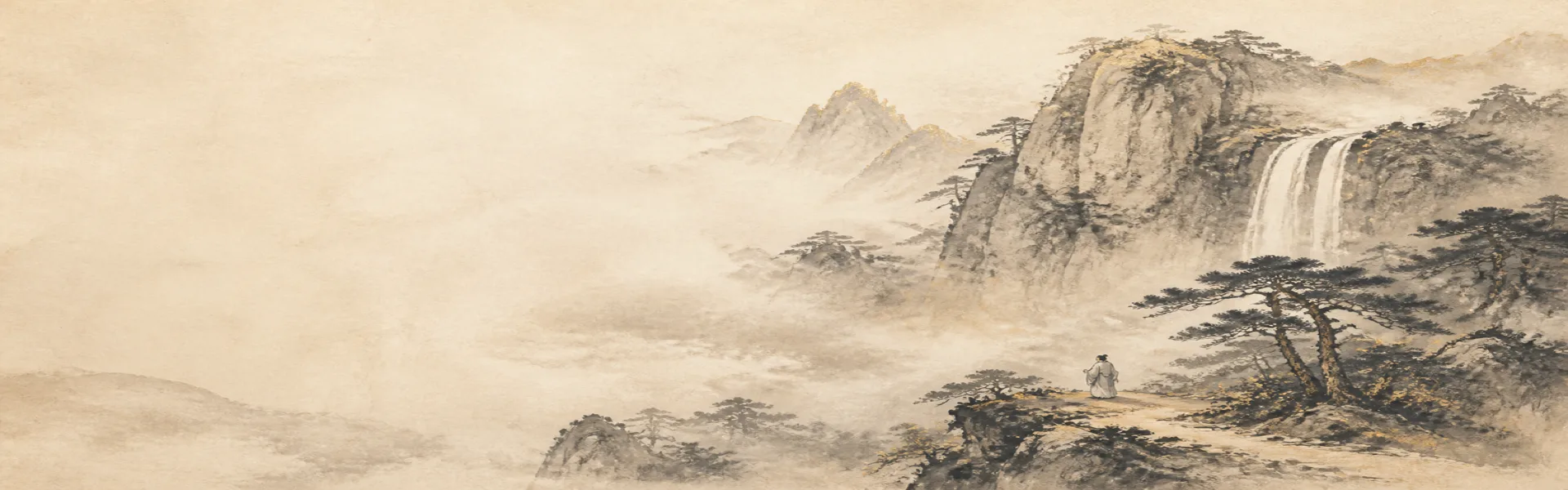
This guide begins with the painted object: its format, materials, marks and viewing sequence. For a wider chronology, visit Origins and History of Chinese Painting; for the working vocabulary of ink, wash and line, see Ink and Brush in Chinese Painting.
1. What “mountain-and-water” names
The term shanshui became an important category of writing and painting, yet surviving works include mineral-colour landscapes, monochrome ink paintings, intimate album leaves and enormous hanging scrolls. A blue-and-green courtly scene and a sparse ink landscape can both belong to the category.
It is therefore safer to ask what a particular object does than to define all shanshui by a single formula. Mountains, waterways, roads, buildings and figures may organize an imagined world, recall a known place, stage a literary theme or display a painter’s command of inherited models.
2. Start with the object and its format
A hanging scroll is viewed upright and can address a room at once. A handscroll is normally opened on a table in sections, from right to left, so space unfolds through the time of looking. Album leaves and fans create other scales, rhythms and social settings.
Mounting, colophons, seals and repairs are part of an object’s history. A familiar image may survive in a later copy, carry a revised attribution or include inscriptions added generations after the painting. Museum labels should be read for date, material, format and attribution before an image is treated as direct evidence of one period.
3. Monumental landscapes and historical change
Works associated with the Five Dynasties and Northern Song periods helped establish monumental landscape as a major pictorial achievement. Tall peaks, ravines, trees, water and small structures could form an ordered, inhabitable world, but workshops, regional practices and court settings produced more than one solution.
Later painters did not simply abandon observation for self-expression. Southern Song, Yuan, Ming and Qing artists altered scale, composition and references to earlier masters for many reasons: patronage, format, local networks, political circumstances and personal aims. The history is a set of overlapping traditions, not a clean break between “real nature” and “pure brushwork.”
4. Routes, viewpoints and the “three distances”
Many landscapes guide the eye by means of a path, stream, bridge, ridge or chain of buildings. The route may disappear behind mist or rock and return elsewhere. In a handscroll the journey is also physical, because the viewer reveals one section while closing another.
Texts connected with Guo Xi describe high, deep and level distance. These terms are useful for noticing how a painter leads the gaze upward, inward or across, but they are not a complete law of Chinese perspective. One work may combine several viewpoints, while another may compress or flatten space for expressive and compositional purposes.
5. Brush, ink and colour build terrain
Contour lines, texture strokes, ink washes and dots can distinguish rock faces, soil, foliage, water and atmospheric distance. Named texture patterns became part of a shared teaching vocabulary and a way for later painters to engage with earlier styles.
Those names should not be turned into a rigid map in which one stroke always proves one region or rock type. Artists recombined, exaggerated and quoted methods. Colour also remained important: mineral blue and green, pale washes and touches of warm pigment coexist with monochrome ink across the history of landscape painting.
6. Empty paper is active space
Unpainted silk or paper may suggest mist, sky or water, separate masses, create a pause or keep a route uncertain. Its role depends on surrounding marks and on the object’s format; blankness is not automatically a symbol of one doctrine.
Season and weather are likewise constructed through conventions as well as observation. Dense leaves, bare branches, wet washes, pale reserves or darkened skies help viewers recognize spring growth, autumn clarity, rain, snow or evening, while titles and inscriptions can redirect what those effects mean.
7. Human figures reveal social worlds
Small figures often establish scale, but they also carry stories. Travellers, fishers, woodcutters, farmers, servants, officials and friends gathering in a pavilion point to work, movement, reclusion, hospitality and exchange within the painted environment.
Their size does not always declare that humanity is insignificant. A tiny bridge or roof can make a mountain immense, provide a destination or identify a literary subject. Look closely at who travels, who labours, who rests and which routes or buildings connect them.
8. Inscriptions turn looking into conversation
Titles, poems, dedications and colophons may name an occasion, recipient, place or earlier master. Seals can record makers, collectors and institutions. These additions can transform how a landscape was understood long after the painted image was completed.
“After” or “in the manner of” an earlier painter need not mean a line-for-line copy. It can announce affiliation, test a received method or create a dialogue with art history. Attribution and dating must still be evaluated from the whole object, not accepted from one inscription alone.
9. Daoist, Buddhist and Confucian readings
Ideas about mountains, reclusion, cultivation and changing nature appear in Daoist, Buddhist and Confucian texts and practices. They can illuminate particular paintings when an inscription, biography, commission or setting provides evidence. Sacred-mountain imagery and maps also have histories that are not identical to literati landscape painting.
For Wudang readers, this distinction matters. A generic painted peak should not automatically be called Wudang or labelled Daoist. Compare visual interpretation with site records, titles and provenance, and explore the broader Chinese Painting guide before assigning a religious meaning.
10. A five-minute close-looking method
First record what the label actually says: object type, material, dimensions, date range and attribution. Then trace one route, compare near and distant brushwork, locate figures and buildings, and note where blank areas interrupt or connect the scene.
Finally read the inscriptions and provenance notes, then revisit your first impression. Ask which conclusions come from visible evidence and which come from expectation. This sequence keeps philosophical interpretation available, but makes it answerable to the particular object in front of you.