How to Read Chinese Regulated Verse: Lines, Rhyme, Tone and Parallelism
怎样读中国近体诗:句式、押韵、平仄与对仗
Chinese regulated verse can look forbidding when a page is covered with tone marks and pattern diagrams. Yet its discipline is easier to grasp if we begin with what a reader can actually see: equal-length lines, lines paired into couplets, recurring rhyme positions, and carefully related images. The formal system is not a cipher that automatically reveals meaning. It is an architecture that gives a poet places to set, balance, turn and close an experience.

This guide concentrates on jintishi (近体诗, “recent-style poetry”), especially the eight-line lüshi (律诗) and four-line jueju (绝句). For historical setting and major poets, begin with the site’s overview of Tang poetry; for the wider literary setting, return to Chinese poetry and literature.
Recognize the form before interpreting
Lines become couplets
In the most common forms, every line contains five or seven written characters, and two lines make a couplet. This visible equality creates expectations: a noun in one line may answer a noun in the next, a near view may meet a distant view, or an action may meet its consequence. Paul Rouzer’s introduction for Columbia University’s Asia for Educators emphasizes how couplets divide a poem into successive units of thought. That does not mean every couplet is sealed off; the interest often lies in how one unit prepares or unsettles the next.
Lüshi, jueju and extended forms
A standard lüshi has eight lines—four couplets—while a jueju has four lines—two couplets. Extended regulated verse, often called pailü (排律), continues for more couplets. Five-character and seven-character versions are both important. These labels describe formal families, not a guarantee that every surviving poem will fit a classroom chart without textual or historical questions.
Rhyme creates distant joints
Regulated poems normally rhyme at the ends of even-numbered lines, and the first line may also enter the rhyme. A single rhyme group usually continues through the poem. Mark those line endings before deciding what the poem “says”: they make non-adjacent lines answer one another acoustically. The rhyme may be invisible to a modern Mandarin reader because the poem was composed within earlier sound systems and later read through inherited rhyme categories.
Hear a historical pattern without forcing modern sound
Ping and ze are historical categories
Regulated verse organizes syllables through the broad opposition of ping (平, level) and ze (仄, deflected) categories. These are not simply modern Mandarin “tones one and two” versus “tones three and four.” Middle Chinese distinguished level, rising, departing and entering categories; later traditions grouped the latter three as ze. Modern varieties redistributed those categories differently. A modern reading can still be musical, but it cannot by itself reconstruct the original tonal pattern.
Patterns are constraints, not drum machines
Within a line and across paired lines, level and deflected positions tend to alternate and respond. Handbooks therefore present a small family of base patterns. Actual poems also contain licensed variants, disputed readings and places where later critics describe a deviation as balanced or “rescued” elsewhere. San Duanmu’s corpus study of 1,460 regulated-verse lines is a useful warning against treating variation as automatic defect: phrasal stress and non-phonological factors matter alongside an abstract template.
Why an old rhyme may no longer sound
Rhyme dictionaries and commentarial traditions preserve groupings that do not always match today’s pronunciation. When two end characters no longer rhyme in Standard Mandarin, first check an annotated edition rather than accusing the poet or copyist of error. Dialect history, sound change, graphic variants and textual transmission can all matter. Columbia’s presentation of Du Fu’s “Spring Gaze” usefully places characters, romanization, glosses and translation together, while also noting the regulated tonal design.
Read parallelism as a relation
Match positions and grammatical work
In an eight-line lüshi, the two middle couplets are normally the principal sites of parallelism. Corresponding positions may hold nouns, verbs, numbers, colors, places or temporal phrases that perform comparable grammatical work. The match need not be synonym against synonym. Contrast, scale, sequence and part-to-whole relations can make a pair more energetic than simple repetition.
Compare images, scale and movement
Read down the two lines vertically as well as across them. Does high answer low, near answer far, spring answer ruin, or stillness answer flight? Zhang Longxi’s study describes symmetry and antithesis as crucial structures in classical Chinese poetry, while stressing that parallelism includes variation. In Du Fu’s “Views in Springtime,” as presented by Columbia, enduring hills and rivers are set against a damaged polity, then flowers and birds carry grief through paired perceptions. Form organizes the pressure; it does not erase historical circumstance.
Notice the turn and the close
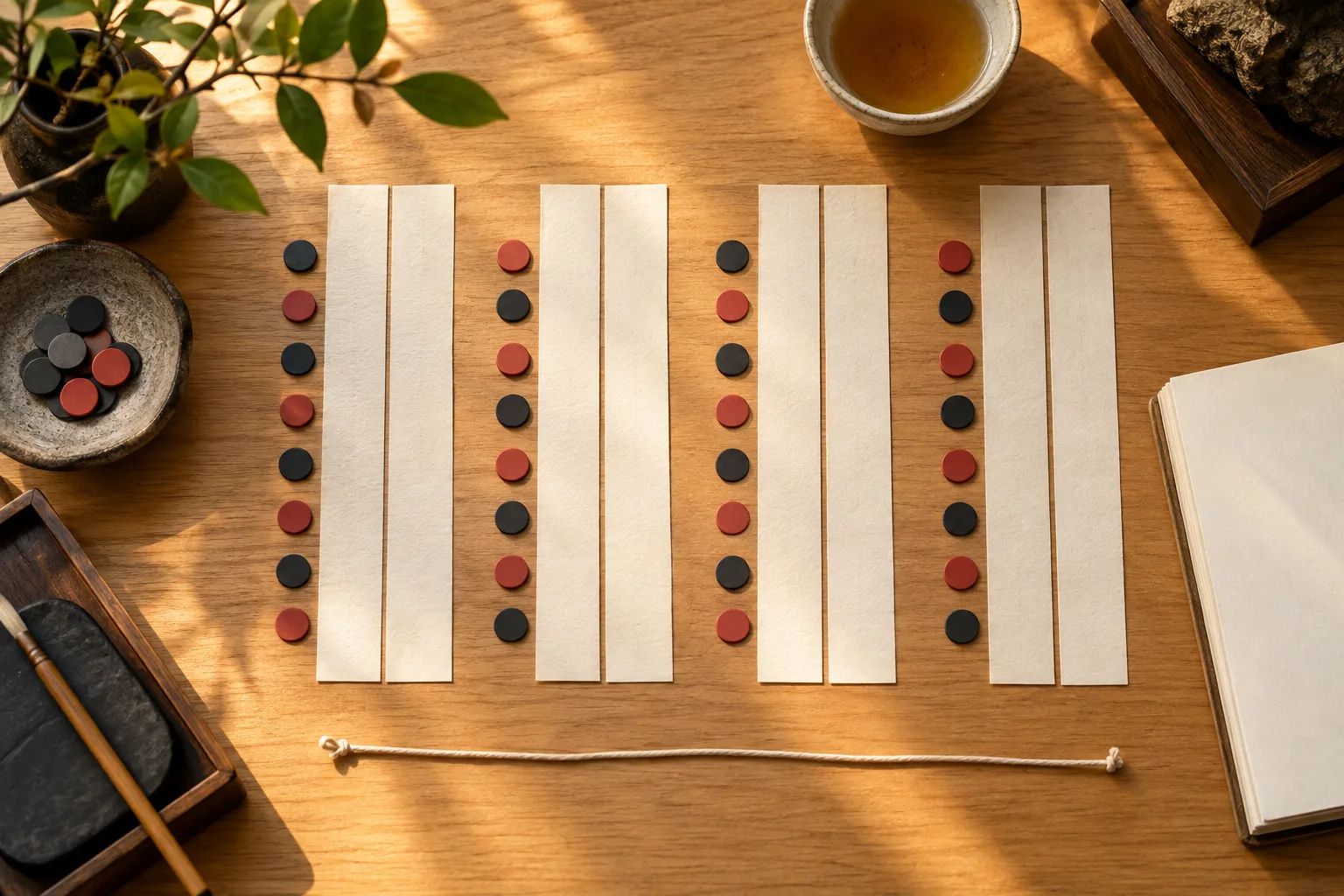
A useful reading convention names the four lüshi couplets opening, development, turn and close. It is a guide, not a compulsory plot. Ask where the scale changes—from landscape to room, public disorder to private body, observation to recollection—and how the last couplet gathers or resists closure. A jueju compresses such movement into two couplets, so an omitted connection or sudden final shift can carry exceptional weight.
Compare text, commentary and translation
Begin with a checked text
Character variants can change sound, grammar or allusion. Use an edition that identifies its source and offers notes; then compare another if a tonal or semantic point bears much weight. Columbia’s selected Du Fu poems provide credited translations and an accessible eight-line example. Its separate “Spring Gaze” learning page helps readers compare characters, pronunciation guides, glosses and a literary rendering.
Translation chooses what to preserve
No translation can simultaneously reproduce character count, historical tone pattern, rhyme, syntax, allusion and semantic range without compromise. One version may clarify grammar; another may preserve couplet balance; another may seek an answering rhythm. Compare them as arguments about the poem, then return to the source text. The site’s guide to key poets and further reading offers routes into annotated editions, while Taoist landscape poetry shows how spatial relations can carry philosophical questions without turning every mountain image into a code.
A six-pass reading method
- Count. Mark the lines, characters per line and couplet boundaries; identify a likely lüshi, jueju or related form.
- Sound. Circle the line-end characters and consult an annotated rhyme source; do not rely only on modern Mandarin.
- Pair. Align corresponding words in each couplet and note grammatical, spatial, temporal and semantic relations.
- Move. Summarize what each couplet does, then identify changes of scale, speaker, time or emotional pressure.
- Compare. Place two translations beside the Chinese and name what each preserves or sacrifices.
- Return. Read the whole poem aloud in a pronunciation you know, treating the pattern as a support for attention rather than a substitute for it.
Regulated verse rewards repeated looking. Technical knowledge sharpens that looking, but it is not the destination. The aim is to hear how constraint and choice work together—and how a poem’s images, history and voice exceed any diagram. For another way literature becomes disciplined attention, continue to poetry as cultivation.
Research note: This guide draws on Columbia University’s Introduction to Tang Poetry; San Duanmu’s corpus study of regulated verse; Zhang Longxi’s study of parallelism and antithesis; and the bilingual Chinese cultural terminology entry on poetry and regulated verse. The formal summaries are deliberately descriptive; individual poems should be checked against reliable editions and commentaries.