The Book of Songs: Voices, Performance and Interpretation
《诗经》:声音、礼乐与阐释
The Shijing (诗经), often called the Book of Songs or Classic of Poetry, brings together 305 transmitted poems from different places, occasions and periods of early China. Court hymns stand beside marriage songs, complaints, blessings, agricultural scenes and voices of separation. The collection matters not because every piece expresses one philosophy, but because later readers made this diverse repertory a shared language for education, ritual, politics and poetry.
This guide explains the received collection, the limits of its origin stories and the work done by performance, transmission and commentary. For the wider development of early Chinese verse, begin with Origins of Chinese Poetry.
A collection of 305 poems
The received text contains 305 poems with words. Six additional titles survive without a text and are traditionally called “silent” pieces. The poems were not written at one moment or by one known author. They preserve layers formed across centuries, mainly within the Zhou world of the early first millennium BCE, before being gathered into the arrangement known to later readers.
Dating individual poems is difficult. Language, ritual setting, named events and comparison with inscriptions can suggest relative periods, but they rarely provide a secure year. It is safer to treat the anthology as a long historical formation than as a snapshot of one dynasty or community.
The four divisions
The collection has four textual divisions: 160 Airs of the States (Guofeng), 74 Minor Odes (Xiaoya), 31 Major Odes (Daya) and 40 Eulogies (Song). “Airs, Odes and Eulogies” is therefore a useful three-part summary, but the received book itself separates the Odes into two sections.
These labels point toward differences of repertory, performance and political setting, yet they do not work like modern shelves marked “folk,” “court” and “religion.” A poem’s place in the anthology is evidence about how editors classified it, not a complete record of who first composed or performed it.
Many voices, not a simple folk archive
The Airs include short poems associated with named regions. Their speakers court, wait, quarrel, labour, travel and remember. Because the language can feel immediate, they have often been described as folk songs collected directly from ordinary people. That possibility cannot be ruled out, but repetition, anonymity and regional labels do not by themselves prove a single social origin.
Performance, selection and editing may have moved a song between village, household and court. A first-person woman in a poem is also a poetic voice, not automatically a recoverable historical individual. The collection preserves social experience while leaving the route from experience to text partly hidden.
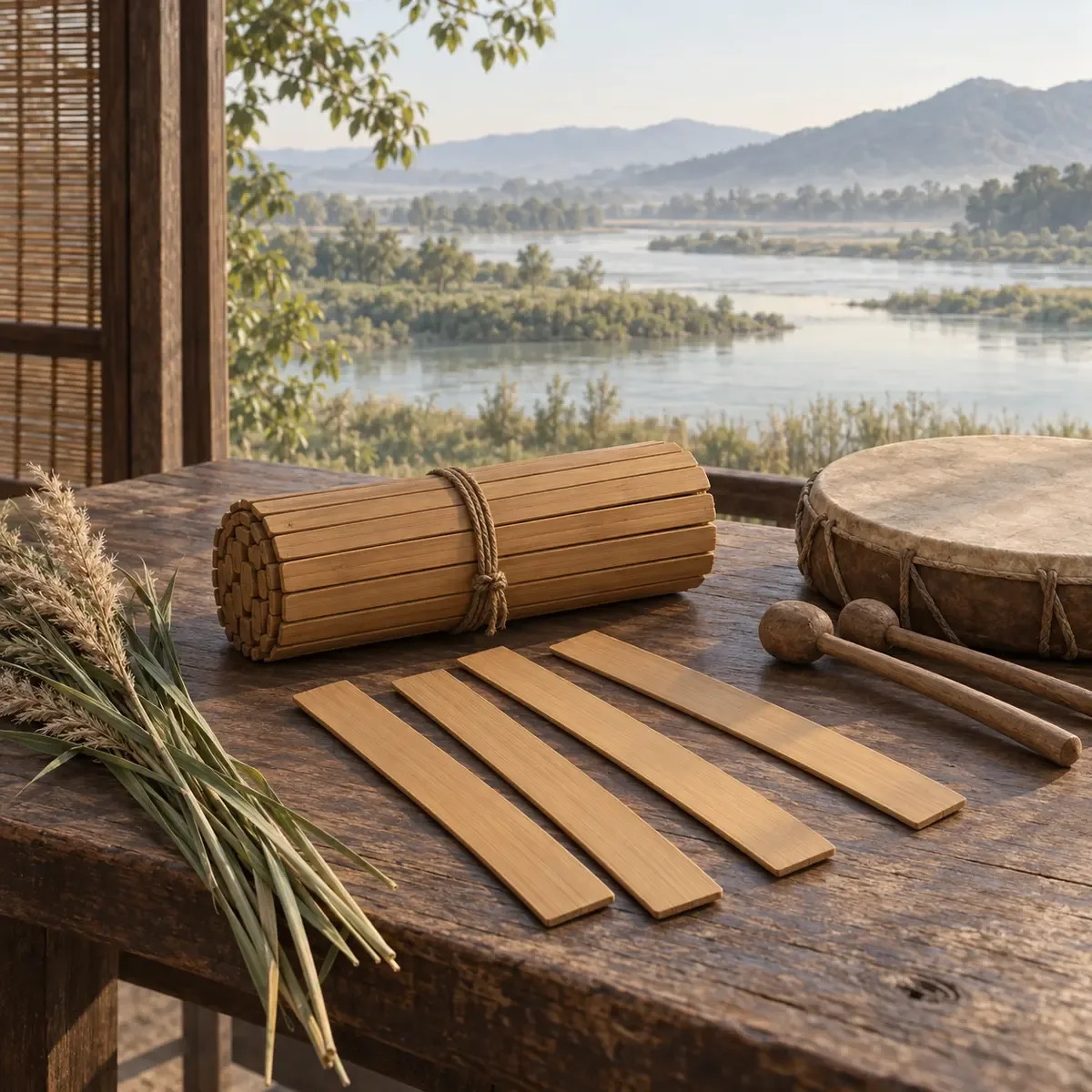
AI-generated editorial illustration; an imagined scene, not a historical photograph or an identified portrait.
Poetry heard as well as read
These works belonged to a culture of singing, chanting, instruments and patterned movement. The words now printed on a page are only one surviving part of performances whose melodies and gestures are largely lost. Refrains, parallel lines and recurring formulas make sense in that audible setting: they support memory, pacing and variation.
The Odes and Eulogies also remind us that early poetry could act within ceremonies. Praise, petition, remembrance and the ordering of participants were not merely subjects; words and music helped an occasion take form. Reading aloud cannot restore an ancient melody, but it can reveal structures that silent reading hides.
Confucius and the story of selection
A famous later account says that Confucius reduced several thousand songs to 305. That story should not be repeated as established history. Its detailed form appears in sources later than Confucius, while earlier evidence shows a body of “Poems” already circulating and being cited. The collection probably took shape through a longer process rather than one editorial act.
Confucius nevertheless became central to the book’s reception. The Analects presents the Poems as material for learning, speech, observation and social conduct. Later educational and canonical institutions amplified that connection. Distinguishing compilation from reception lets us respect the Confucian history of the text without turning a traditional attribution into a verified event.
Manuscripts and the received text
The complete anthology survives through a transmitted tradition shaped during and after the Han. Excavated and newly published manuscripts now show that individual poems and smaller groups circulated in writing before the imperial canon was fixed. A manuscript acquired by Anhui University, dated to around 300 BCE, contains versions of 57 poems also found in the received collection.
Such witnesses are valuable precisely because they are neither identical to the later book nor wholly different from it. Variant wording, order and written forms help scholars study how songs moved between memory, manuscript and commentary. One manuscript cannot prove the exact shape of an earlier complete anthology.
The Mao tradition and its prefaces
Several interpretive schools were recognised in the Han. The text most widely transmitted today belongs to the Mao tradition. Short prefaces assign many poems a moral or political occasion, while the longer Great Preface develops an account of poetry, emotion, order and criticism.
These explanations are historically important, but they are interpretations rather than transparent records of original composition. A courtship poem may be read in one period as intimate speech and in another as praise or remonstrance. The task is not to discard the prefaces or obey them automatically. It is to ask what each interpretive layer makes visible, and what it redirects.
Wind, exposition, comparison and evocation
Later discussions often organise the “six principles” as three sections or functions—feng, ya and song—and three modes—fu, bi and xing. Fu can suggest presentation or exposition; bi, comparison; and xing, the raising of an image that sets another movement of thought in motion.
These are durable reading tools, not mechanical labels. An opening with birds, reeds or fruit may establish rhythm, season, relation or analogy without reducing to one coded meaning. The productive question is how the opening changes what can be heard in the lines that follow.
Repetition, variation and rhyme
Many poems develop through repeated stanzas in which only a few words change. The change may advance an action, intensify feeling, alter distance or simply prolong a performable pattern. Translation can make the repetition look redundant; read aloud, it becomes architecture.
Much original rhyme is no longer audible in modern Mandarin because pronunciation has changed. Historical reconstruction can reveal older sound relationships, but it remains a scholarly model rather than a recording of one uniform ancient voice. Rhythm, parallel syntax and stanza design still offer direct ways into the poems.
How to read one poem
Begin with the poem before its later story. Mark the speaker, addressee, repeated words, changes between stanzas and sequence of images. Read it aloud. Then compare a literal gloss with one or more translations, noting where grammar permits alternatives. Only after that should you add the Mao preface and later commentary.
This order keeps uncertainty useful. It allows a song to remain a song while showing how it became a classic. It also prevents two opposite mistakes: imagining an untouched folk voice behind every line, or treating centuries of commentary as if they were the poem’s original setting.
A classic made by continued use
The Shijing endured through copying, teaching, quotation, ritual and disagreement. Its language furnished later poetry with images and phrases; its commentaries shaped political and ethical reading; its sound patterns continue to challenge translators and historical linguists.
Its diversity is the point. No single formula contains the collection. Readers meet regional airs, court repertories, ancestral praise and editorial interpretation in the same book. The broader Chinese Poetry and Literature guide places this early anthology within the longer tradition.