Poetry as Cultivation at Wudang: Reading, Attention and Writing
武当诗文与自我涵养:阅读、观察与写作
A mountain can be encountered through paths and buildings, but also through words: a place-name, a poem, a commemorative inscription or a record of a visit. At Wudang, reading these different kinds of writing opens another way into the relationship between landscape, religious life and cultural memory.
Here, poetry as cultivation means giving time to language and attention. This guide distinguishes historical religious uses of verse from a contemporary writing exercise that any reader may try. Neither literary skill nor a moving poem is proof of spiritual attainment.
1. Several kinds of writing, several questions
Begin by identifying the object in front of you. A poem may arrange a moment of perception; a stele may commemorate a building campaign; a gazetteer may organise accounts of places, people and institutions. They can illuminate one another without becoming interchangeable.
Ask who composed the words, who commissioned or preserved them, and whom they addressed. The person named as author need not be the calligrapher, engraver or later editor. Keeping these roles separate makes an inscription more interesting, not less.
2. The Ming mountain and its written record
Wudang’s architectural complex took organised form under the Ming, with major imperial patronage. That setting matters when reading praise, commemorations and official language: the mountain was both a religious place and a subject of political representation.
Ren Ziyuan’s fifteen-fascicle Dayue Taihe shan zhi, presented in 1431, offers a concrete point of entry. Its contents include imperial edicts, accounts of the mountain and poetry. Read it as a compiled historical witness, asking how selection and arrangement make a particular image of Wudang.
3. Read an inscription in its setting
Before interpreting a few visible characters, record the whole object where access and photography are permitted. Note the location, arrangement, date or signature if legible, and whether you are looking at an original surface, a restoration, a rubbing or a modern reproduction.
A worn character should remain uncertain until checked. Do not silently complete it from memory or a familiar quotation. An official dedication can have documentary, religious and literary purposes at once; its public function is not a reason to dismiss its craftsmanship.
4. Couplets invite comparison
For a pair of inscribed lines, first compare meaning and sentence movement. Which words answer one another? Does one line open a view while the other turns towards conduct, time or a sacred presence? Sound and formal conventions can then be studied with an appropriate annotated reading.
Do not assume that every pair follows an identical tonal scheme, or judge older pronunciation solely by present-day Mandarin. A translation can make the relation between the lines visible without pretending to reproduce every feature of the Chinese.
5. Daoist verse is not one uniform practice
Verse may be encountered in instruction, religious praise and literary reflection. A text’s role must be established from its edition and setting rather than inferred from rhyme alone. Reading silently today is not automatically a reconstruction of the way a community used it.
A useful distinction is between what a passage says, how a commentary explains it and how a particular community performs or teaches it. These are related forms of evidence, not three names for the same thing. Respecting a tradition includes being clear about which of them you have actually encountered.
6. A specific example: Zhang Boduan’s Wuzhen pian
The eleventh-century Wuzhen pian, often translated as Awakening to Reality, presents internal-alchemical teaching in poetic forms. Its opening group comprises sixteen regulated poems. This is a specific Song-period text with a commentary history, not evidence of a single timeless Wudang curriculum.
Its concentrated imagery needs context. Read a poem beside its notes and compare how an editor explains an allusion or technical term. The vocabulary of an elixir should not be turned into a recipe, a bodily instruction or a claim of health benefit simply because it appears in verse.
7. Zhang Sanfeng: respect and textual provenance
Zhang Sanfeng is a Ming-dynasty figure of enduring importance to Wudang. The History of Ming records his connection with the mountain and imperial interest in him. His place in Wudang’s cultural memory deserves respectful treatment.
The history of an individual poem requires another question: in which collection and edition does it appear? A Qing collection compiled by Li Xiyue gathers writings under Zhang Sanfeng’s name. A later collection is evidence of transmission and reception; it does not by itself establish the composition date of every item. Discuss each attribution precisely without diminishing the figure.
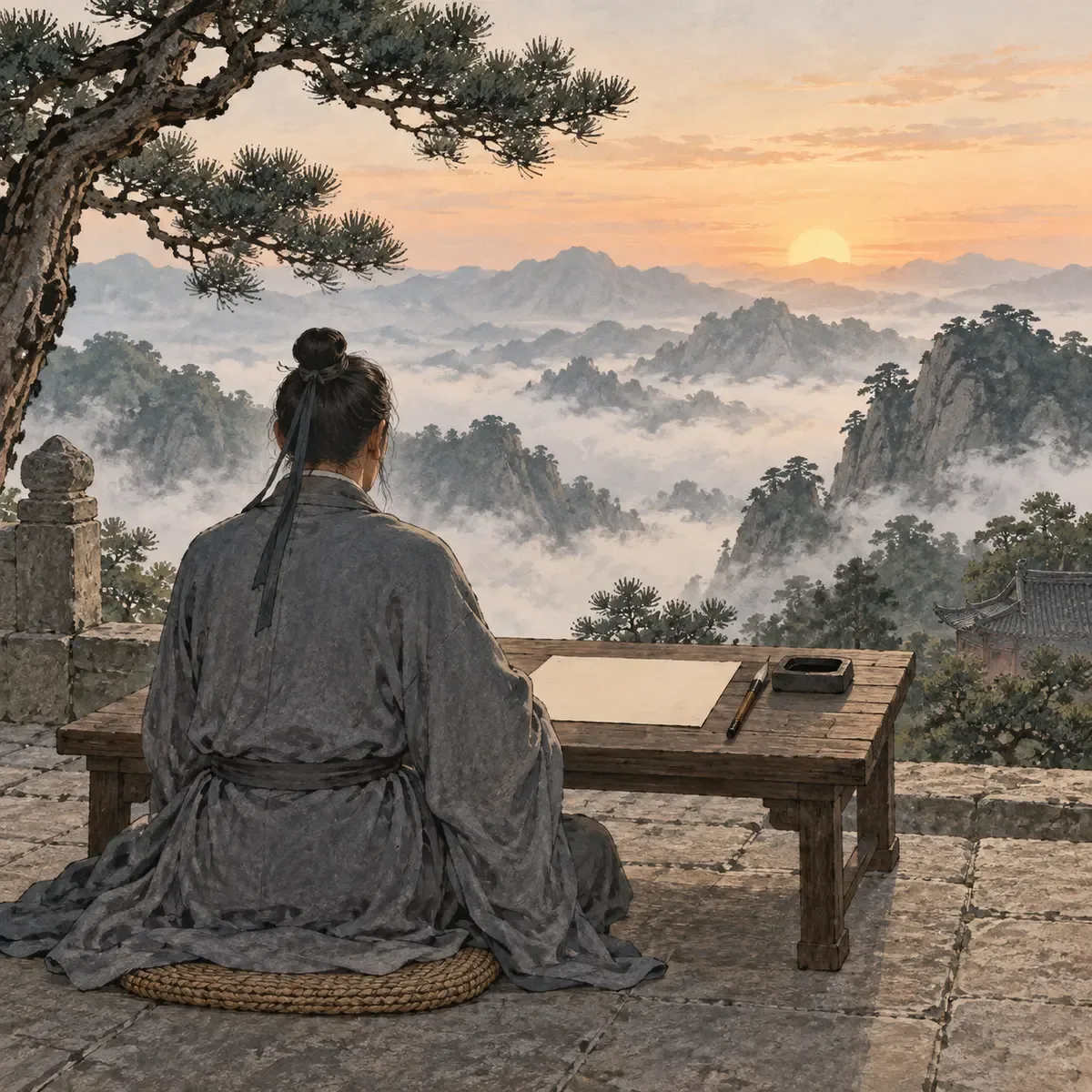
AI-generated editorial illustration of looking before writing; an imagined scene, not a historical portrait or a reconstruction of a Wudang site.
8. Let observation precede the poem
For a contemporary exercise, choose an ordinary place where you may pause without obstructing others. You need neither a mountain journey nor a brush. Note three concrete details: a changing sound, the edge of a shadow, or the movement of a person or leaf.
Make a second note for associations and memories. Keeping observation separate from association does not ban imagination; it shows where imagination begins. This exercise is offered here as a modern reader practice, not as an authenticated ancient Wudang method.
9. Draft briefly, then revise honestly
Write four short lines from those notes. Choose one point of view and leave out what does not serve it. Four lines are only a manageable length for this exercise; they do not automatically make the result a classical jueju.
Read the draft aloud if convenient. Replace a general word with a precise one, remove an adjective that does no work, and check whether the final line adds something rather than explaining everything. Keep the first draft so you can see what revision changed.
10. Cultivation includes how you treat others
Treat the exercise as an invitation, not a test of wisdom. You may keep the poem private, write in your strongest language or stop after a few notes. A beautiful line does not certify the writer’s character, and another person’s hesitation is not evidence of poor attention.
If you share a piece, separate your own words from quotations and name any translator whose wording you use. Ask before turning another person’s story or photograph into public material. Careful attribution and considerate conduct matter alongside literary ambition.
11. Continue between reading and writing
Return to one historical text after the exercise. What did its author select, repeat or leave unresolved? Notice how your own difficulty in choosing a word changes the questions you ask of an older poem, without making your experience a substitute for historical evidence.
Continue with Daoist traditions and landscape poetry, or return to Chinese Poetry and Literature for forms and reading paths. The aim is not to possess a mountain in a few lines, but to meet both place and language with greater care.