Chinese Thread-Bound Books: Folding, Stitching and the Shape of Reading
中国线装书:折页、装订与阅读形态
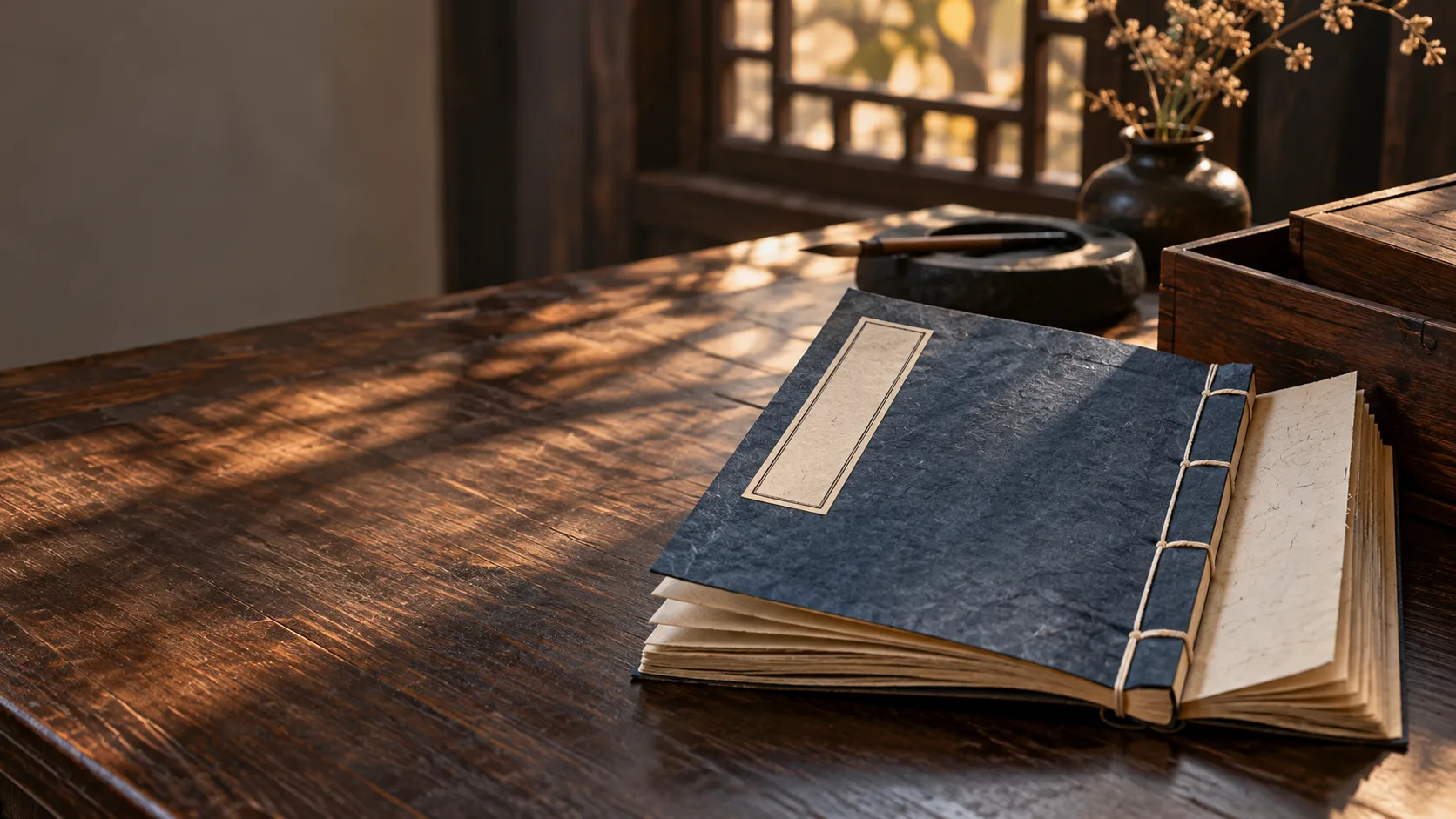
A Chinese thread-bound book is easy to recognise: soft paper covers, a narrow title slip and thread running through holes beside the spine. Yet this familiar form is not the beginning of the Chinese book, nor was it the only form in use. Scrolls, folded concertina books, butterfly bindings and wrapped-back bindings all belong to a longer history in which paper, printing, labour and reading continually reshaped one another. This guide treats the book as a made object. It asks how a leaf was folded, where ink sits, what the binding permits, and what later repair may conceal.
Before the thread-bound book
From continuous roll to folded sequence
Early Chinese texts existed on several supports, including bamboo or wooden slips, silk and paper. Once paper became a principal writing surface, the scroll offered a continuous field that could be opened section by section. Buddhist manuscripts and printed texts also used concertina, or accordion, formats: a continuous sheet was folded back and forth, allowing a reader to move between compact object and extended surface.
Princeton University Library’s exhibition The East Asian Tradition follows this movement from slips to paper scrolls, while From Bamboo to Printed Paper compares several later structures. These are families of form, not a single straight evolutionary ladder. Old formats could continue beside new ones because different texts, institutions and readers required different things.
Butterfly binding and the printed leaf
In butterfly binding (hudie zhuang, 蝴蝶装), a sheet printed on one side is folded with the printed surfaces facing inward. The folds gather at the spine and the leaves are pasted together there. When opened, the two printed halves spread like wings; between openings, blank versos can appear. The format made individual folded sheets into a compact codex-like object suited to page-by-page consultation.
Surviving objects caution against tidy dates. The International Dunhuang Programme catalogues a tenth-century manuscript booklet of the Diamond Sutra in butterfly binding. A structure can therefore appear in manuscript practice as well as in the history of printing, and an old book may have been rebound after its first making.
Wrapped-back binding reverses the fold
Wrapped-back binding (baobei zhuang, 包背装) turns the printed side outward. The folded edge becomes the fore edge, while the open ends are gathered at the spine, usually secured internally and enclosed by a cover that wraps around the back. This protects the printed faces from meeting each other and produces a different rhythm of opening.
The British Library catalogue records surviving volumes of the Yongle Dadian in Chinese wrapped-back binding. Such catalogue descriptions are especially useful because they distinguish the text’s date, its present structure and its materials. Those three histories do not always coincide.
Why thread binding became familiar
A binding associated with the Ming book market
Thread binding (xian zhuang, 线装) became widely used in China during the Ming period, especially as commercial printing expanded. Yasushi Oki’s study, “Spread of the Stitched Book Binding and its Background in China”, connects the shift from pasted butterfly bindings toward wrapped-back and stitched structures with the flourishing late-Ming book market. The University of Hong Kong’s summary of Oki’s research likewise stresses that thread binding did not need the long drying time of pasted leaves and could move into circulation quickly.
This does not mean every Ming book was thread-bound or that the form sprang into existence fully finished. Binding histories overlap. A publisher could reuse older blocks; an owner could rebind worn volumes; a library could preserve a text in a structure later than its printing.
How a folded leaf works
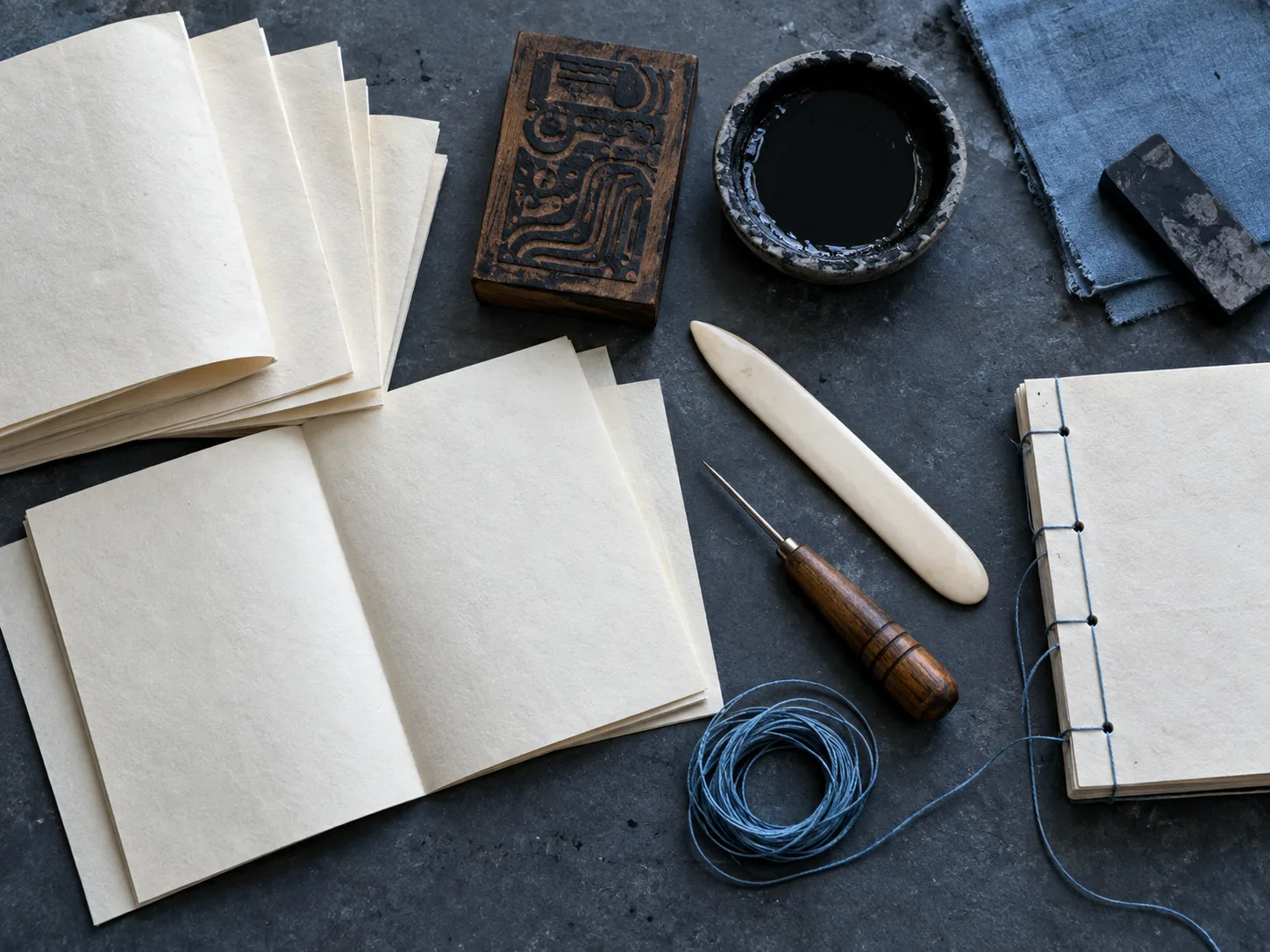
A traditional thread-bound leaf is normally printed or written on one side, then folded so that the blank side lies inside. The folded edge faces outward; the two open edges meet at the spine. Paper twists may first stabilise the stack. Holes are then made through the text block near the spine and soft thread secures covers and leaves together. Four-hole sewing is common, but it is not a universal rule: size, place, date, maker and repair history all matter.
The fold protects the unprinted side and gives each thin sheet the handling weight of a double leaf. It also means Western terms such as “recto,” “verso” and “page” can obscure as much as they clarify unless a catalogue states exactly how it counts leaves and openings.
Cover, title slip and protective case
Soft paper covers make the volume flexible rather than rigid. A title slip can identify a work or fascicle, while printed headings, page centres and colophons provide other bibliographic clues. Several fascicles may be grouped in a fitted folding case. The case is not merely decoration: it keeps flexible volumes together and protects exposed paper edges.
The Library of Congress describes one Qing manuscript as a six-volume thread-bound edition, while another catalogue record for a late-Ming print notes sixteen volumes in four cases. These concrete descriptions show why “a book” may mean one physical fascicle, a set of fascicles or the work represented by the whole set.
How form shapes reading
Page centre, fold and printed frame
Woodblock printing often organises a leaf around a central fold, sometimes marked by a column carrying the title, fascicle or leaf number. Borders, columns and the central “fish-tail” device can help a reader and binder keep the sequence. Because the fold becomes the outer edge in a thread-bound volume, information at the centre of the printing block remains visible at the fold rather than disappearing into the spine.
This material logic connects with the site’s guides to Chinese calligraphy paper and ink rubbings: paper is never a neutral carrier. Fibre, sizing, absorption, pressure and folding affect what can be printed, read and preserved.
Reading one fascicle inside a larger work
A reader may hold a light, flexible fascicle rather than an entire large work at once. Dividing a text into fascicles distributes weight, allows damaged parts to be replaced or rebound separately, and lets a long work occupy several cases. It can also complicate modern digitisation: a screen sequence may make separate fascicles look like one continuous modern volume.
For literary history, binding sits beside selection and arrangement. The guide to Chinese poetry anthologies explains how editors shape a canon; binding and fasciculation shape the units in which that selection is stored and encountered.
Marks left by readers and collectors
Seals, annotations, replacement covers, inserted slips and repaired thread can record a book’s later life. A collector’s seal is evidence of an impression, not automatically proof that the named person owned the volume; the seal itself may need authentication. A neat modern title slip does not prove an old binding, and fresh thread can coexist with much older paper.
Compare the site’s guide to Chinese seals and seal carving and its account of Wudang gazetteers. Text, object and provenance answer different questions. A gazetteer can transmit historical claims, while the binding tells us about one surviving copy’s manufacture and use.
A six-step method for looking at a bound book
Describe before dating
When a library, museum or digitised collection permits close study, proceed from visible structure to cautious inference:
- Read the catalogue first. Record institution, shelfmark, title, stated date, material and current binding.
- Identify the unit. Decide whether you are viewing one leaf, one fascicle, one volume or a multi-case set.
- Trace the fold. Locate folded and cut edges, printed and blank surfaces, and the relation between the page centre and spine.
- Separate layers. Distinguish paper, printing, cover, title slip, thread, case, repairs and later owners’ marks.
- Compare openings. Check title page, first and last leaves, colophon and damaged areas rather than relying on one attractive image.
- State uncertainty. Say “presently thread-bound” when the original structure is not demonstrated, and cite the catalogue or conservation report.
Do not turn an old book into a craft prop
Rare books are vulnerable to light, pressure, skin oils, abrasion and forced opening. Follow the holding institution’s rules; use supports and clean, dry hands when instructed; never flatten a flexible volume, pull thread, lift a pasted label or test whether a leaf can separate. A modern practice model is the right place to learn stitching. An original volume is evidence, not a template to dismantle.
The Library of Congress interview “Working with the Three-Dimensional and Functional Book” shows why treatment decisions depend on paper, thread, structure and the history of each object. Conservation is not cosmetic renewal.
Keep text history and object history together
A colophon may preserve the date of an edition whose sheets were later rebound. A repaired copy may retain early printing but little of its first cover. Conversely, a traditional-looking binding may enclose a modern facsimile. Responsible description therefore avoids dating a whole object from one feature.
Begin with the broader Chinese poetry and literature pathway, then compare calligraphy, paper, printing, anthologies and surviving copies. The most useful question is not “Is this the authentic Chinese binding?” but “Which layer of this particular book am I seeing, and what evidence supports that conclusion?”