Poetry on Chinese Paintings: How to Read Inscriptions and Colophons
中国画上的诗:怎样读题款与题跋
A Chinese painting may ask to be read as well as seen. Beside a mountain, orchid or solitary boat, written lines can name an occasion, dedicate the work, echo an older poem or answer the image in a new voice. Yet not every word belongs to the painter, and not every inscription was added when the image was made. The first discipline of looking is therefore simple: separate the object’s layers before interpreting their conversation.
This guide approaches poetry on painting through material evidence. It complements Wudang.Org’s introductions to Chinese poetry, Chinese calligraphy and the Chinese handscroll. The aim is not to decode every difficult character at sight, but to build a reliable sequence of questions.
One object, several kinds of writing
English often calls almost any writing on a painting an “inscription.” Chinese catalogues use more precise terms, but actual objects resist a single neat formula. A title may precede an image; the artist’s own words may sit within the picture field; a friend may add a poem; collectors or later viewers may attach comments on separate paper. Placement, hand, seals, date and mounting all matter.
The artist’s inscription
An artist’s inscription may record a date, place, dedicatee or circumstance of making. It can also contain a poem or a short reflection. Because it shares the painted surface, viewers often treat it as part of the first design—but authorship and date still require checking against a catalogue, an accepted transcription and the physical evidence.
A poem by another hand
Painter, poet and calligrapher need not be the same person. A collaborator may write on the painting soon after it was made, or a poem may be added much later. The Met’s record for Tiger Hill, for example, identifies Lu Zhi’s sixteenth-century painting but a long colophon transcribed by Xu Weiren, who lived centuries afterward. That distance is not a defect; it is part of the scroll’s history.
Later colophons and viewing histories
A colophon is often commentary written on an additional sheet attached before or after the image. It may discuss attribution, quality, biography, ownership or earlier responses. On a handscroll, successive colophons can turn one painting into an archive of encounters. Collector seals can add further evidence, but a seal is a trace of claimed contact or ownership—not automatic proof that every attribution is correct. See the separate guide to Chinese seals and seal carving.
What “the three perfections” can—and cannot—mean
Poetry, calligraphy and painting are often grouped as the “three perfections” (诗书画三绝). The phrase is useful when it directs attention to three activities meeting on one object: poetic language, the visual force of handwriting and pictorial marks. It becomes misleading when it is treated as a rule that all three must share one creator, moment or message.
Poem and image may converge
A poem may name the same site or season as the image, make audible what the painting leaves silent, or place a modest scene within literary memory. In such cases, relation is built through selection rather than illustration: a few words can alter how mist, distance or an empty pavilion is perceived.
Poem and image may also diverge
Some texts respond to an older work, quote a poem from another period or argue about attribution. The Met’s Stag Hunt preserves a group of later colophons whose writers interpret the hunting subject morally and debate its authorship. Their words disclose reception, not necessarily the painter’s original intention.
Calligraphy is not transparent packaging
Writing has size, pace, pressure, spacing and rhythm. A brisk running hand and a measured regular hand can frame the same poem differently, but style should not be turned into a personality test. Begin with visible features and a secure identification of the script; the Wudang.Org guide to the five script styles provides a useful foundation.
Read the format before translating the poem
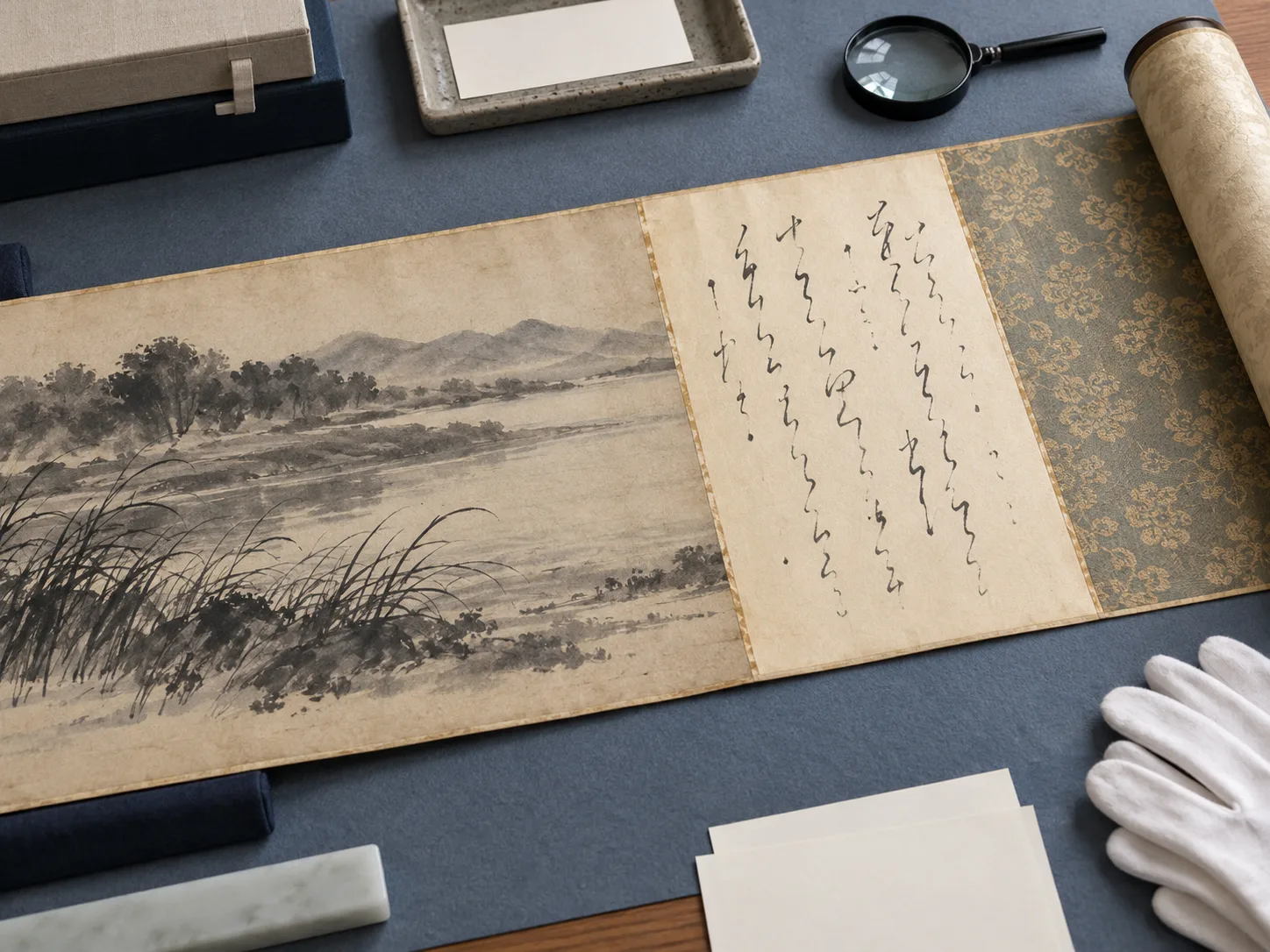
Format controls encounter. A handscroll is unrolled from right to left in sections; a hanging scroll is viewed vertically and displayed for a limited time; an album turns through separate leaves. Written matter may occupy the picture field, a frontispiece, a separate colophon sheet or the mounting. The guide to mounting Chinese painting explains why joins and borders are evidence rather than neutral decoration.
Map the physical zones
Before reading, mark where image, inscription, signature, seals, colophons and mounting begin and end. A different paper tone or a seam may indicate a later addition, but only conservation study can date materials securely. Online images often crop away precisely the evidence needed for this step.
Establish who wrote what
Use a museum record or scholarly catalogue to distinguish painter, calligrapher, colophon writer and former owner. Do not infer authorship from proximity alone. Names may appear through signatures, seals, headings or later annotations, and traditional attributions can change as research advances.
Compare words and marks without forcing equivalence
After a dependable transcription and translation, ask what the poem adds: place, season, sound, memory, dedication or judgment. Then return to the image and handwriting. Look for a relation that the object supports, not a symbolic code in which every brushstroke must correspond to a word. The same discipline applies when studying ink and brush in Chinese painting.
A six-step method for a museum page or gallery visit
This sequence keeps material facts ahead of interpretation and works even when you cannot read all the characters.
- Name the format. Is it a handscroll, hanging scroll, album leaf, fan or another object type?
- Map the layers. Locate image, written panels, seams, silk borders, seals and later mountings.
- Check the record. Note the credited painter, calligrapher, colophon writers, date, medium and attribution language.
- Separate transcription from translation. Confirm what the text says before interpreting why it is there.
- Compare relationships. Test whether text names, extends, contrasts with or historically reframes the image.
- State uncertainty. Distinguish a visible fact, a museum attribution and your own inference.
Two objects that make the layers visible
The Met’s handscroll essay explains how inscriptions and later colophons make a scroll both image and documentary history. Tiger Hill offers a striking chronological separation between painting and colophon, while Stag Hunt shows several later voices interpreting both subject and attribution. Together they warn against flattening a scroll into a single authorial moment—and show why poetry on painting is best read as a structured conversation across materials and time.
Sources consulted: Dawn Delbanco, “Chinese Handscrolls”, The Metropolitan Museum of Art; The Met collection records for Tiger Hill and Stag Hunt. Object dates and attributions follow the cited museum records; interpretations above are intentionally qualified where the evidence does not identify a single author or moment.