Tang Poetry: Forms, Voices and a Lasting Canon
唐诗:体式、声音与经典的形成
Poetry from the Tang dynasty (618–907) occupies an exceptional place in Chinese literary memory. Names such as Wang Wei, Li Bai and Du Fu became reference points for later writers, while anthologies and education carried selected poems far beyond their first occasions. Calling the period a “golden age” describes that long history of admiration; it should not imply that three centuries produced one style or that later poetry merely declined.
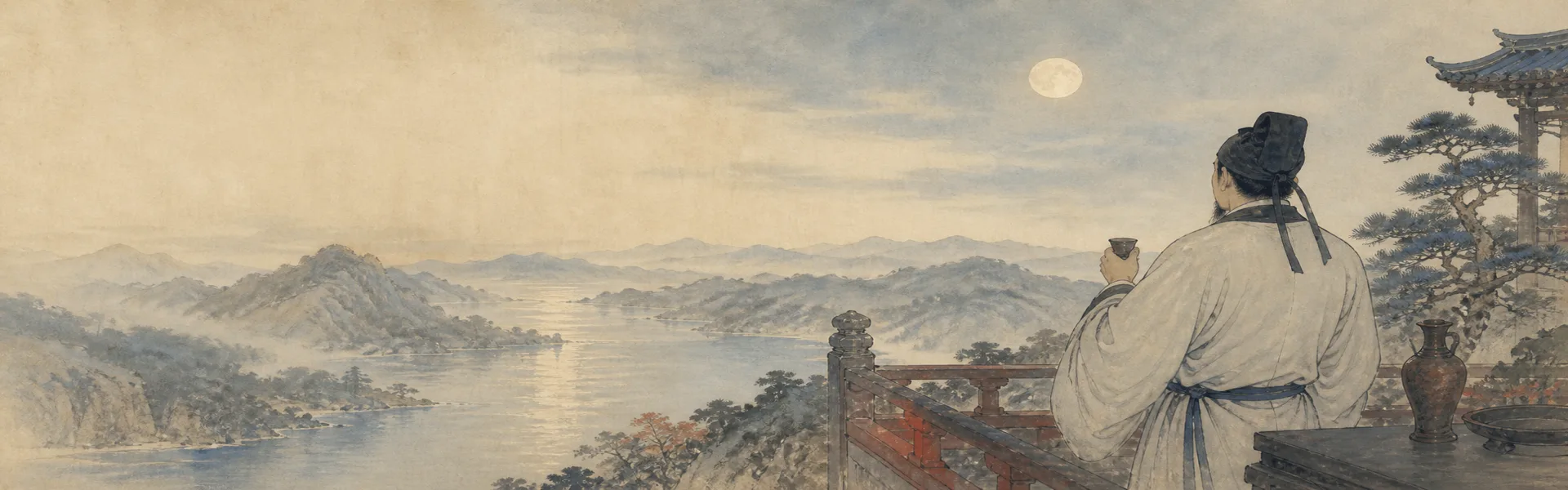
This guide introduces forms, social settings, religious vocabularies and historical change without turning poets into simple character types. For the earlier repertory that Tang writers inherited and quoted, see the Book of Songs.
How a “golden age” was made
Tang poems survived through personal collections, court compilations, manuscript circulation, quotation and later anthologies. What modern readers call “Tang poetry” is therefore both a body of writing and a canon assembled across centuries. Famous poems are real Tang works, but their present prominence also reflects later selection, commentary and schooling.
The label remains useful if treated as a question: what conditions allowed so much varied poetry to be written, exchanged and preserved, and why did later periods return to it? This approach replaces a contest over the “best” dynasty with a history of forms and readers.
Capital, provinces and roads
Chang’an and Luoyang connected government, ritual, entertainment and communities arriving from across Asia. Yet Tang poetry was not confined to capitals. Officials travelled to provincial posts, envoys crossed frontiers, monks moved between monasteries, and families experienced long separations. Roads, rivers, guesthouses and mountain passes became recurring settings because movement structured many writers’ lives.
Cosmopolitan exchange should not be reduced to colourful background. Music, objects, religions and people moved through Tang territories under changing political conditions. A poem may register curiosity, distance, hierarchy or conflict as well as openness. Each work needs its own setting rather than a general claim that the period was uniformly tolerant or worldly.
Poetry as social practice
Verse could mark a farewell, answer a friend, acknowledge a gift, celebrate an appointment or address a patron. A poem was often an action within a relationship, not a private diary entry discovered later. Titles, addressees and occasions help reconstruct that action, although the surviving title may itself have been shaped by an editor.
Literary skill also mattered to official ambition. Poetry formed part of some examination and recruitment practices, but requirements changed, and examination verse alone did not create the art. Education produced writers and readers who shared forms, references and evaluative language; careers, friendships and setbacks then gave those resources different uses.
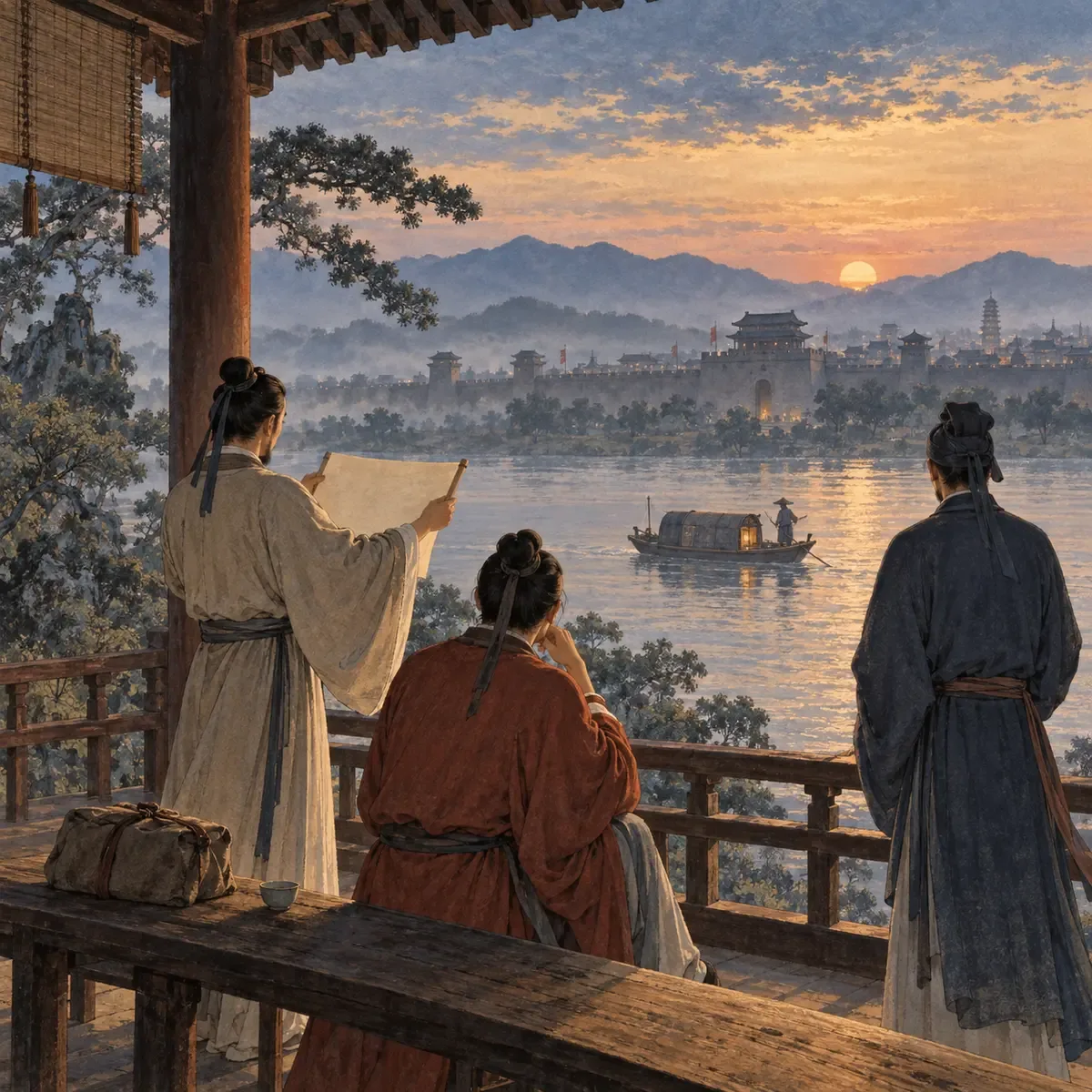
AI-generated editorial illustration; an imagined scene, not a historical photograph or an identified portrait.
Old-style and regulated verse
Tang writers used both old-style verse (gushi) and newer regulated forms (jintishi). Old-style poems allowed greater freedom in length, tonal organisation and rhyme changes. Regulated verse developed patterned relations among level and deflected tones, rhyme and line structure. Five- and seven-character lines were especially prominent, but not every Tang poem followed one template.
A regulated octave (lüshi) normally has eight lines, with parallelism expected in its two middle couplets. The first and last couplets are not governed by a simple ban on parallel construction. A regulated quatrain (jueju) has four lines and achieves concentration through selection and turn, but no single plot formula explains every example. Rules created possibilities for variation as well as constraints.
Period labels are reading tools
Later literary histories commonly divide Tang poetry into early, high, middle and late phases. These labels help readers follow shifts in court style, form, politics and taste, but poets did not live inside neat classroom boxes. Careers overlap the boundaries, regional differences matter, and a style can be revived long after its first appearance.
Early Tang writers refined inherited forms and explored regulated verse; the decades around the reign of Xuanzong later came to represent “High Tang” confidence and range. Mid- and late-Tang poetry developed new arguments about plainness, difficulty, history and allusion. The sequence is not a ladder from immaturity to perfection and decline.
Wang Wei: landscape and attention
Wang Wei (traditionally 699–759) served as an official and was remembered as both poet and painter. His writing can make human presence small within sound, light, water and changing terrain. Apparent quiet is carefully composed: an empty scene may contain an unheard speaker, traces of labour or the pressure of official life beyond the frame.
His documented Buddhist commitments matter, but they do not turn every landscape into a doctrinal illustration. Later readers have also heard Daoist resonances in withdrawal, naturalness and diminished self-assertion. It is better to trace a poem’s exact vocabulary and structure than to assign the whole work to one exclusive philosophy.
Li Bai: movement, persona and Daoist connections
Li Bai (701–762) wrote across court, travel, friendship, landscape and imaginative ascent. His verse can shift scale quickly—from a cup or shadow to a river, moon or heaven—and later reception made spontaneity central to his image. That effect is artistic construction as well as temperament; apparent ease may be the result of highly practised form.
Li Bai had meaningful connections with Daoist people, places and language. Poems of roaming, transcendence and celestial journey belong within that context, but they should not be used as straightforward proof of every biographical legend. The celebrated drinking persona and the tale that he drowned while reaching for the moon are parts of reception with different evidentiary status.
Du Fu: craft, witness and later reputation
Du Fu (712–770) used demanding forms to write about service, family, illness, displacement, friendship and war. His regulated verse demonstrates how parallel structure can hold several scales at once: a room and an empire, private grief and public disorder. Translation often conveys the scene more easily than the dense relations among individual words.
Later readers called him the “Poet-Historian” and placed him at the centre of the canon. Those titles recognise his historical range and influence, but they are judgments made through reception. A poem can be evidence for what conflict felt like without functioning as a neutral chronicle, and a speaker should not automatically be equated with an unfiltered diary voice.
The An Lushan rebellion and historical change
The rebellion that began in 755 and continued under An Lushan’s successors until 763 was a major political and human catastrophe. Capitals fell, people were killed or displaced, government authority weakened and regional military power grew. It altered careers, travel and the language through which poets addressed loss and responsibility.
The huge casualty number often repeated from before-and-after household registers is not a count of deaths. Registration failure, lost territory and displacement contributed to the decline. Avoiding false arithmetic does not minimise suffering; it distinguishes documented disruption from a precision the evidence cannot support. The dynasty continued for more than a century, and literary change after 755 was varied rather than a single mood of decline.
Middle and late Tang: more than a short list
Bai Juyi argued for intelligibility in some poems and used old yuefu models for new social subjects, while other works are intricate narratives or intimate exchanges. Han Yu and Li He pursued different kinds of strangeness; Du Mu compressed historical reflection; Li Shangyin made allusion and uncertain address central to his effects. These names mark contrasts, not a complete ranking.
Women including Xue Tao and Yu Xuanji also participated in Tang literary worlds, although preservation and later anthologies treated writers unevenly. Monks, courtiers, provincial officials and less securely identified authors further complicate the canon. Reading beyond three famous men reveals several overlapping networks rather than one procession of masters.
Buddhist, Daoist and classical vocabularies
Tang poets wrote in a world where Confucian learning, Buddhist institutions and Daoist traditions interacted with local cults, court ritual and personal practice. A poet might use Buddhist emptiness, Daoist transcendence or a classical allusion without offering a systematic statement of belief. The same image could change meaning across works.
For Wudang readers, mountains, reclusion, immortals and roaming are important connections, but they require close reading. A mountain is not automatically Daoist, and withdrawal may be religious, political, aesthetic or temporary. The most respectful approach identifies the textual signal before naming the tradition.
How to read a Tang poem
Start with occasion and form. Who addresses whom? Is the poem old-style, a quatrain or an octave? Mark rhyme, repeated images, parallel lines and the point where direction changes. Then ask what the title and historical setting add, while remembering that editorial titles and biographies may be later constructions.
Compare translations for different purposes: one may preserve syntax, another rhythm, another allusion. None is the poem itself, but each can make a relationship visible. The wider Chinese Poetry and Literature guide offers a route through forms, contexts and responsible comparison.