Daoist Traditions and Landscape Poetry: Place, Reclusion and Interpretation
道家、道教与山水诗:地方、隐逸与解读
Mountains, rivers and recluses occupy a large place in Chinese poetry. They also invite a tempting shortcut: call every quiet landscape “Daoist,” then treat scenery as a direct expression of one philosophy. That shortcut hides more than it reveals.
Landscape poems could arise from travel, office, exile, estate life, friendship, Buddhist practice, Daoist sacred geography or inherited literary convention. Several of these may operate at once. The useful question is not whether a poem belongs inside one label, but what its words, occasion and transmission allow us to say.
“Daoist poetry” is not one genre
The label can refer to at least three things. Some verse was written within Daoist communities for ritual, instruction or revelation. Some secular poetry borrowed images associated with immortals, grotto-heavens or alchemy. Other poems contain no specifically Daoist vocabulary but have been read through ideas such as naturalness, wandering or freedom from fixed distinctions.
These categories overlap, yet they are not interchangeable. An ordained author does not make every line doctrinal; an immortal image need not record a religious practice; and a modern reader’s sense of affinity with the Laozi or Zhuangzi is an interpretation, not proof of the poet’s intention.
Landscape existed before a landscape genre
Earlier Chinese writing already described journeys, hunts, gardens, fields, rivers and mountains. Scenery could establish a ritual setting, praise a court, mark distance from home or shape a speaker’s emotion. There was therefore no single moment when writers first noticed nature.
What changed over the early medieval centuries was the weight that mountains-and-waters could carry within a poem. Travel through a named terrain, close observation and reflection increasingly organized whole works. “Landscape poetry” is best understood as a category that became prominent, not as scenery invented from nothing.
Xie Lingyun and crafted mountains-and-waters
Xie Lingyun, who lived from 385 to 433, became a central figure in later histories of shanshui—mountains-and-waters—poetry. His works make difficult movement through terrain, changing viewpoints, plants, rocks and water part of the poem’s structure. They also draw on classical learning and philosophical reflection.
Later critics did not agree on what made his poetry “natural.” Some admired vivid representation and elaborate craft; others contrasted that craft with the apparent ease they found in Tao Yuanming. The disagreement matters: terms such as ziran, naturalness, changed meaning across periods and should not be turned into a timeless style label.
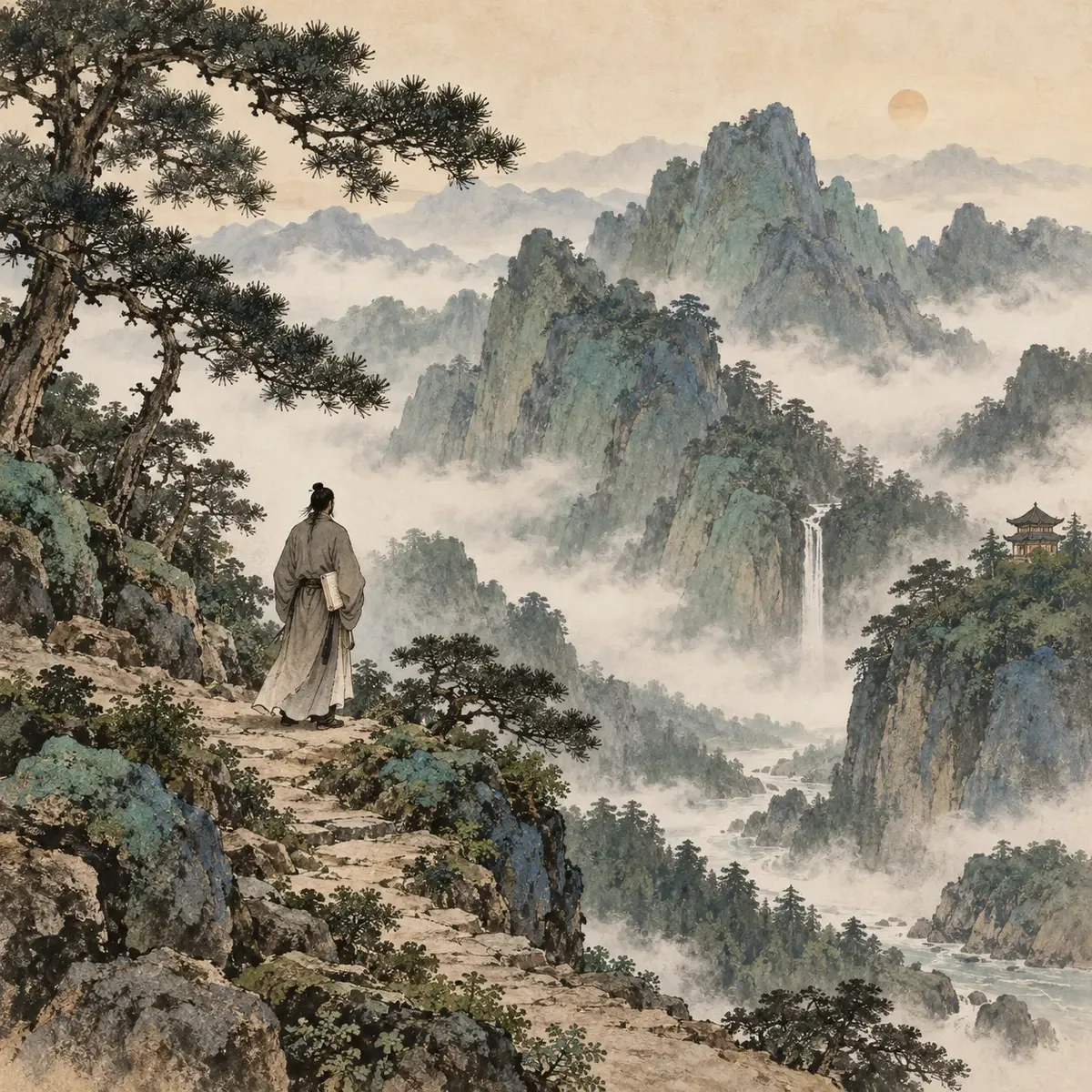
AI-generated editorial illustration; an imagined scene, not a historical photograph or an identified portrait.
Mountains-and-waters and fields-and-gardens
Shanshui poetry and tianyuan, fields-and-gardens poetry, are related but useful distinctions. The first often follows travel through striking terrain. The second brings cultivation, dwelling, neighbours, food, labour and seasonal routine into view. Neither category has perfectly fixed borders.
This distinction prevents every rural scene from becoming a remote wilderness. A garden may be managed, a field worked, a mountain route engineered and a supposedly empty place crossed by workers, pilgrims or officials. Landscape is both perceived form and inhabited world.
Tao Yuanming and the reception of reclusion
Tao Yuanming became the exemplary poet of fields, gardens and withdrawal for many later readers. His writings connect officeholding, return, farming, family, scarcity, wine, friendship and reading. They do not reduce to a single decision to reject society.
His later reputation was also made by editors and critics who valued sincerity, plainness and naturalness in changing ways. Reading reception alongside the poems helps us respect Tao’s choices without turning him into an untouched pastoral ideal. Withdrawal could be ethical, economic, literary and personal at the same time.
Reclusion remained a social language
A recluse was not necessarily unknown or alone. Poems of withdrawal circulated among friends; visitors sought out absent hosts; officials praised men who declined office; writers moved between service and retreat. Reclusion could describe a residence, a stance, a reputation or a temporary interval.
This ambiguity is part of the poetry’s force. A closed gate may signal freedom, disappointment, political caution or a convention shared with the reader. Instead of deciding whether the poet was a “true recluse,” ask who speaks, to whom, under what circumstances and through which inherited scene.
Travel, viewpoint and the work of attention
Landscape poetry often moves. A path turns; height changes; mist conceals a ridge; water opens a new line of sight. Such sequences make perception an event rather than a static picture. They can also record fatigue, danger, weather and the practical limits of travel.
Attention is not automatically a religious doctrine. Precise looking may serve description, memory, courtly display, self-positioning or spiritual reflection. The poem’s form—its order of images, shifts of scale, sounds and pauses—should be examined before assigning a philosophical school.
Wang Wei: Buddhist setting and layered reception
Wang Wei’s Tang poetry is frequently associated with quiet landscapes and apparent absence. He was also an official, estate owner, socially connected writer and serious Buddhist layman. Those settings matter more than the vague claim that silence itself is Daoist.
Later readers, painters and translators helped form the Wang Wei familiar today. A spare scene can hold sensory detail, social occasion and Buddhist resonance without yielding one hidden message. Read what is present, note what the poem leaves unsaid, and keep later aesthetic admiration distinct from historical evidence.
Hanshan: a voice, a place and a layered corpus
“Hanshan,” or Cold Mountain, can name a poetic speaker, a legendary recluse and the collection transmitted under that name. Scholars have long disagreed about its dating and unity; internal evidence does not require every poem to come from one author at one moment.
The corpus combines colloquial force, mountain imagery, Buddhist teaching, social criticism and other inherited references. Its vivid first-person voice should not be copied directly into a biography. The legends are important reception history, while the poems must still be read as a transmitted and possibly composite collection.
Daoist institutions and sacred geography
Explicitly Daoist poetry belongs to institutional as well as philosophical history. Clergy, patrons and literati wrote around temples, revelations, rituals, scriptures and named sacred places. Mountains could be mapped as grotto-heavens and blessed lands rather than treated merely as beautiful wilderness.
In this setting, names and routes matter. A peak may carry a scripture’s association, a community’s memory or a pilgrimage function. Yet even at a Daoist site, a poem can mix religious meaning with politics, friendship and scenery. Location supplies evidence, not an automatic interpretation of every line.
Immortals and alchemy: read the register
Cranes, clouds, cinnabar, jade chambers, celestial journeys and immortals belonged to a broad literary vocabulary. Sometimes they point toward a specific practice or text. Elsewhere they praise distance, longevity, transformation, elegance or imaginative escape.
Context decides how literally to read them. Look for named figures, technical sequences, ritual settings and links to an author’s community; then compare ordinary poetic usage. Avoid translating every elixir into chemistry or every flight into reported experience, but do not erase religious meaning when the evidence is specific.
How to read a landscape poem
Begin with the poem rather than the label. Mark the speaker, addressee, place names, movement, season, human work and shifts in viewpoint. Notice form, parallelism, allusion and the difference between what is seen, remembered and imagined. Then ask what is known about the text’s date, author and transmission.
Only after that should broader traditions enter the reading. Compare Buddhist, Daoist, Confucian, political and literary possibilities without forcing a single winner. Continue with Tang poetry, or return to Chinese Poetry and Literature for forms, contexts and further reading paths.