Chinese Poetry: Poets, Editions and Reading Paths
中国诗词阅读:诗人、版本与入门路径
A reading path is a way into Chinese poetry, not a ranking of its poets. A short lyric, a landscape poem or a passage from an early anthology can each provide a worthwhile beginning. What matters is choosing a manageable text and a source that helps you ask better questions.
This guide brings together a selective poet map, distinctions between kinds of editions and a method for comparing translations. It does not prescribe a single sequence or promise mastery within a fixed time. Readers working in Chinese, English or French can use the same habits of careful comparison.
1. Start with a question
Choose something you genuinely want to notice: how a farewell is staged, how a landscape changes across several lines, or how repetition shapes a speaking voice. Read the poem once before consulting the notes, then return to the details that became less straightforward on a second reading.
Keep enjoyment and historical inquiry together without making either a test of the other. You may respond to a poem before understanding every allusion; that response is an opening, not proof that its original setting or meaning is already clear.
2. Use a selective map, not a league table
For early poetry, begin with a selection from the Book of Songs or the Songs of Chu rather than assuming every text has an individually identifiable author. Tao Yuanming provides one route into pre-Tang poetry. Wang Wei, Li Bai, Du Fu and Bai Juyi offer several Tang entry points; read more than one poem before attaching a single personality to a name.
Su Shi and Lu You can extend a route into Song poetry, while Li Qingzhao offers an important entry into ci, or song lyrics. These are starting points rather than a complete canon. Compare form, occasion and the speaker within each text instead of assigning every poet a fixed emotional or religious identity.
3. Know what kind of book you are opening
An anthology selects across authors or themes; selected works narrow attention to part of one writer’s output. A collected edition may include different genres and material absent from introductory selections. The word ‘complete’ describes an editor’s scope, not a guarantee that everything the author ever wrote has survived.
An annotated edition explains words and references. A critical edition also makes decisions about textual witnesses and variants visible. These functions can overlap. Before choosing, inspect a sample entry: does it supply the original text, identify the source edition and distinguish translation from commentary?
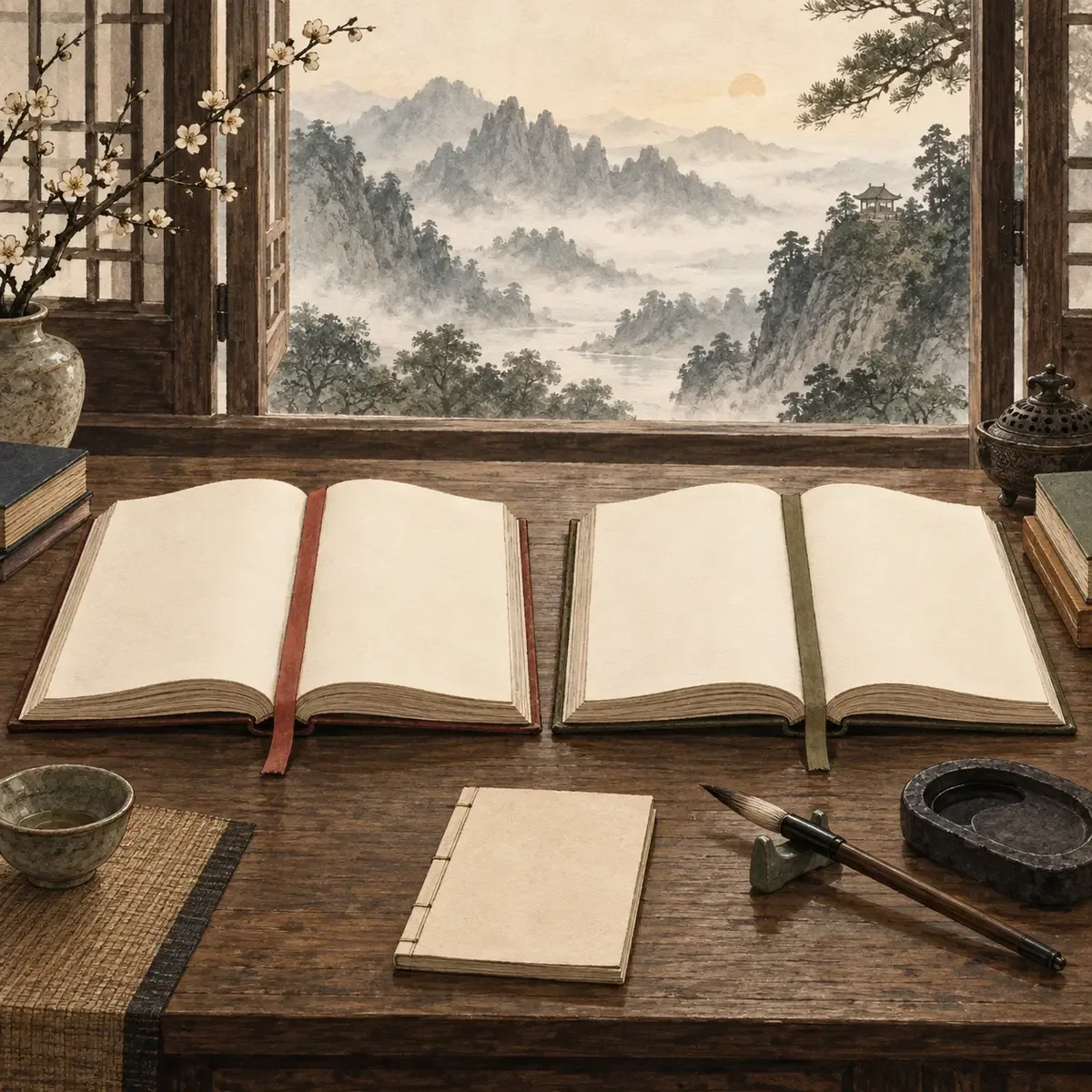
AI-generated illustration of comparing editions; the blank books do not reproduce identifiable publications or historical manuscripts.
4. Compare translations of the same poem
Place two translations beside the same Chinese text. Mark differences in the speaker, tense, punctuation, line division and repeated words. Where one version names an emotion and another leaves an image to carry it, ask whether the wording comes from the poem, a note or the translator’s interpretation.
Do not decide that a rhymed translation must be unreliable or that an unrhymed one must be literal. Read the translator’s stated aims and examine the actual choices. Different base texts can also explain a disagreement; a useful comparison records that possibility before declaring an error.
5. Keep a small source record
For a poem you want to revisit, record its Chinese title or opening line, attributed author, collection, editor or translator, publication details and page or poem number. If you use a scan, add the volume and image or folio reference. A translated title alone may not identify the poem unambiguously.
Separate what the text says from what a later note proposes. A date assigned by an editor, an uncertain attribution and a modern punctuation choice are different kinds of information. A short note such as ‘dating proposed in this edition’ is more useful than silently turning an interpretation into a fact.
6. Widen the map beyond familiar selections
A Tang-and-Song shelf is a selection, not the endpoint of Chinese poetry. Ming and Qing writing deserves reading on its own terms, and women’s writing should not be reduced to one exceptional name. Ask whose work an anthology includes, which genres it favours and where its chronological boundaries fall.
Women Writers of Traditional China: An Anthology of Poetry and Criticism, edited by Kang-i Sun Chang and Haun Saussy and published by Stanford University Press in 1999, offers a focused way to broaden that selection. Read its editorial framing as well as the poems; an anthology gives access while still making choices.
7. Match an English-language guide to your question
Zong-qi Cai’s edited How to Read Chinese Poetry: A Guided Anthology, from Columbia University Press, combines Chinese texts, English translations and guided discussion. It is a useful format when you want to connect a reading to features of the original rather than collect translated favourites alone.
Burton Watson’s edited and translated The Columbia Book of Chinese Poetry: From Early Times to the Thirteenth Century, also from Columbia, offers a historical selection with a clearly bounded period. Its subtitle matters: use another source for later writing. Neither book replaces checking the notes and scope of the particular edition you use.
8. Work between Chinese and French without losing the source
For Chinese reading, look for a clearly identified annotated text, not only a modern paraphrase. Keep the poem and explanatory prose distinct. A dictionary may resolve a word without resolving its role in this line; syntax and the surrounding poem still need attention.
For a French-language approach, François Cheng’s L’Écriture poétique chinoise includes an anthology of Tang poems; the 1977 Seuil edition is recorded in the Musée Cernuschi library catalogue. Treat it as a particular author’s approach to poetic writing, not a substitute for every period or edition. Record the edition you actually consult.
9. Read religious associations precisely
When a poem is presented as Daoist, ask what supports that description: a named author’s documented setting, a collection’s religious use, specific vocabulary or a later interpretation. A mountain view or an image of seclusion alone does not settle the question. Literary voice and personal affiliation should not be collapsed into one.
Apply the same care to a work transmitted under a revered name. Record how the edition attributes it and whether it discusses its textual history. Uncertainty about one text is not a reason to dismiss an entire tradition, nor does respect require treating every later attribution as contemporary evidence.
10. Build a small, repeatable reading practice
Choose one short poem with a reliable text and usable notes. Read it aloud if you wish, mark one repeated word or structural turn, then write a few sentences describing what changes from beginning to end. Keep observation separate from speculation, and record one question that remains open.
Return with another translation or a second poem by the same author. Revise one earlier observation rather than aiming to finish a poet. The useful outcome is modest and visible: you can identify your source, explain one textual choice and say what you still do not know.
11. Continue through the poetry section
For an early-text route, turn to The Book of Songs. For forms and selected Tang voices, use Tang Poetry. Either route can accompany this guide; neither is a compulsory first stage.
For questions about scenery, reclusion and religion, continue to Taoist and Landscape Poetry. The poetry and literature overview brings the paths together. Choose the next text according to the question you now want to pursue.