How to Read Chinese Paired Couplets: Parallel Lines, Calligraphy and Place
怎样读中国对联:对仗、书法与空间
A Chinese paired couplet can look immediately balanced: two vertical lines, two hanging scrolls, two sides of an entrance. Yet balance is only the beginning. To read a pair responsibly, ask how its phrases correspond, where its words came from, how the brush gives them presence, and what the surrounding place asks the text to do.
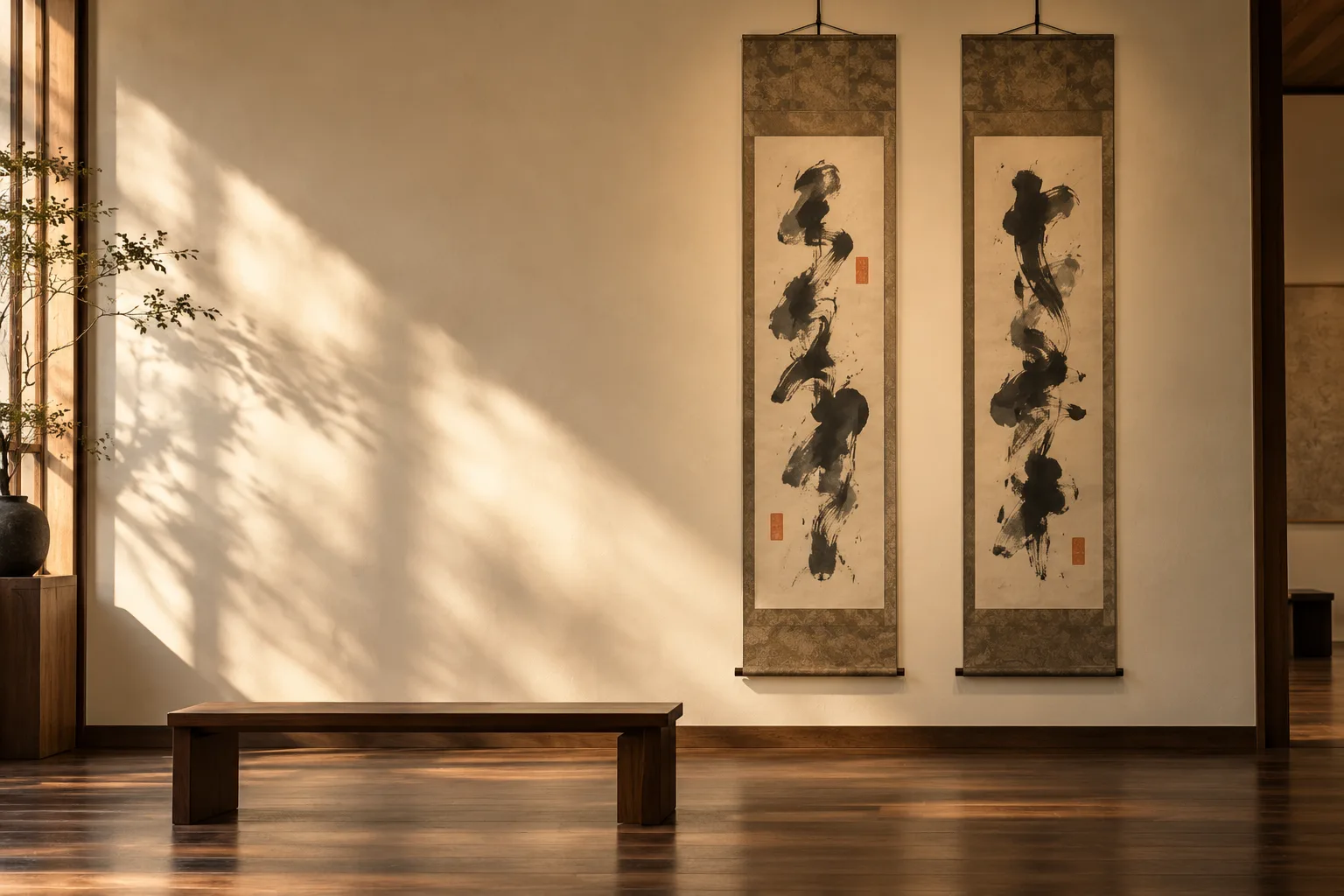
This guide extends Wudang.Org’s introductions to Chinese poetry and literature and calligraphy. It treats the couplet as a meeting of language, writing and setting. It does not provide a transcription of a particular Wudang inscription, and no line should be attributed to a historical author without object-level evidence.
A couplet is both a relationship of lines and a physical format
Begin by identifying what kind of pair you are seeing
In English, “couplet” can mean any two lines understood together. A Chinese duilian (对联), by contrast, often refers more specifically to matched lines presented as a pair: on paper, silk, wood, stone or architectural surfaces. Museum records frequently describe calligraphic examples as a “pair of hanging scrolls,” such as the Smithsonian National Museum of Asian Art’s Couplet in standard script.
The categories overlap but are not identical. A two-line passage may remain within a longer poem or appear on one album leaf; a displayed pair may quote, select or recombine older verses. Before analysing rules, establish whether you are looking at a poetic unit, two coordinated objects, an architectural inscription, or a later mounting of earlier words.
Count characters, then map phrases rather than isolated words
Formal paired inscriptions normally invite comparison between equal-length lines. Start by counting characters, but do not stop there. Mark phrase boundaries, grammatical roles and repeated patterns: a place may answer a place, an action an action, a season a season, or an image its contrast. Classical Chinese compresses meaning, so one character does not always equal one independent modern word.
Parallelism can create likeness, contrast, continuation or a widening of perspective. The Cambridge study “Parallelism and Antithesis” discusses symmetry and antithesis as related structural principles in Chinese literary expression. That relationship is subtler than replacing every noun with an opposite noun.
Do not import every rule of regulated verse
Couplets also appear inside regulated verse, where tonal pattern, line length, rhyme and the position of parallel lines belong to a larger poetic design. The site’s guide to regulated verse explains that system in its own context. A freestanding calligraphic pair may draw on those disciplines without functioning as a complete regulated poem.
Conversely, two adjacent lines in a poem are not automatically a doorway inscription. Textual form, material form and social use must be examined separately before they are brought together.
Parallel reading asks what corresponds—and what changes
Read the two lines across several levels
A useful first pass compares four layers: length, syntax, semantic fields and sound. Which units occupy corresponding positions? Do the lines balance subject and action, near and far, movement and stillness, or human conduct and landscape? Tonal relations may matter, but they cannot be reconstructed reliably from a modern translation alone.
Translation should preserve the relation before polishing each line in isolation. If one line is made expansive and the other terse, the reader may lose a balance present in Chinese. Keep ambiguities visible when a character can support more than one grammatical role or cultural association.
The second line may answer, turn or complete the first
Antithesis is one possibility, not the only one. A second line can echo the first with new imagery, redirect it from landscape to ethics, move from observation to wish, or complete a scene. Parallel positions help the reader notice the movement; they do not eliminate it.
This is why a couplet should be read twice: first vertically, so that each line develops in order, and then relationally, so that corresponding segments illuminate one another. A diagram of matches is a provisional aid, not a replacement for reading the pair as speech.
Sources may be older than the displayed object
Do not assume the calligrapher composed every word. The Metropolitan Museum of Art explains that Yang Tianji’s Couplet Composed from Jiang Kui’s Verses transcribes a pair assembled from phrases in several ci poems. The museum’s Calligraphy Couplet by Lianfang Songfou likewise notes that its lines conflate two poems by Su Shi.
Another object may quote a hymn, adapt a poem, or join lines selected from different works. Source tracing is therefore part of interpretation. Consult inscriptions, cataloguing, biographies and reliable editions; the site’s guide to anthologies and textual transmission explains why familiar lines can acquire new contexts as they circulate.
Calligraphy turns paired language into an embodied encounter
Script, scale and brush rhythm shape the reading
The same words can feel very different in standard, clerical, seal, running or cursive script. Upright spacing may emphasize clarity and monumentality; connected movement may heighten speed or continuity. These are visual effects to describe carefully, not fixed psychological codes. Use the site’s five script styles as a starting vocabulary.
Scale matters as much as script. Large characters encountered across a hall ask the body to move and look differently from small writing held in the hand. Ink weight, dry-brush texture, turns, pauses and the distribution of blank paper create rhythm across each scroll and between the pair.
Mounting, seals and dedications are evidence
Silk borders, paper colour, wooden panels, seals, signatures and dedications can indicate how a work was presented or for whom it was made. They should not be treated as decoration around a detachable text. At the same time, a later remounting can change dimensions or the apparent relationship of the two parts.
Record what is visible before drawing conclusions. Distinguish the main text from signatures and collectors’ seals; identify which information comes from the object and which comes from a catalogue. For books and albums, the site’s guide to thread-bound books and reading formats offers a related reminder that material structure directs sequence.
A matched pair can still contain productive asymmetry
Paired scrolls need not look mechanically identical. One line may contain denser forms, a different concentration of dark ink, or an especially forceful final character. The viewer experiences balance across unequal shapes. Good analysis names those differences before converting them into symbolic claims.
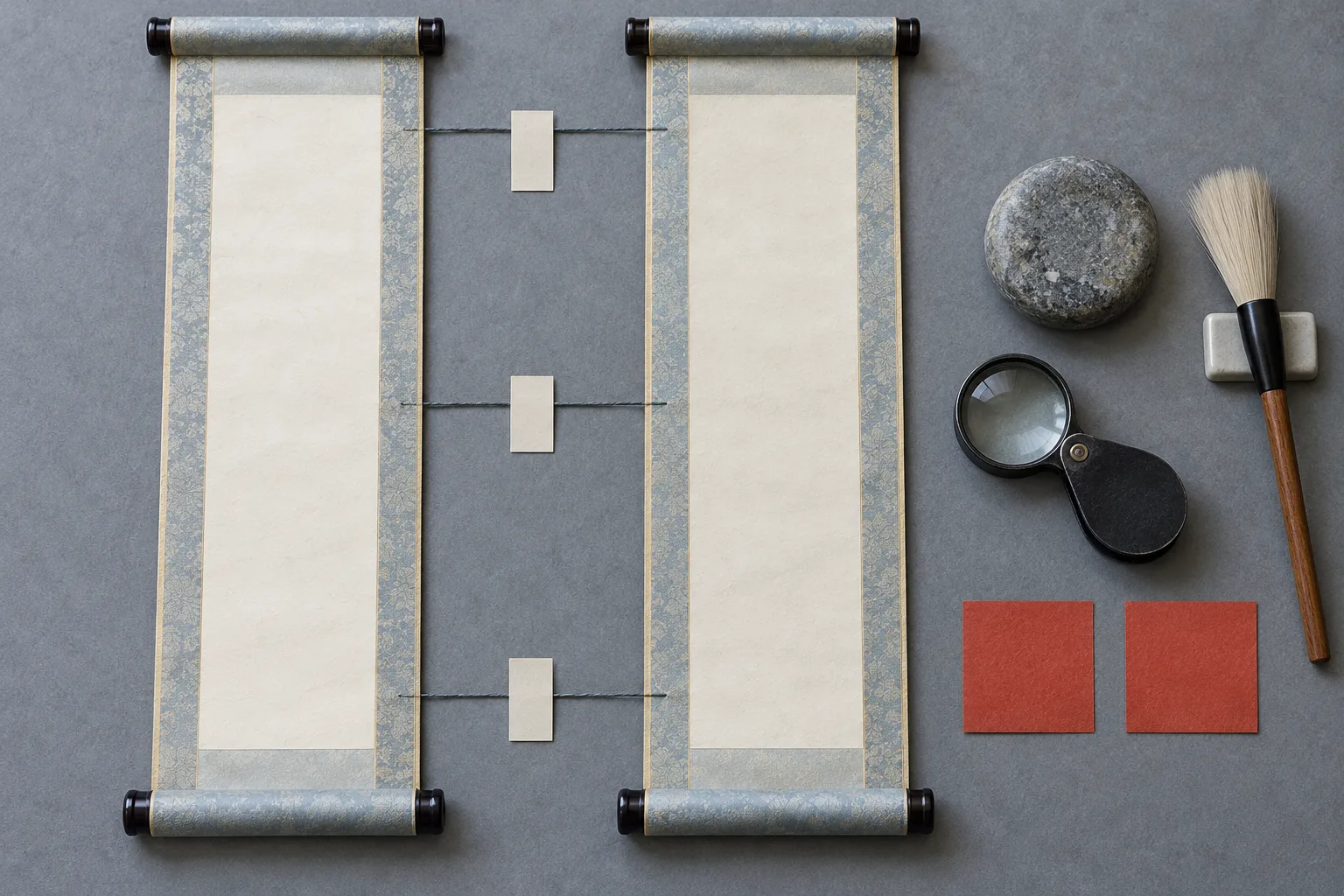
Object records help test visual impressions. The National Museum of Asian Art describes Fu Shan’s Couplet in standard script as a rare large standard-script work and relates its monumental manner to earlier inscriptional calligraphy. Such curatorial evidence is stronger than assigning a mood solely from brush shape.
Place, occasion and provenance complete the reading
Architecture makes words address a particular audience
When a pair flanks a doorway, hall or sacred space, placement joins language to movement. Visitors approach between two lines; distance, height and surrounding plaques influence what can be read. The site’s overview of Wudang plaques, couplets and calligraphy and its guide to stone inscriptions and steles show why architectural context and material evidence matter.
Setting does not prove authorship or date. A couplet now displayed at a temple may be a replacement, restoration, quotation or modern gift. Record the exact site, material, current installation, visible inscription and documented provenance before connecting it to a named patron, priest or historical figure.
Use a six-step method for a pair in a museum or at a site
- Identify the object. Record whether it is two scrolls, panels, carved surfaces or two lines within another format.
- Establish the sequence. Use labels, inscriptions and site guidance rather than guessing from a detached photograph.
- Transcribe and count. Preserve variant or uncertain characters and mark phrase boundaries.
- Map correspondences. Compare syntax, semantic fields, imagery and, where evidence permits, sound and tone.
- Read the calligraphy. Describe script, scale, brush movement, blank space, mounting, signatures and seals.
- Test the context. Trace textual sources, maker, recipient, place, date, remounting and later movement; state what remains unknown.
This order keeps observation ahead of interpretation. It also gives translators a shared evidence base: the English, Chinese and French versions may phrase ideas differently, but they should not silently add a lineage, author or historical episode.
Responsible reading preserves uncertainty
A museum label, a local guide and an old anthology answer different questions. Use each for what it can establish. If the source text is unidentified, say so; if one character is damaged, leave it uncertain; if the original placement is unknown, do not reconstruct an ideal doorway from symmetry alone.
A paired couplet rewards this patience. Its meaning lies neither in text alone nor in visual atmosphere, but in the disciplined conversation among two lines, two material surfaces and a place of encounter. Readers can continue with Tang poetry to explore how parallel lines work within longer poems.