18 · Gu 蛊 ䷑

第十八卦 蛊 ䷑

GUA 18, Repairing What Has Decayed, describes facing inherited neglect and repairing its causes rather than hiding the symptoms. The lower trigram, Wind and Wood ☴, can be read as the inner condition or starting impulse of the situation; the upper trigram, Mountain ☶, shows the outer setting or the direction in which that impulse becomes visible. Read together, they describe a movement from underlying conditions into choices, behaviour, and consequences. In modern life, this pattern may appear in work, relationships, study, leadership, or an important decision whenever you are being asked to practise facing inherited neglect and repairing its causes rather than hiding the symptoms. The first task is not to predict success or failure. It is to establish what is actually happening, identify the present stage, notice who carries the responsibility and risk, and choose an action that fits the real conditions. Keep this central caution in view: Repair is not an excuse for endless investigation. Once the cause is clear enough, begin the corrective work.
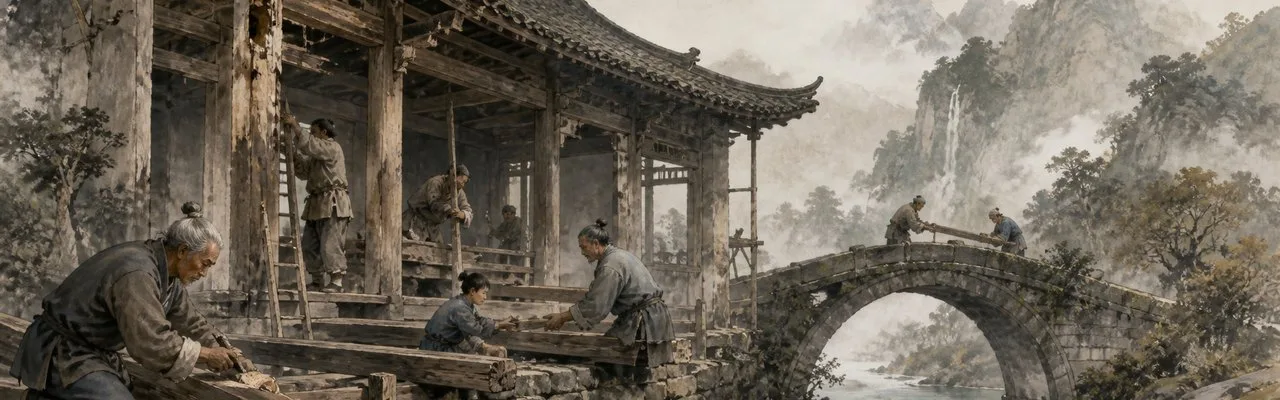
Ink illustration for hexagram 18, Gu 蛊, Repairing What Has Decayed: craftsmen replace the beams of an old wooden pavilion and repair an arched stone bridge.

Some problems are inherited rather than newly created. Investigate how the damage developed, accept responsibility for the present, and repair causes in stages. The purpose of this page is practical: to help a beginner recognise the situation, choose a sensible response, and avoid turning a symbolic reading into a rigid command.

GUA at a glance

  • Core situation: facing inherited neglect and repairing its causes rather than hiding the symptoms.

  • Helpful attitude: slow down enough to see the pattern, then choose a proportionate action.

  • Useful question: what stage is this situation in now, and what is the smallest responsible next step?

  • Main caution: Repair is not an excuse for endless investigation. Once the cause is clear enough, begin the corrective work.

The GUA, drawn line by line

The standard sign is ䷑. Read the six positions from the bottom upward:

━━━━━━━  上九
━━━ ━━━  六五
━━━ ━━━  六四
━━━━━━━  九三
━━━━━━━  九二
━━━ ━━━  初六
 

The lower three lines form 巽 ☴ (Wind and Wood); the upper three form 艮 ☶ (Mountain). The bottom is the beginning of the situation, the middle shows development and responsibility, and the top often shows excess, completion, or transition.

What this GUA means in simple terms

Some problems are inherited rather than newly created. Investigate how the damage developed, accept responsibility for the present, and repair causes in stages.

The six lines as practical stages

The lines are positions in a changing situation. If you are reading a cast GUA, pay special attention to the moving line. If you are studying without a casting, read the six lines as six different vantage points rather than a guaranteed timeline.

1. 初六:干父之蛊,有子考,无咎,厉终吉。

Setting right what was spoiled by the father. If there is such a son, the late father is without blame. Danger, but in the end good fortune.

The repair begins at the bottom, with a son setting right what his father let decay; the commentary says his “intent is to carry on the father’s purpose”, not to condemn him. Correcting one’s elders carries danger, but starting early and respectfully ends well. Fix the inheritance while the damage is still small.

2. 九二:干母之蛊,不可贞。

Setting right what was spoiled by the mother. One should not be rigidly steadfast.

A strong line at the inner centre sets right what the mother spoiled, and must not be rigidly firm about it. The commentary praises it for “finding the middle way”. Where the fault lies with someone gentle or close, correct with patience and tact; force here would wound more than it heals.

3. 九三:干父之蛊,小有悔,无大咎。

Setting right what was spoiled by the father. There will be a little regret, but no great blame.

At the restless top of the lower trigram, a hard line attacks the father’s damage with too much zeal, so there is “a little regret”. Yet the commentary concludes “in the end, no blame”: overcorrecting a real wrong is better than leaving it. Push the repair through, but expect friction and soften your manner.

4. 六四:裕父之蛊,往见吝。

Tolerating what was spoiled by the father. Going on, one meets humiliation.

This weak line near the ruler “tolerates” the father’s damage, letting it slide instead of repairing it. The commentary says that going on this way “gains nothing”, only humiliation. At the threshold of responsibility, indulgence is the real risk: a fault left alone grows, so do not mistake leniency for kindness.

5. 六五:干父之蛊,用誉。

Setting right what was spoiled by the father; one earns praise.

The yielding ruler in the fifth place sets right the father’s damage and earns praise, because it relies on the strong helper in the second. The commentary says it “carries on through virtue”. Lead a repair by honouring what was good in the past and drawing on capable people, so change wins support rather than resistance.

6. 上九:不事王侯,高尚其事。

He does not serve kings and princes; he holds his own affairs higher.

With the repair finished, the top line stands outside it all: it does not serve kings and princes, and holds its own work higher. The commentary says “its resolve can be taken as a model”. This is the honourable withdrawal of the mountain recluse: when the work is done, step back and cultivate yourself without bitterness.

Bottom line

GUA 18 is a practical lesson in facing inherited neglect and repairing its causes rather than hiding the symptoms. Use it to see the pattern more clearly, act with proportion, and remain willing to change when reality gives new information.

Continue with the previous GUA, 17 · Following, or the next GUA, 19 · Approach.

Seeker’s Q&A

How do I fix a problem I inherited?

The Judgment says to think three days before the start and three days after: diagnose before acting, then check that the repair holds. The lines show the work is often a son or daughter mending what a parent left.

Why did Tu Fu say Qin would win?

He read Jin as the mountain in autumn, its fruit ready to fall. Whatever one makes of the omen, the strategic point stands: a side that has let decay set in is vulnerable, and whoever repairs first holds the advantage.

What does “stirring the people and nourishing virtue” ask of me?

Wind at the foot of the mountain stirs what has gone stale. Begin the repair with yourself: one neglected task, one apology owed.

Should I blame the people who left the mess?

The second line counsels gentleness with a mother’s errors, and the fifth earns praise for repair done with care. Fix the work without humiliating those who came before.

One-minute practice

Choose one small thing that has gone stale: a drawer, an unanswered message, a habit. Spend one minute starting its repair, breathing slowly, without trying to finish it all at once.