Doumu: The Dipper Mother and the Nine Emperors
斗母:北斗之母与九皇
If you walk into a Taoist temple and find a goddess with several faces and many arms, holding the sun and the moon, you have probably met Doumu (斗母, also written 斗姆 or 斗姥), the Dipper Mother. This page teaches you to read her image, to know where she comes from, and to understand why her festival and the Nine Emperor Gods festival fall on the same days.

Who she is
Doumu is honoured as the mother of the stars of the Northern Dipper, and of the Nine Emperors (九皇) who are those stars. Taoist rites for the Dipper treat her as their principal deity. Her full titles are long; the short forms are enough to recognise: Doumu, or Doumu Yuanjun (斗姆元君).
Where she comes from: three accounts
The texts do not agree, which is useful to know before you read any one of them. Three accounts are often given:
- The Lingbao lingjiao jidu jinshu (灵宝领教济度金书) says the Primordial Celestial Venerable made the Jade Emperor from yang breath by day and Doumu from yin breath by night.
- The Yuqing wushang lingbao ziran Beidou benzhen jing (玉清无上灵宝自然北斗本真经; titles vary slightly) tells how she was Ziguang Furen (紫光夫人), a consort of King Zhou Yu in the age of Longhan, and bore nine sons from a lotus pond.
- Many scholars, and some Taoist texts themselves, also link her to Marici (摩利支天), a Buddhist goddess of light who is shown with three faces and eight arms. Some Taoist sources treat the two as one figure under different names; others insist Doumu is a Taoist goddess in her own right.
A common mistake is to ask which of these is “the” origin. They are layers: a cosmic account, a story and a cross-tradition link, written down at different times, and the images follow the same layering.
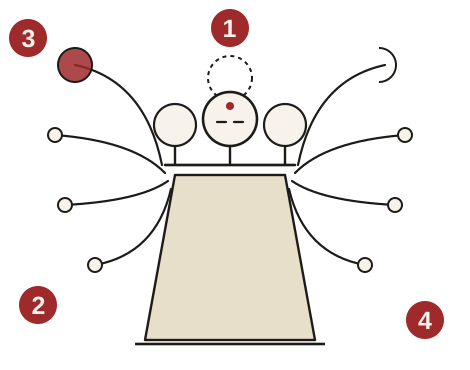
A schematic for reading an image of Doumu. It is not a copy of any one statue, and images differ.
- The heads: commonly four, three seen side by side and one behind; the front one has a third eye.
- The eight arms, in pairs.
- The sun and the moon, held in the upper pair of hands.
- The other hands, which carry emblems such as a bell, a seal or weapons; the lists vary from text to text.
How to read her image
Look first at the heads. The common form has four, with a third eye in the front face; some texts give three. Then count the eight arms. The upper pair holds the sun and the moon; the other hands carry emblems, and the lists differ: a bell, a seal, a bow, a halberd, a spear, depending on the text. Do not expect any two statues to match. What matters is the pattern: many faces see in many directions, many arms act, and sun and moon stand for the whole sky, with the stars below her.
Her sons, the nine
In the Beidou scripture her nine sons are the Heavenly Emperor (天皇大帝), the Emperor of Ziwei (紫微大帝) and the seven stars of the Dipper, named Tanlang, Jumen, Lucun, Wenqu, Lianzhen, Wuqu and Pojun. That is why her children are called the Nine Emperors. Other texts give different lists of nine, so treat this one as the standard that many temples use, not the only one. Her relation to the Dipper itself is explained on the Northern Dipper page.
Her festival, and the Nine Emperor Gods in Singapore
Her birthday is the ninth day of the ninth lunar month. The Nine Emperor Gods festival (九皇诞) is held from the first to the ninth day of that month, so the two close together. In Singapore the festival is a major temple festival, and the national heritage portal Roots.gov.sg documents it as intangible cultural heritage. Hougang Dou Mu Gong (后港斗母宫), also called Kew Ong Yah, is among the temples associated with it. If you want to see Doumu’s world in practice, that month is the time. Be a visitor, not an audience: see worship, temples and offerings for what to do on entering a temple.
What this page does not claim
I have not verified that any hall on Wudang Mountain is dedicated to Doumu, so this page says nothing about one. Sources also disagree on the nine sons’ names, on her dates of origin and on how far she is Marici; the page names those disagreements instead of settling them.
To try: at your next temple, look for her hall. Count the heads, find the sun and the moon, and notice which hand holds what. Then ask yourself what you would expect a mother of stars to be shown doing.
Further on the site
- The Northern Dipper: the stars, the ritual and the temple images.
- Wang Lingguan: the guardian at the temple gate.
- The deities of Wudang Mountain: Zhenwu and the figures around him.
- The Taoist pantheon: the full overview.


