At the first gate of many Taoist temples you meet a red-faced figure with a fierce open mouth, armour and a whip. He is Wang Lingguan (王灵官), and he is usually the first image a visitor sees. This page teaches you to recognise him, to tell the legend from the record, and to understand why he stands where he does.
Who he is
Lingguan means “numinous official”. In the texts he has several titles: Heavenly General of the Jade Pivot Fire Office (玉枢火府天将), Lord of Abundant Grace (隆恩真君) and Huoluo Lingguan (豁落灵官). The Ming History identifies the Lord of Abundant Grace with Wang Lingguan and says he followed Sa, a master of talismans.
How to recognise him
Look for a red face, a beard that sweeps upward, an open mouth showing long teeth, armour and a whip (iron in some descriptions, golden in the story below). Later sources add a third eye in the forehead. The fiery eyes are the key to him: tradition says they let him tell the false from the true.
A common mistake is to confuse him with a general of a Buddhist temple or with Guan Yu. Check the red face and the whip first, then look at where he stands.
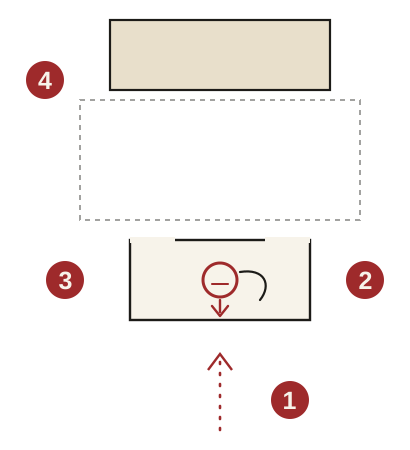
A plan, looking down. It is not to scale and does not show any particular temple.
- The approach: the visitor arrives from outside.
- The hall at the mountain gate, the first building.
- Wang Lingguan, with his whip, standing inside and facing outward.
- The courtyard and the main halls, beyond the gate.
Why he stands at the gate
His statue is usually placed in the hall at the mountain gate, facing outward, and believers typically greet him first when they enter a temple. He is counted as the protector of Taoist talismanic arts and of the altar. Reference works compare his role to that of the guardians at Buddhist gates. Facing outward matters: he is looking at you as you arrive, and the tradition says his eyes can tell what is false from what is true. To a visitor, that is the point of a threshold: a moment to arrive honestly.
The legend
The story comes from Ming and Qing accounts of immortals, so treat it as legend, not history. Wang E (王恶, “Wang the Bad”) was a temple spirit, worshipped locally, who made the villagers give him children to eat. A Taoist named Sa Shoujian (萨守坚), a disciple of the 30th Celestial Master, burned his eyes with a flying talisman, and they became fiery eyes. Wang complained to the Celestial Court. The Jade Emperor gave him eyes that see clearly and a golden whip, and allowed him to follow Sa and report any fault. After twelve years he had found none. He became Sa’s disciple and was renamed Wang Shan (王善, “Wang the Good”). Notice how the story explains the image: the fierce face is a changed spirit, now on the side of order.
What the record says
The history of the belief is later than the legend suggests. Under the Yongle emperor (1403–1424), a Hangzhou Taoist named Zhou Side (周思得) claimed to have been taught the Lingguan skills, and a Temple of the Heavenly General and a Hall of Patriarchs were built west of the Forbidden City. Under Xuande (1426–1435) the temple was enlarged and titles were granted to Sa and Wang; sources differ on the temple’s new name. In the first year of Chenghua it was enlarged again as the Temple of Numinous Manifestation (显灵宫). The Ming History itself notes that the skill came from a tradition some people called false. Treat the dates of the titles and the temple names as details that sources report slightly differently.
In Fujian, he had temples of his own, called Temples of the Heavenly General. His birthday is the 13th day of the sixth lunar month, and some sources give the 23rd.
What this page does not claim
I have not verified which temples on Wudang Mountain have a Lingguan hall, so this page does not say. See the deities of Wudang Mountain for who stands in the mountain’s halls.
To try: at the next temple gate you pass, look for him before you look at anything else. Ask which way he faces, what he holds, and what he seems to be checking you for. Then walk in.
Further on the site
- The deities of Wudang Mountain: Zhenwu and the figures around him.
- Worship, temples and offerings: what to do on entering a temple.
- The Taoist pantheon: the full overview.