WUDANG TAIJIQUAN · 武当太极拳

Wudang Tai Chi for Beginners: Core Posture, Breath, Spiral Force and How to Start 零基础学武当太极拳:身法纲要、呼吸配合与入门次第

A practical first-month teacher’s handbook: how to align your knees and spine safely, why movement starts from the feet and waist rather than the hands, and what to practise in fifteen minutes a day.

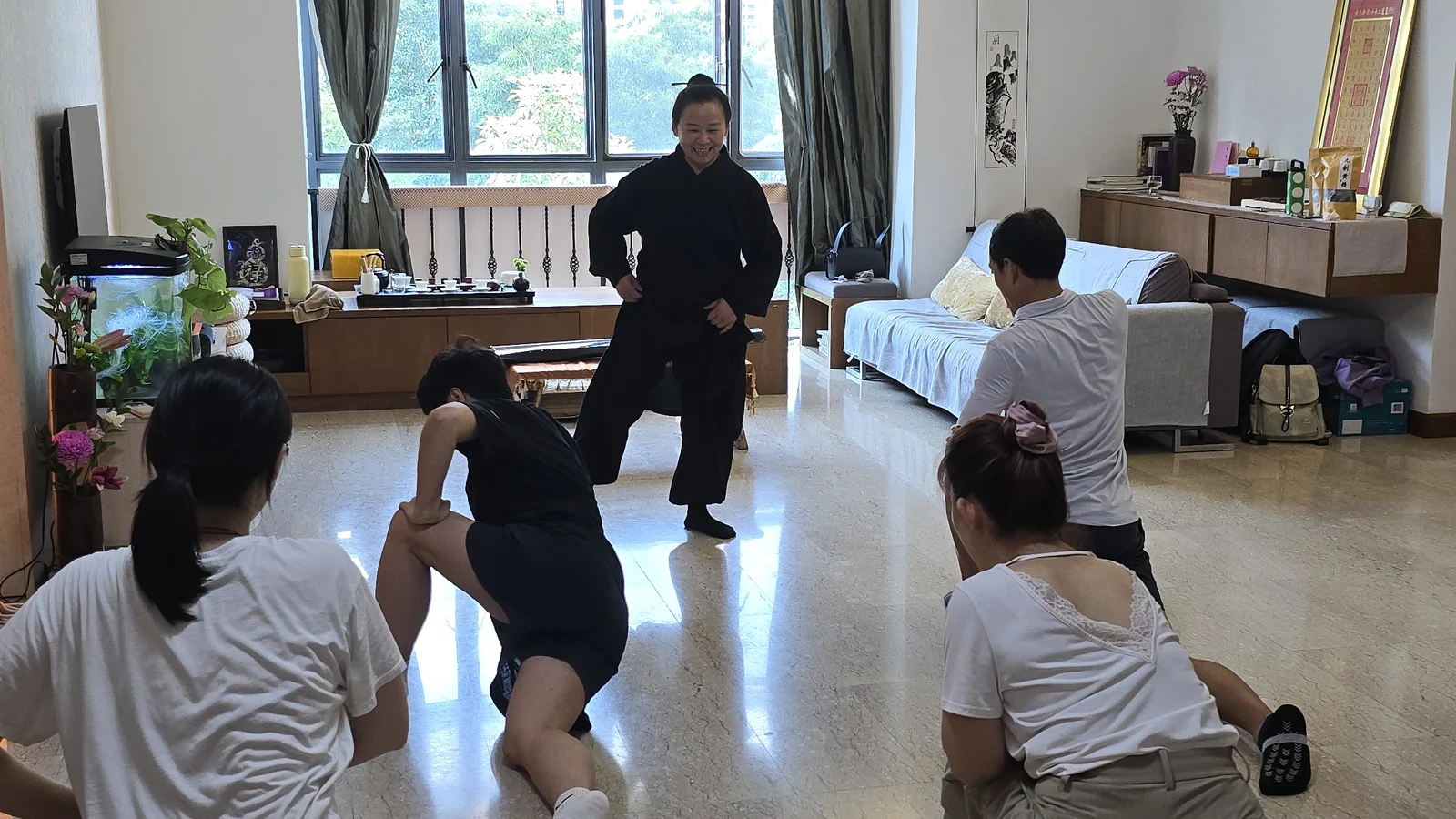
A Wudang taijiquan lesson in a sunlit room: students seen from behind kneel into deep lunges to open the hips while a teacher in black Taoist-style clothing stands in a wide stance, smiling, with an ink-painting scroll on the wall behind.

When you watch an experienced practitioner move through Wudang Taijiquan, your eyes naturally follow the hands gliding like clouds. When you try to copy those hand shapes on your first day, however, the movement often feels awkward, your shoulders creep up toward your ears, and your front knee aches. Why? Because in authentic Tai Chi, the hands never move by themselves—they are the last leaf on a tree moved by the root, trunk, and branches.

1. The Five-Point Body Check Before You Take a Single Step

Before memorizing choreography, stand quietly with your feet shoulder-width apart (standing practice) and check five landmarks from the soles of your feet to the crown of your head:

  1. Even, Three-Point Footing (足底平铺): Let your weight rest evenly between the ball of the big toe, the ball of the little toe, and the centre of the heel, neither gripping with the toes nor collapsing onto the inner arch.
  2. Unlocked Knees Aligned With the Toes (松膝合尖): Soften the knees without squatting deeply. Check two non-negotiable joint-safety rules: your kneecap must point in the exact direction of your toes, and it should not push past the toes under load.
  3. Settled Kua and Neutral Pelvis (松腰落胯): Imagine sitting lightly onto the edge of a high wooden stool so the hip creases (kua) fold inward instead of arching the lower back.
  4. Sunk Shoulders and Heavy Elbows (沉肩坠肘): Let the shoulder blades melt down the ribcage and keep a soft egg-sized space in each armpit, recalling the usefulness of empty space in Tao Te Ching (Dao De Jing) Chapter 11.
  5. Gently Suspended Crown (虚领顶劲): Lengthen the back of the neck as though a light thread lifted the crown, tucking the chin slightly while keeping the jaw and tongue relaxed.
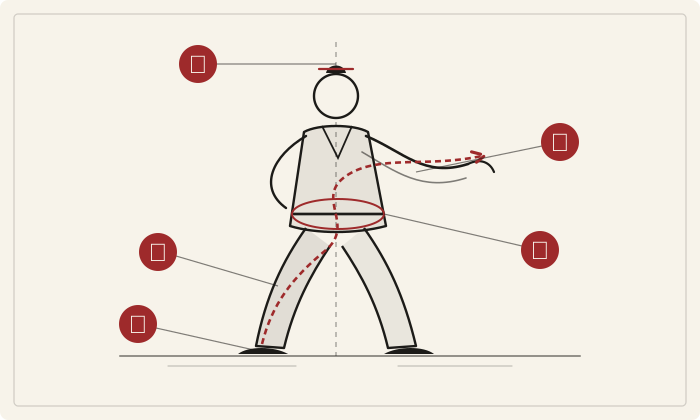
Classical diagram of Wudang Taijiquan structural alignment showing rooted feet, unlocked knees, waist rotation axis, sunk shoulders and elbows, and suspended crown

How whole-body spiral movement connects in the classical Taijiquan Treatise: “Its root is in the feet, issued through the legs, governed by the waist, and expressed in the fingers.”

  1. Rooted soles (其根在脚): weight settles evenly into the ground before shifting
  2. Unlocked knees and settled kua (发于腿): elastic transfer aligned cleanly with the toes
  3. Waist and central equilibrium (主宰于腰): turning the torso as one cylinder directs the arc
  4. Sunk shoulders and dropped elbows (沉肩坠肘,形于手指): arms curve smoothly without stiff force
  5. Gently suspended crown (虚领顶劲): upright axial poise uniting stillness and motion

2. How Breath Works: Why Beginners Should Never Force Coordination

A common beginner mistake is holding the breath while trying to remember whether a palm turn is “supposed” to be an inhale or an exhale. Recall the warning in Chapter 10 and Chapter 55 of the Tao Te Ching: “Using the willful mind to force the breath is called stiffness” (心使气曰强), whereas concentrating the breath into suppleness restores natural harmony (专气致柔).

During your first month, follow one simple rule: breathe quietly through the nose at your body’s natural pace, never holding the breath. Once the choreography feels familiar, your breath will pair with the frame on its own—rising and opening movements naturally invite an inhale, while sinking, folding, and settling movements naturally invite a long, unforced exhale, echoing the stillness taught in the Qingjing Jing.

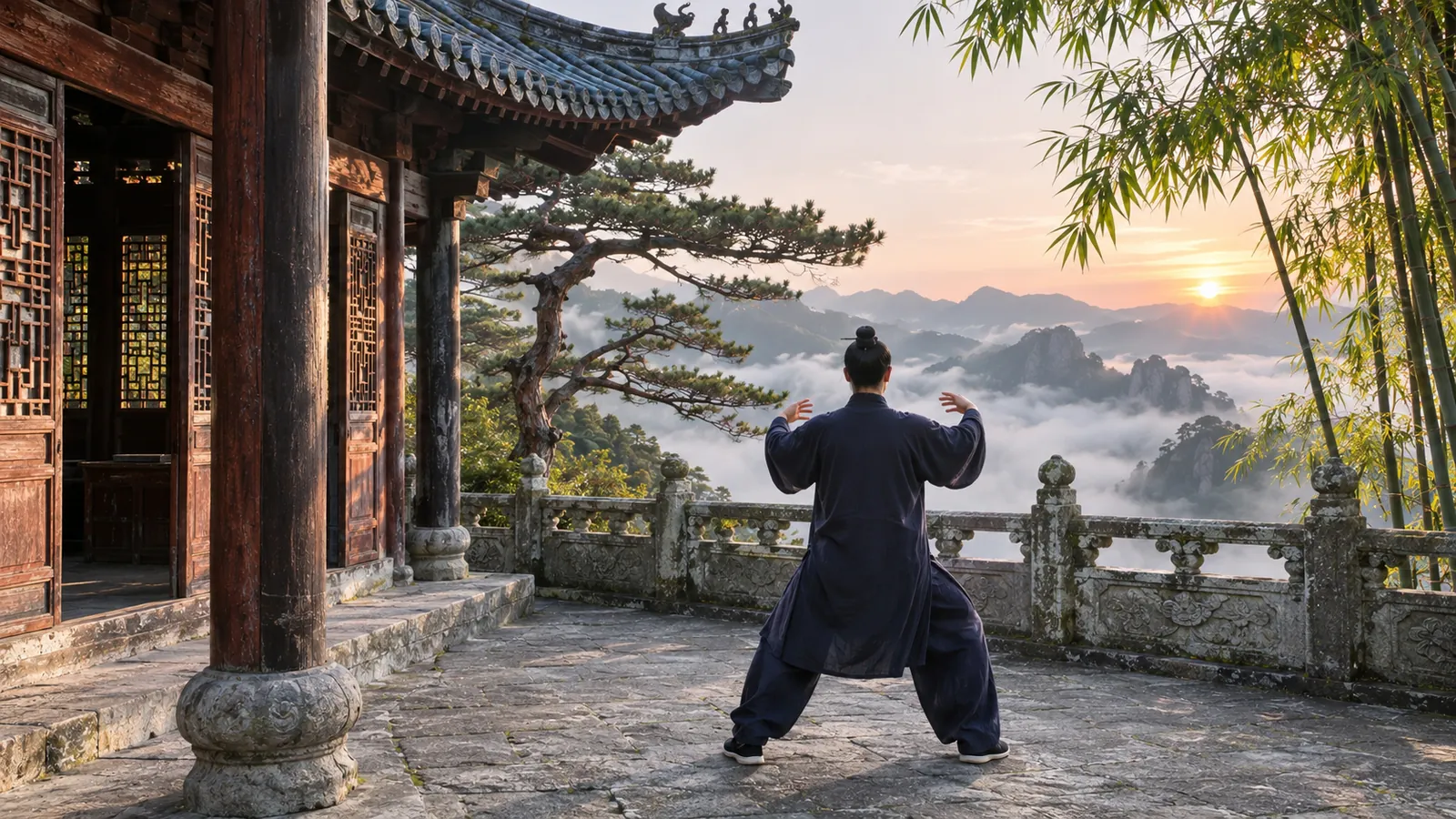
Practitioner in dark indigo Taoist robes with a topknot seen from behind in a rooted Tai Chi stance on a grey granite mountain terrace beside a Chinese timber hall above morning clouds.

Morning Tai Chi alignment on a quiet stone terrace: rooted soles, unlocked knees, and relaxed shoulders facing the mountain mist.

3. Your First Four-Week Progression (15 Minutes a Day)

  • Minutes 1–4 — Quiet Standing (Zhan Zhuang): Stand in parallel stance, run through the five-point check above, and let the day’s hurry drop out of your shoulders.
  • Minutes 5–9 — Joint & Tendon Preparation: Practise two to four movements from the Eight Sections of Baduanjin or review our comparison guide Choosing Your First Qigong Set so the spine and ribcage move freely.
  • Minutes 10–15 — Weight-Shifting & Cloud Hands (云手): Practise shifting 70% of your weight smoothly from one leg to the other, turning from the waist first and letting the relaxed arms follow half a beat behind.

4. Studying With a Teacher in Singapore and on Wudang Mountain

Books and diagrams clarify structure, but a teacher’s eye catches the subtle shoulder lift or knee twist you cannot feel on your own. Wudang.Org connects heritage study on Wudang Mountain (UNESCO World Heritage ancient temple complexes) with accessible training in Singapore. Complete beginners can start on Start Here, sample a weekend Baduanjin workshop, or immerse over three days at the Tai Chi Retreat Camp in Singapore. For background on how internal training compares with external styles, read Wudang vs Shaolin.

Wellness & medical boundary: Wudang Taijiquan is a cultural and movement discipline for balance, coordination, and calm focus; it makes no medical cure claims. Stop immediately if you feel sharp knee pain or dizziness, and consult a healthcare professional regarding pre-existing medical conditions.

Seeker’s Q&A · Frequently Asked Questions

How can beginners protect their knees when learning Wudang Tai Chi?

Keep stances moderately high at first, ensure the kneecap always points in the exact direction of the toes without collapsing inward, never push the knee past the toes when shifting weight, and fold from the hip joints (kua) rather than leaning onto the kneecaps.


Should a beginner coordinate every Tai Chi hand movement with inhale and exhale on day one?

No. Trying to force breath timing while still learning footwork causes breath-holding and chest stiffness. Start with quiet, continuous nasal breathing; natural coordination between opening/inhaling and settling/exhaling develops once the posture feels comfortable.

How much space and time do I need for daily beginner Tai Chi practice?

A clear floor space of roughly two steps by two steps (about 2 × 2 metres) and fifteen unhurried minutes a day—combining standing alignment, gentle qigong loosening, and single-posture weight shifting—is enough to build a genuine foundation.
