Your First Calligraphy Strokes: The Eight Principles of 永
书法的第一批笔画:永字八法
You may not own a brush yet, and that is a fine place to begin. Most calligraphy teachers, sooner or later, ask a new student to write one character: 永 (yǒng), which means “eternal” or “lasting”. This page explains why that character, what its eight strokes are called, how to hold a brush without strangling it, and how to practise with nothing more than water and an old newspaper.
Why teachers start with 永
The character 永 is small, but it contains a dot, a horizontal, a vertical with a hook, a rising stroke and three kinds of falling stroke. Counted the ordinary way, 永 has five strokes; the eight principles divide them into eight movements. Tradition holds that these are the basic movements of the regular script, and the habit of teaching them through this one character is known as the “eight principles of yong” (永字八法). Tradition attributes the idea to early calligraphers; we do not name one here, because the sources do not agree and our guide to the five script styles calls it a durable teaching mnemonic, not proof that one character holds every movement a calligrapher needs.
That is the right way to take it. 永 is a way in: eight small exercises you can repeat in a few minutes, with a name for each so a teacher can say “watch your 勒” and you know what is meant. It is not the whole art, and it does not make one grip or one style the only correct one.
Try this: write 永 once, in any way, with a pencil. Keep the page. In a month you will enjoy comparing it.
The eight strokes
Each stroke has an old name. The names are picture-words, a teacher’s shorthand for the feeling of the movement, and you do not need to memorise them on day one. Read the list once, then look at the numbered picture beside it.
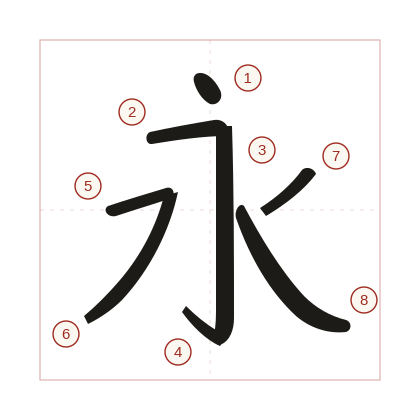
The character 永 (yǒng), its eight strokes numbered in the order this page describes them.
- 侧, the dot
- 勒, the horizontal
- 努, the vertical
- 趯, the hook
- 策, the rising stroke
- 掠, the long left-falling stroke
- 啄, the short left-falling stroke
- 磔, the right-falling stroke
- 侧 cè, the dot. The word means “side” or “tilt”. The dot is not a blob: the brush lands, turns slightly, presses a little and gathers back, so the dot has a small head and a tail.
- 勒 lè, the horizontal. The word suggests a rein held back. The brush starts, travels right with an even pace and gathers at the end, rather than flying off the line.
- 努 nǔ, the vertical. The word means “effort” or “strain”, as of a drawn bow. The line goes down steadily and straight, and in 永 it stops at the turn where the hook begins.
- 趯 tì, the hook. The word means “to leap”. At the bottom of the vertical the brush pauses, turns and flicks upward and to the left in a small, quick movement.
- 策 cè, the rising stroke. The word means a riding whip. It starts thin at the left, rises up and to the right, and ends in a point, as if the whip had flicked up.
- 掠 lüè, the long left-falling stroke. The word means “to skim” or “to sweep”. Starting from the centre, the brush glides down to the left in a long curve that thins out.
- 啄 zhuó, the short left-falling stroke. The word means “to peck”, like a bird. It is short and quick, ending in a point.
- 磔 zhé, the right-falling stroke. Its old sense is to split open; in calligraphy it names the right-falling stroke, which spreads at the end. The line sweeps down to the right and widens at the end, where the brush presses and lifts away.
Different teachers and different models describe these movements a little differently, so treat the lines above as a first map, and ask your teacher how they want each one done.
How to hold the brush
Ask a teacher to show you in person if you can, since a photograph of a hand does not tell you everything. The common starting point is the five-finger grip. The thumb and index finger hold the shaft from the two sides, the middle finger hooks round the front, the ring finger presses back against the shaft, and the little finger supports the ring finger. The brush stands upright, roughly at a right angle to the paper, and the palm stays open inside, as if you were holding a small egg. Our page on brush technique notes that grip and arm support are practical choices, and a fully lifted arm is not a goal for every learner.
Keep your posture and breathing natural. Sit or stand so your shoulders can drop, your back is easy and both feet are on the floor. You do not need a special breathing method: breathe the way you usually do, and if you notice you are holding your breath, let it go.
Your first practice: water on newspaper
Ink makes beginners tense, because every mark is permanent and every mistake costs paper. Start with water instead. Spread a few sheets of newspaper on a table, or use a water-writing cloth (水写布), which darkens when wet and dries on its own so you can write again. Dip the brush in clean water, press out the extra against the rim of the cup, and write.
The Four Treasures of the Study page explains how to choose a brush, and a brush matters less at this stage than you might think: a modest brush that springs back to a point is enough. Bring in ink only once the movements feel familiar, and then change one thing at a time, as that page advises.
Write each stroke on its own, slowly, ten times, before you try the whole character. Then write 永 five times, wait a minute and watch the water disappear. That fading is part of the lesson: the movement is what you keep.
What beginners get wrong
- Pressing too hard. A brush is not a pencil. Pressing flattens the hairs and makes a heavy, stiff line. Let the brush do some of the work.
- Rushing. A stroke has a beginning, a course and an ending. Hurrying skips the ending, which is where most of the character shows.
- Copying the outline, not the movement. If you only trace the shape of a printed 永, your hand learns nothing about how it was made. Watch a teacher write it, or a video, and copy the speed and the pauses.
- Gripping. A white-knuckled grip tires the hand and makes the line shake. If your fingers ache, you may be holding too tight; if an ache persists, ask a doctor. Put the brush down, shake the hand out and begin again lighter.
Our calligraphy as Taoist cultivation page makes a similar point about noticing where a grip tightens or where rushing prevents observation, and making one manageable adjustment. It is a good habit to bring to the paper.
A short session to try
Ten minutes will do. Set up your newspaper, wet the brush and settle. Write each of the eight strokes three times, slowly, naming each one under your breath if it helps. Write 永 three times. Stop while it is still pleasant.
If your hand, wrist or shoulder hurts, or you feel dizzy, stop and rest. Stop too if you have a fresh injury or a medical condition that makes sitting or holding a brush uncomfortable, and ask your doctor. Calligraphy is a quiet activity, but pain is a signal to rest, not to push through.
When the eight strokes feel familiar, read about the five script styles to see where regular script sits among them, or visit the calligraphy overview for the rest of the tradition.