The Five Script Styles in Chinese Calligraphy
中国书法的五种主要书体
Chinese calligraphy is often introduced through five script families: seal, clerical, regular, running and cursive. The grouping is useful for orientation, but no short label can describe every hand, period or object. The families developed at different times, continued beside one another and were repeatedly studied or revived.
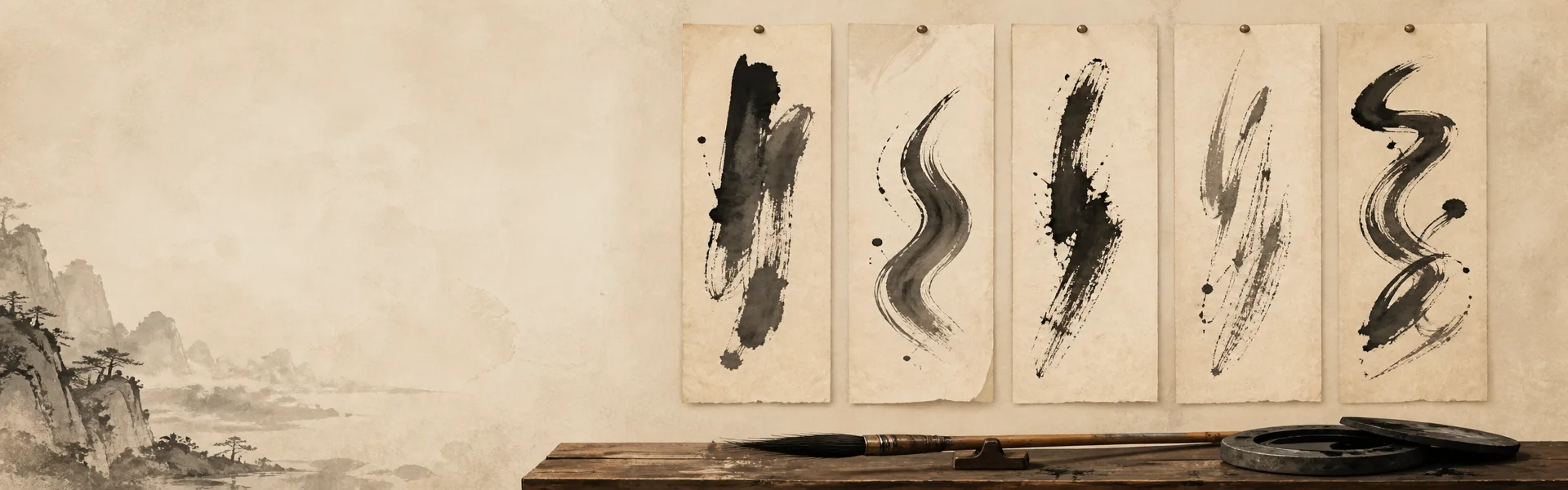
Begin by asking two questions: what features can you actually see, and what does the object label establish? Script, character form, material, date and function are related, but they are not interchangeable. A careful description leaves room for uncertainty and for works that sit between familiar categories.
1. How the five labels work
The five names organise a large field; they are not five compulsory steps from primitive to perfected writing. “Seal” and “clerical” each cover varied historical forms, while regular, running and cursive can approach one another in the hand of a single writer. Some surveys also treat oracle-bone writing separately because it predates the familiar five-family scheme.
Use the label as a hypothesis to test against visible evidence. Look at how strokes begin and end, how components are spaced, how much the forms are abbreviated and whether neighbouring characters connect. Then check the date, medium and catalogue description before turning a visual impression into a historical claim.
2. Seal script: an ancient family with later lives
Seal script is a broad retrospective family. “Large seal” can refer loosely to varied early inscriptions rather than one standard script. Small-seal forms are associated with Qin regularisation, but surviving early writing remains more diverse than a single imperial model.
Small-seal models often appear elongated and balanced, with curving lines and relatively even visual weight. Those traits are guides, not a recognition formula: carving, casting, brushwork, copying and rubbing all affect the line. Seal forms continued in seals, headings, antiquarian study and later calligraphic revivals; they did not simply disappear when other scripts developed.
3. Clerical script: transformation across Qin and Han practice
Forms grouped as clerical script took shape through Qin and Han writing practices. Manuscripts and inscriptions show transformation over time, not a single moment when clerks invented a faster script. Changed component structures and more horizontal organisation helped establish forms from which later scripts developed.
Many mature clerical works use broad proportions and strokes whose pressure, turn or flared finish creates a strong lateral rhythm. Not every character is flat, and no universal rule requires exactly one dramatic flare in every character. A wooden slip, an ink manuscript and a stone rubbing may also present the same family very differently.
4. Regular script: articulated structure, many models
Regular script developed over the late Han and subsequent centuries. Influential Tang works became major models, but they are neither one uniform style nor the final version of all regular writing. Different writers organise weight, proportion, tension and space in recognisably different ways.
Its strokes are generally articulated and its components clearly structured, which makes it useful for close study. That does not make it universally the slowest, easiest or only responsible starting point. The “Eight Principles of the character yong” is a durable teaching mnemonic, not proof that one character contains every movement a calligrapher needs.
5. Running script: a range of connected writing
Running script describes a wide range of more continuous writing. Some examples stay close to regular script; others approach cursive through abbreviation, linking and quicker transitions. It is therefore better understood as a field of practice than as a fixed halfway point.
Letters, drafts, poems and presentation pieces may all use running forms, but function alone does not identify the script. Readability depends on the writer, reader, text, condition and reproduction. A visible connecting line can reveal brush movement, yet connection is only one feature among structure, rhythm and abbreviation.
6. Cursive script: convention, speed and disciplined reduction
Cursive script uses conventional reductions and connected movements that cannot always be reconstructed from a modern regular form by intuition alone. Speed may contribute to its appearance, but cursive is not merely careless or accelerated handwriting. Studying its established forms is part of learning to write and read it.
Terms such as draft cursive, modern cursive and wild cursive describe useful historical and stylistic groupings, not sealed compartments. Highly cursive writing can be difficult even for a fluent reader, especially without a transcription, but it remains writing rather than “abstract painting.” Legibility varies by work and viewer; expressive force does not cancel linguistic structure.
7. Boundaries, mixtures and changing registers
Real works often resist a quick five-way test. Regular writing can loosen into running forms, while a cursive passage may retain clearly separated characters. Later calligraphers also revived early scripts, mixed features or deliberately transformed older models.
Describe an ambiguous work with graduated language: “regular with running features,” “running-cursive,” or “an archaistic clerical manner” may be more accurate than forcing one absolute answer. The same handscroll can also change register as the text, pace or available space changes.
8. Read the object, not only the script name
Material and transmission shape what the viewer sees. Ink on prepared paper records different information from characters cast in bronze, carved in stone or transferred through a rubbing. Damage, recutting, mounting, photography and digital contrast can all alter apparent thickness and edge quality.
A famous hand may survive through a later copy, tracing, engraving or rubbing rather than an uncontested autograph. Record the date of the object in front of you and its stated relationship to any earlier model. The calligraphy history guide explains these layers in more detail; keeping them visible prevents a later reproduction from being mistaken for an original sheet.
9. Learning without one universal order
There is no single sequence suitable for every learner. Some teachers begin with regular script for articulated structure; others use clerical or seal forms to focus attention on the brush tip, rhythm or component shape. The choice also depends on the model, the learner’s aims and the quality of instruction.
Copying an identified model is more useful than imitating a generic “ancient style.” Note the work, writer or attribution, object date, reproduction source and scale. Slow comparison can build accuracy, but long devotion to one model is not a universal requirement; comparing related works helps reveal what belongs to a script family and what belongs to one particular hand.
10. Script family is not the same as character set
Traditional, simplified, variant and archaic character forms concern how a character is written; seal, clerical, regular, running and cursive concern the script family or manner. The two questions intersect, but one does not determine the other. Contemporary work can use different character forms in different scripts and contexts.
Do not assume that every calligraphic work uses traditional characters, or that a simplified form is automatically unsuitable. When copying an older text, check the source rather than converting forms mechanically. Historical variants, later standardisation and simplifications that merge several traditional forms into one can all affect which written form fits a particular passage.
11. A five-question comparison exercise
Choose two clearly labelled works, preferably with reliable dates and good images. For each, record: which features support the script label; which features do not fit the simplest textbook description; what the material preserves; how abbreviated the forms are; and whether the object is an original, copy, engraving or rubbing.
Compare one passage at a time without ranking the works from easy to advanced. If a label remains uncertain, state the uncertainty. Then return to the calligraphy guide to examine line, spacing, rhythm and format, or continue to the history guide to place the objects within a longer chain of transmission.