Chinese Ink Rubbings: Stone, Paper and the Life of Calligraphy
中国传拓:石刻、纸墨与书法的流传
An ink rubbing turns a hard, often immovable surface into a portable sheet. Paper receives the contours of characters or images cut into stone, cast on bronze, carved in wood, or impressed in clay; ink then makes the surface legible as a field of black and white. The English word “rubbing” can be misleading. Traditional Chinese methods generally do not resemble making a dry pencil rubbing. They use dampened paper, careful tamping and ink applied from above.
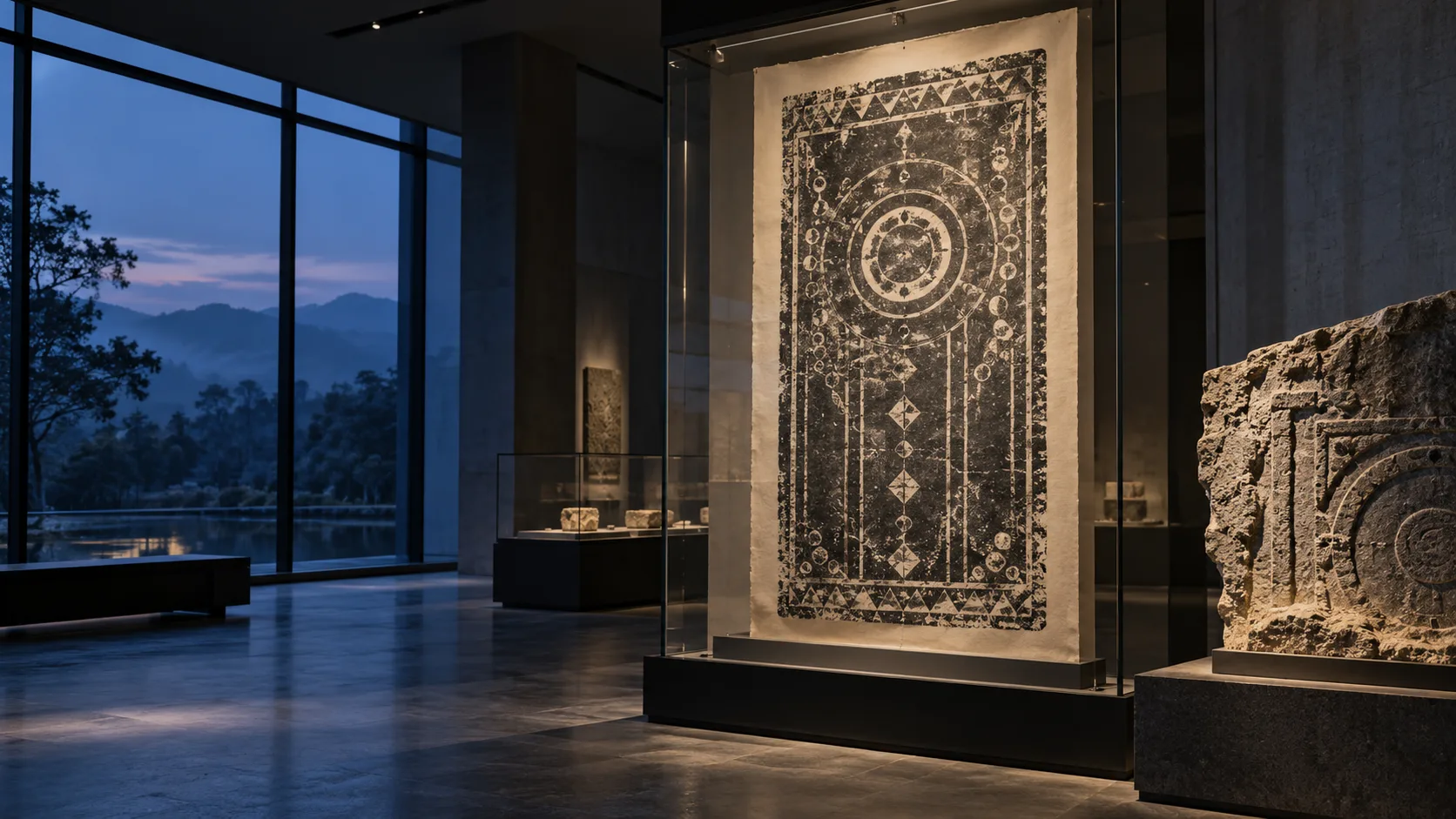
A rubbing is therefore neither the original monument nor a neutral photograph of it. It is a new object made at a particular time, by particular hands, with particular paper, ink, pressure and mounting. Reading that chain clarifies both the history of Chinese calligraphy and the documentary value of Wudang’s stone inscriptions.
Five objects, not one
The first text or image
A monument may begin with a brush-written text, a drawn design or a model assembled for carving. Even when a stele preserves calligraphy associated with a named writer, the visible stone line has passed through selection, transfer and cutting. The site’s history of Chinese calligraphy explains why medium matters: a brush trace, a carved groove and a printed impression are related, but they are not identical evidence.
The carved or cast surface
Stone, bronze, wood and clay behave differently. A cutter may clarify a turn, regularize a damaged stroke or interpret an ambiguous model. Later abrasion, cracks, recutting and repair alter the matrix again. The surface from which a rubbing is taken is thus one stage in an object’s life, not a timeless original.
The sheet, its date and its mounting
The rubbing has its own date. The Metropolitan Museum of Art, for example, identifies one object as a twentieth-century rubbing of a stele carved in 841, while another nineteenth-century rubbing records a stele dated 169. Album leaves, handscrolls and hanging scrolls can crop, join and reorder sheets, creating a second viewing structure. A catalogue label should separate the date of the inscription, the date of the carved surface, the date of the impression and the date of its mounting.
How black and white are made
Damp paper meets relief
In a common method, thin paper is placed over a clean hard surface, lightly dampened and pressed into recessed lines and around raised forms. After the sheet has settled, ink is patted over its upper surface. The Metropolitan Museum’s account of the eighteenth-century Hall of Three Rarities albums describes traced calligraphy being engraved in stone, paper pressed into the lines, and ink applied so the recessed characters remain white against black.
Incised and raised forms read differently
On an incised inscription, paper within the grooves may escape the ink and appear pale while the surrounding plane becomes dark. Raised relief can produce a different balance. The Shanghai Museum notes that rubbing has been used to record not only inscriptions but also the shape and patterns of bronzes, cliff carvings, seals and other hard objects. “Black characters on white” or “white characters on black” is therefore an observation to verify, not a rule to assume.
Pressure, seams and material leave evidence
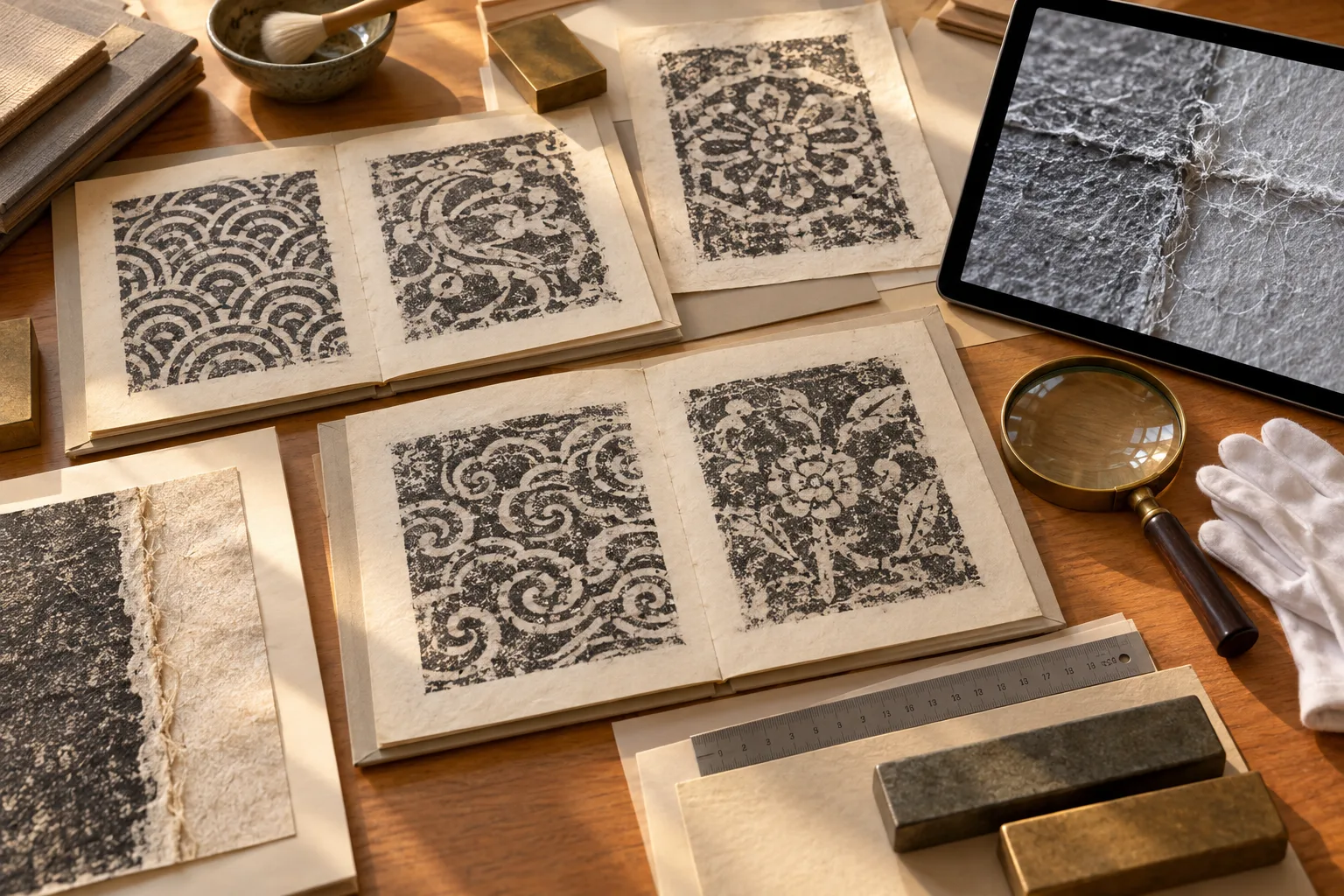
Uneven pressure, variations in moisture, ink density, paper fibers and sheet joins can all affect the result. A pale gap may be a recess in the stone, a damaged area, a fold or a maker’s choice. Conservation research treats historical rubbings as composite material objects—handmade paper, carbon-based ink, possible binders and later mounting—not as disembodied images.
What a rubbing preserves—and changes
Portability made comparison possible
Rubbings carried inscriptions and images away from monuments. Scholars, collectors and students could compare letter forms, compile epigraphic records and study models across distance. The Field Museum describes their long role in circulating historical data, poetry, religious texts, calligraphy and pictorial designs; Harvard-Yenching Library still identifies a dedicated Chinese Rubbings Collection within its research holdings.
A surface state can outlive the surface
An early impression may preserve lines later worn, broken or recut. That makes a dated rubbing valuable evidence, sometimes the best surviving witness to an earlier state. Yet it records only what its maker could reach and transfer at that moment. Lighting and depth are flattened; scale may be changed by mounting or reproduction; a damaged area can be mistaken for an ancient feature.
Copies form chains
Some famous calligraphies survive through several mediations: a brush original was traced, engraved, rubbed, recopied, recut and rubbed again. The Met’s Hall of Three Rarities set is explicit about this process, while its thirty-two album volumes show how reproductions could also establish a canon of scripts. Compare such examples with the site’s guide to the five script styles, but do not mistake a carved model for unfiltered brush movement.
Read the label before the line
Build a four-date record
Start by writing four separate entries: subject or text; original composition date if known; date of the surviving matrix; and date of this rubbing and mounting. Add material, dimensions, provenance and catalogue number. If a field is uncertain, leave it uncertain. This prevents a “rubbing of an ancient stele” from being casually described as an ancient sheet.
Compare object, rubbing and photograph
When a reliable photograph of the source surface exists, place it beside the rubbing. Look for reversed orientation, missing edges, cracks, joins and areas of unusually even black. Then compare another impression from the same matrix if possible. Differences can reveal deterioration, recutting or workshop practice. The Shanghai Museum’s survey of rubbing techniques is useful precisely because it treats rubbing as both documentary method and art, not as mechanical duplication.
A six-pass reading method
- Name. Identify the matrix material, subject, script and current format without collapsing them into one “original.”
- Date. Separate composition, carving or casting, impression and mounting dates.
- Orient. Determine how recess, relief and transfer produce the visible black-and-white relation.
- Inspect. Note paper fibers, seams, folds, losses, ink density, seals and later annotations.
- Compare. Use catalogued impressions, photographs and transcriptions to distinguish surface history from transfer effects.
- Protect. Study published or digitized examples; never rub, chalk, wet or touch heritage stone without explicit professional conservation authority.
A rubbing rewards the same slow, sequential attention as a scroll. The site’s guide to reading a Chinese handscroll offers a useful comparison: mounting, order and the viewer’s movement create meaning beyond the image alone. For rubbings, the central question is not “How faithful is the copy?” but “What stages produced this particular sheet, and what can each stage responsibly tell us?”
Research note: This guide draws on the Metropolitan Museum of Art’s records for the Hall of Three Rarities and dated stele rubbings; the Shanghai Museum’s exhibition overview; the Field Museum’s Chinese Rubbings Collection; Harvard-Yenching Library’s collection description; and peer-reviewed conservation research on paper and ink in historical rubbings. It describes reading and documentation, not instructions for taking impressions from cultural property.