Chinese Water Droppers: Flow, Form and the Scholar’s Desk
中国水滴:控水、造型与文人书案
A Chinese water dropper is small enough to disappear among larger writing tools, yet its job is precise: carry water to the inkstone in controlled amounts. Too little water leaves an inkstick dragging; too much can produce a weak pool that takes time to correct. The dropper therefore connects vessel design, hand movement and the gradual preparation of ink.
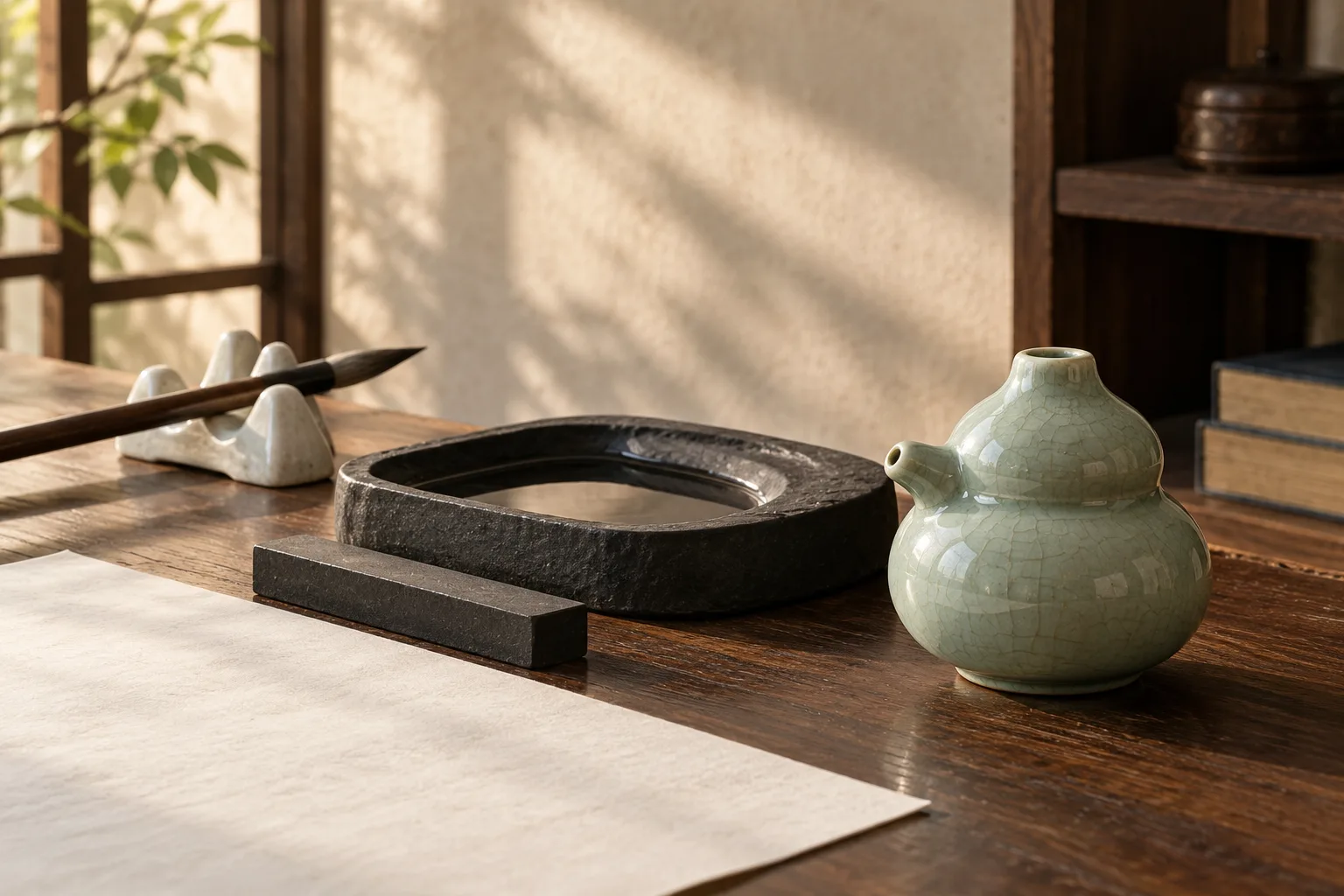
This guide extends the Four Treasures of the Study and the material guide to Chinese inkstones. It treats museum objects as dated witnesses rather than a single timeless standard. A catalogue name, opening, glaze or animal form can tell us much, but only when object record, construction and evidence of use are kept together.
Begin with function, openings and flow
The dropper belongs to the work of preparing ink
The Metropolitan Museum of Art describes a three-legged toad-shaped water dropper, dated from the Yuan to early Ming period, as a scholar’s utensil for controlling the amount of water added while grinding ink. This is the essential distinction: a dropper is not merely a miniature bottle. Its body stores a small reserve, while its outlet helps the user add water incrementally to the stone.
One opening, two openings and hidden filling points solve different problems
Some vessels have a narrow mouth from which water is tipped. Others combine a filling or air opening with a short spout, allowing the hand to regulate flow by angle or by covering and releasing a hole. The British Museum’s peach-form Dehua example records a filling opening in the base; its exterior form therefore conceals part of the working structure. Before interpreting an animal or fruit, locate every aperture and ask how the vessel could be filled, held and emptied.
A related water pot or washer is not automatically a dropper
Catalogue terms matter. A water pot may offer a wider mouth for dipping or transferring water; a brush washer receives water and pigment from a used brush; a dropper is designed for small additions. Historical names and present museum labels are not always identical, so form and recorded use should be compared rather than forcing every small desk vessel into one category.
Material and shape carry several kinds of evidence
Ceramic bodies connect desk tools to kiln histories
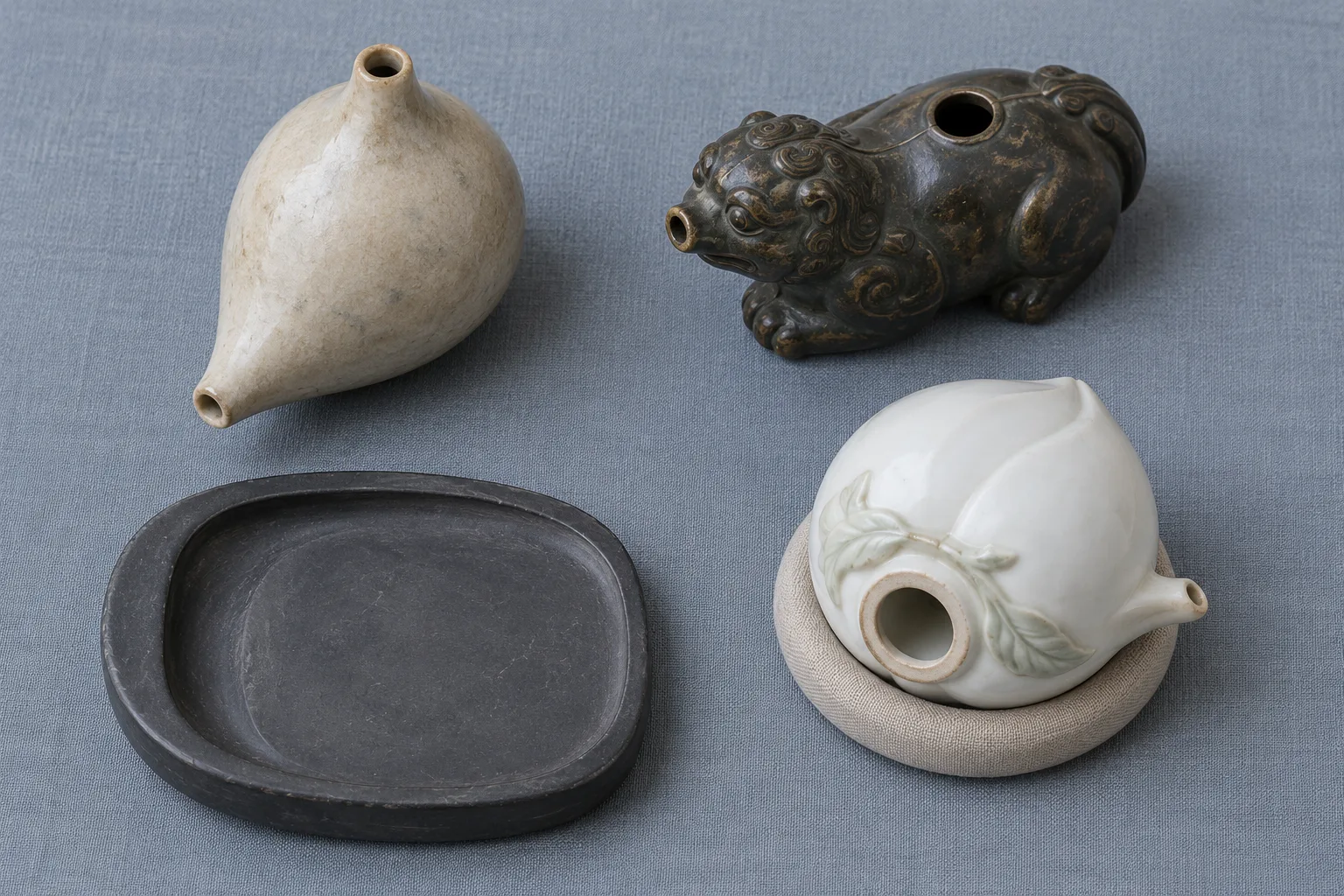
Museum records preserve droppers in stoneware and porcelain with Jun, Dehua, Jingdezhen and other ceramic associations. The Met’s Yuan-dynasty Jun-ware water dropper and the British Museum’s cicada-form porcelain example show why material, glaze, firing body and shape must be read together. A familiar glaze name does not by itself identify a kiln, date or intended user.
Animal and plant forms can be playful without becoming trivial
Toads, birds, peaches, cicadas and mythical creatures turn a practical reservoir into a small sculpture. The form may direct the hand toward a spout, disguise a filling hole or place symbolic associations on the desk. It can also reflect ceramic modelling and collecting taste. Interpretation should begin with the specific object record; the same creature does not carry one fixed meaning in every period and medium.
Archaistic design can link the writing desk to older vessel traditions
The Met notes that a Qing porcelain dropper in the form of a mythical creature resembles a bronze example in a Japanese scholar’s collection and relates to shared literati interest in stationery rooted in archaic bronzes. “Archaistic” does not mean that the object is ancient. It identifies a later act of looking back, translating an older visual language into another material and use.
Read the dropper within a changing scholar’s desk
The Four Treasures never stood alone
The Hong Kong Palace Museum’s guide to Qing imperial workshops and the scholar’s studio lists water droppers with brush pots, brush rests, paperweights and seals beside the Four Treasures. A working desk was an arrangement of interdependent tools. Continue with the site’s guides to inksticks, brushes and brush rests to see how scale and sequence shape that arrangement.
Portable sets change the relationship between vessel and stone
The National Museum of Asian Art notes that portable lacquered writing boxes could place an inkstone and water dropper in the base, with trays above for brushes and solid ink. In a fitted box, dimensions and lid clearance become part of an object’s identity. A loose museum display may separate components that once travelled and worked as a designed set.
Trade and collecting can give one form several biographies
A water dropper may be catalogued through excavation, shipwreck, court workshop, private collection or modern museum transfer. Those histories answer different questions. The British Museum’s wreck-associated toad-form stoneware dropper belongs to a documented cargo context; that context should not be silently transferred to visually similar objects without provenance.
Use a six-pass method at the desk or in a museum
Separate what you see from what the label supplies
- Identity: record the catalogue title, date range, place, material and dimensions.
- Openings: locate mouth, spout, air hole, base opening and any lid.
- Flow: infer cautiously how water could enter, move and leave; do not test a museum object.
- Surface: note glaze, clay body, metal, patina, moulding, carving, repairs and wear.
- Image: identify animal, plant or archaistic form only after mapping the working structure.
- Context: distinguish studio use, fitted set, court production, trade cargo and later collecting history.
Condition can interrupt the original function
A blocked spout, lost stopper, old repair or separated lid may make a dropper look impractical today. That does not prove it was ornamental from the start. Conversely, a vessel-shaped object should not be filled merely to “confirm” a theory. Handling, cleaning and testing belong to trained collections staff or to appropriate modern tools.
A small vessel reveals the tempo of calligraphy
The water dropper reminds us that ink preparation is incremental. Water, inkstick, stone and brush meet through repeated adjustments rather than one fixed recipe. Reading the object well means moving from opening to material, from material to hand, and from hand to the larger desk—without turning one elegant survivor into a rule for every workshop, period or calligrapher.