Origins and History of Chinese Calligraphy
中国书法的源流与历史
Chinese calligraphy has no single moment of invention and no straight line from an ancient script to a modern art. Its history survives in bones, bronzes, wood, silk, paper, stone, copies and rubbings. Each material preserves some things and changes others.
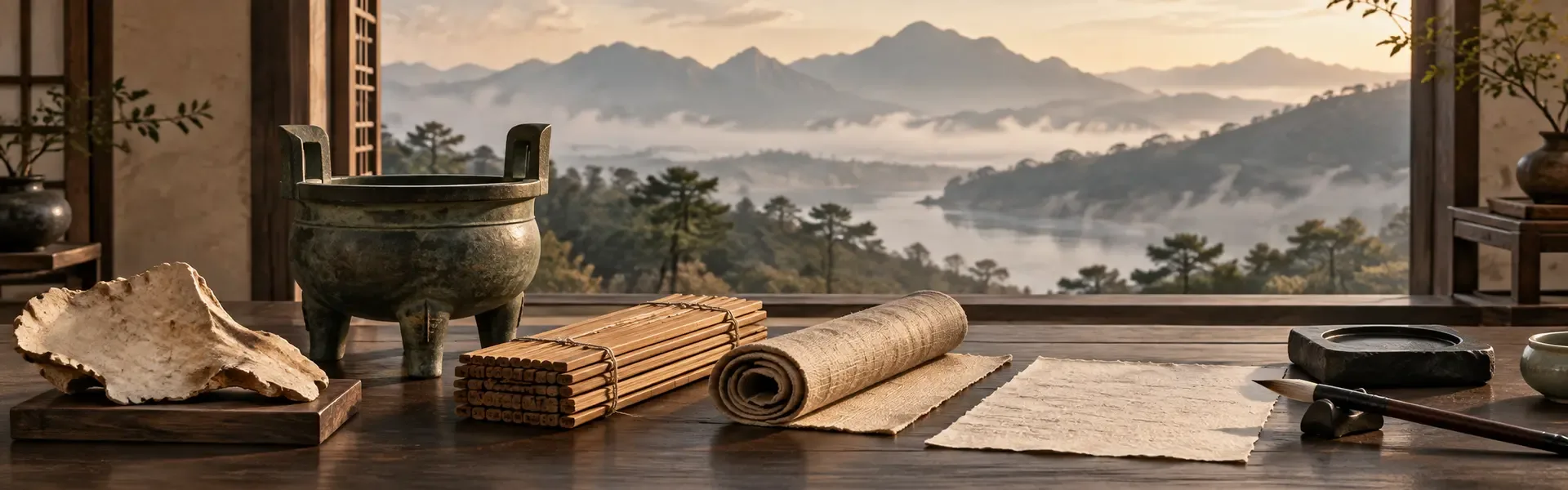
The safest way to enter that history is through identified objects. Ask what survives, when this object was made, what earlier model it may transmit, and how its date was established. This keeps admiration close to evidence without making the tradition feel less alive.
1. Begin with surviving evidence
An object label is a compact historical argument. It may give a period rather than a precise year, distinguish a named maker from an attribution, or describe a later copy of an earlier work. These qualifications are part of the object’s history, not obstacles to appreciation.
Before comparing styles, record the object’s material, format, date and stated relationship to any earlier model. A bone fragment, bronze vessel, handscroll and rubbing do not preserve writing in the same way. Their differences help explain what can—and cannot—be inferred from their visible lines.
2. Shang inscriptions and the limits of survival
Inscribed oracle bones from the Shang dynasty preserve an early substantial body of Chinese writing. Their survival shows an already developed writing practice used in a particular divinatory setting. It does not prove that every early act of writing used bone, or that other writing materials were absent.
Incised marks reflect both writing and the resistance of the surface. Avoid treating every narrow or angular line as a complete picture of early brush movement. When a museum record does not provide a transcription, a modern reader should not invent one from resemblance alone.
3. Bronze inscriptions and durable memory
Cast and inscribed bronzes preserve texts associated with ritual, lineage and political authority over long periods of early Chinese history. Their characters vary across regions, periods, workshops and objects; “bronze script” is therefore a useful broad label, not one uniform hand.
The process behind an individual vessel matters. A form transferred through a mould is not evidence that all bronze inscriptions were made in exactly the same way. Read the catalogue for that object, and distinguish the date of the vessel from the later history of copying its inscription.
4. Qin and Han transformations
The Qin state is associated with measures that regularised written forms for administration. This did not create one spoken language, nor did it freeze writing into a final shape. Regional practice, inherited forms and official models belong to a more complex history than a single act of unification.
During the Qin and Han periods, forms grouped under seal and clerical script were used and transformed across different contexts. Clerical writing cannot be reduced to a story in which anonymous clerks suddenly invented it for speed. Surviving manuscripts and inscriptions instead show changes in structure, stroke form and writing practice over time.
5. Materials shape what writing can do
Writing circulated on bamboo and wooden slips, silk, paper and other supports. Paper was present in the Han period, while later improvements, production and wider use changed the scale and conditions of writing. A traditional association with Cai Lun should not be retold as the invention of paper from nothing.
Brush, ink and surface work together. Absorbency, preparation and format affect an edge, a dry trace and the spread of ink. No single material “created” calligraphy, but changes in materials made different kinds of writing, preservation and circulation possible.
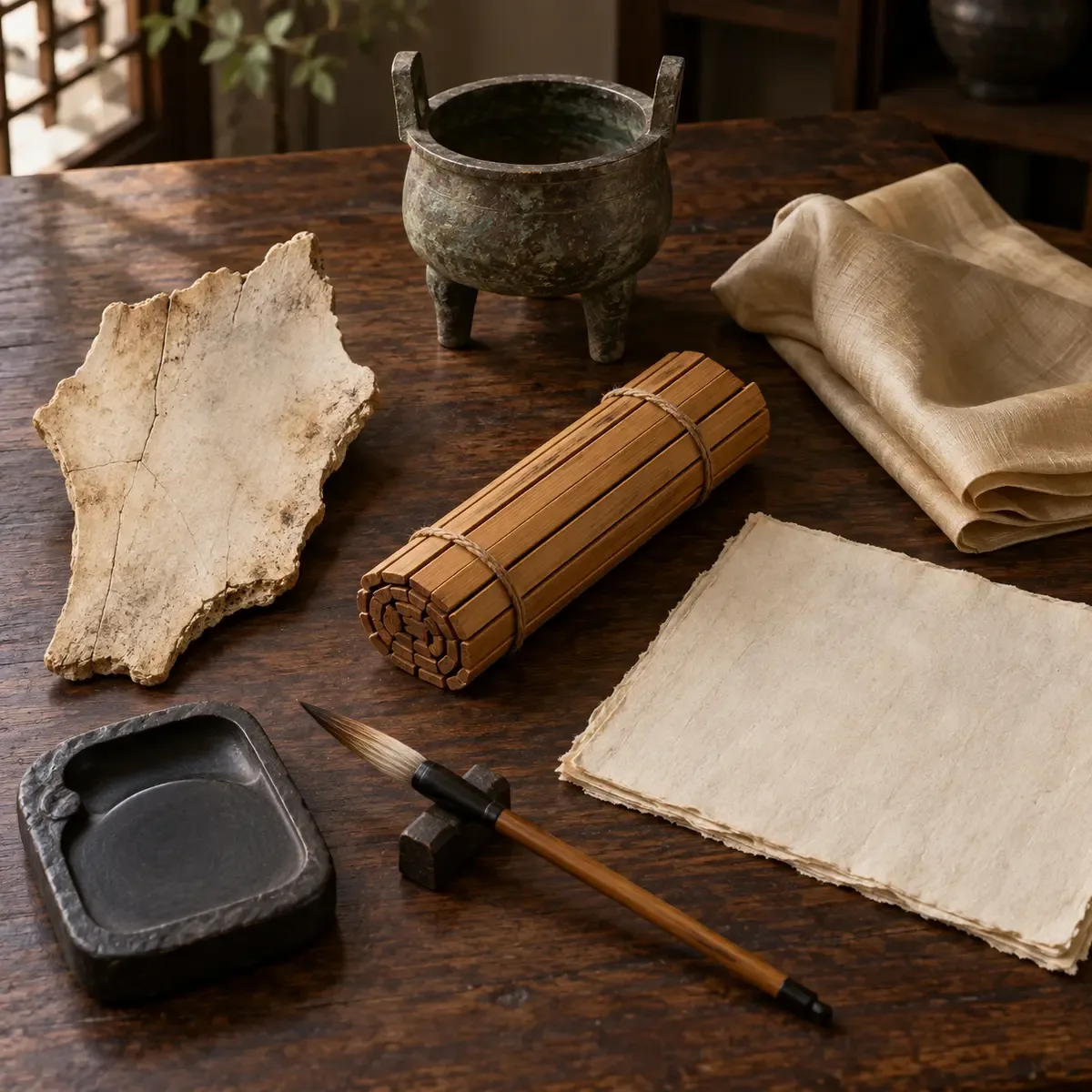
Editorial illustration of writing materials from different periods; not a reconstruction of one archaeological assemblage. AI-generated.
6. Script families overlap
Seal, clerical, regular, running and cursive are broad script families used to organise a varied field. They were not five consecutive stages in which each new script erased the previous one. Older forms could remain useful in seals, inscriptions, study and artistic revival while newer practices developed beside them.
The family name is only a beginning. Date, writer, region, purpose and medium can matter as much as the label. Continue with the guide to the five script families when the visual distinctions themselves are your main question.
7. Named writers and transmitted models
By the early imperial centuries, writings about calligraphy and the reputations of individual writers formed part of the tradition. Stories about brush washing, inspiration or unusual working methods can illuminate later memory, but a memorable story is not automatically contemporary evidence.
Wang Xizhi became an exceptionally influential model. Yet works associated with him often reach viewers through later copies, tracings, engravings and rubbings rather than an uncontested autograph. The relationship between a surviving object and an earlier model should always remain visible in the label.
8. Tang calligraphy was plural
Tang calligraphy includes influential regular-script models as well as running and cursive works. Writers such as Ouyang Xun, Chu Suiliang, Yan Zhenqing and Liu Gongquan are often studied through particular works and later reproductions. Their differences resist a single definition of the period’s style.
Accounts of inspiration, emotion or drinking may belong to the reception of a work, but they should not replace the object’s date, text and material history. Cursive has conventions and readable structure; calling it “wild” does not mean that legibility or disciplined practice was simply abandoned.
9. Return is also invention
Song and Yuan writers studied earlier models while developing new relationships among calligraphy, poetry, collecting and criticism. A return to antiquity was never a mechanical return to an unchanged past: the available copies, social setting and purposes of writing were different.
Zhao Mengfu’s Four Anecdotes from the Life of Wang Xizhi, for example, is an ink-on-paper handscroll of the 1310s. Wang is its subject and an important model; Zhao is the named maker of this later work. The object shows how historical reference and new creation can occupy the same scroll.
10. Engraving, rubbing and the history of copies
Model-letter collections and stone inscriptions allowed admired writing to circulate beyond a single sheet. Yet an engraving and the rubbing taken from it are separate material stages. The Smithsonian’s label for one volume of Model Letters from the Chunhua Pavilion distinguishes an engraving dated 992 from a twelfth-century rubbing.
Later study of stelae did not simply defeat the study of model letters. Writers and scholars used these bodies of evidence in different, sometimes competing ways. Copy quality, access, excavation and changing taste all shaped what people could see in the past.
11. A living history, not a story of decline
Brush writing no longer performs every task it once did, but this does not make modern calligraphy a remnant without daily life. It continues in education, public inscriptions, studios, exhibitions, religious settings and personal practice, alongside pens, printing and digital tools.
To read a work historically, note four things: maker or attribution; date of this object; material and format; relationship to an earlier model. Mark what is not established. Then return to the calligraphy guide for ways of looking at brushwork, spacing and text without turning observation into a claim about personality.