Calligraphy and Taoist Cultivation: Text, Attention and Practice
书法与道家修养:读懂文字,专注落笔
A brush, a sheet of paper and a passage worth reading can offer a modest starting point for cultivation: an opportunity to notice how we work, respond to difficulty and return to a task. Calligraphy can be approached in this spirit without claiming that every well-written character is a spiritual achievement.
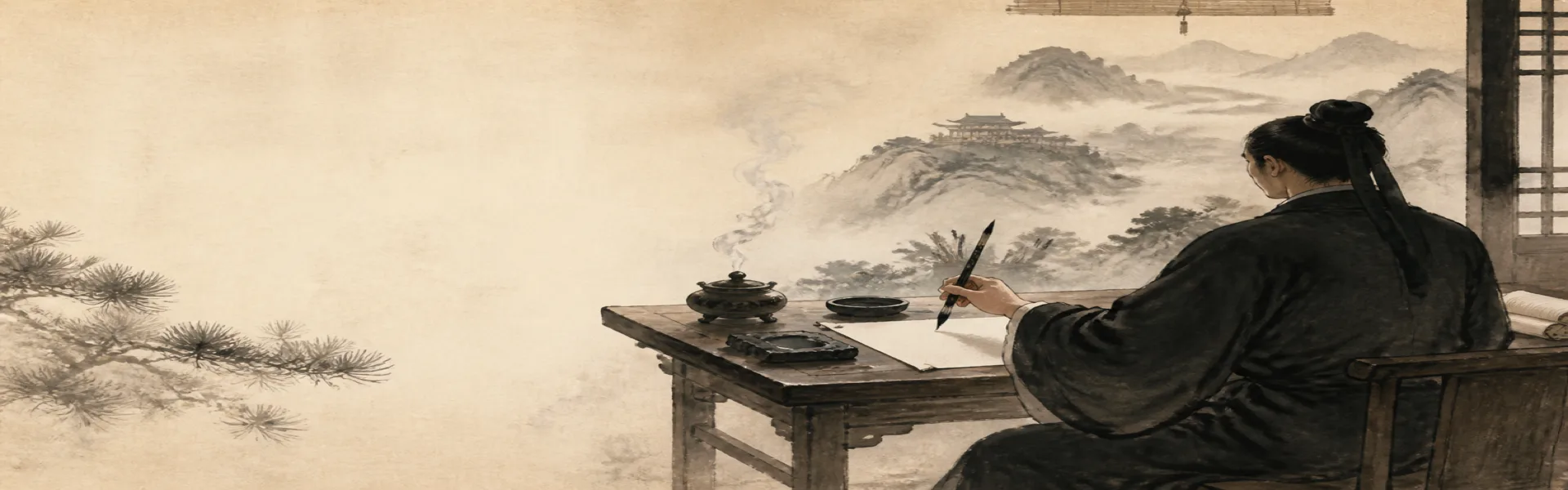
Its relationship with Taoism has more than one layer. Religious writing belongs to particular communities and purposes; philosophical ideas can shape how a writer understands practice; an ordinary study session can invite careful attention. Keeping these layers distinct makes their connections more meaningful.
What does cultivation mean here?
In this guide, cultivation means working thoughtfully on a practice and on one's relationship to it. A learner might pay attention to impatience, excessive force or the temptation to judge a page before understanding it. These are invitations to reflection, not a test of spiritual rank.
Calligraphy is not exclusively Taoist. A text, its use and its setting matter more than a mountain backdrop or a flowing style. Before calling a work religious, ask what evidence connects that particular object or act of writing to a religious context.
Religious writing has its own context
Taoist traditions include scriptures, talismans and ritual uses of writing. Their significance cannot be reduced to the appearance of a few brushstrokes. A temple's explanation of an object may involve its text, intended use and relationship to a particular tradition.
Reading about such writing is different from receiving instruction in a ritual. This page does not supply a talisman-making method or promise religious efficacy. When visiting a temple or attending a class, ask what may appropriately be studied, copied or photographed; do not assume one community's answer applies everywhere.
Know the text and the model
If you choose a passage from a Taoist text, read its meaning before treating it as a pattern. Record the title, edition or translation, and the passage you selected. A short, understood sentence offers a better basis for reflection than impressive-looking words whose meaning is unknown to you.
Also distinguish the author of the words from the calligrapher and from whoever made the surviving copy or reproduction. An old attribution is not the same as a surviving autograph. This matters when a model is presented as the work of a famous master.
Wu wei: a question about unnecessary force
Wu wei, often translated as non-action, does not simply mean doing nothing. In a calligraphy lesson, it can prompt a useful question: am I responding to the brush and paper, or trying to force a preconceived result? This is a way of interpreting practice, not a universal historical rule for calligraphy.
Learning still involves choices, repetition and feedback. Do not make effortless movement another demand to satisfy immediately. Notice where a grip becomes unnecessarily tight or where rushing prevents observation, then make one manageable adjustment.
Look at the spaces as well as the marks
Try looking first at the intervals between strokes, characters and lines. Does one area feel crowded while another feels open? What changes if you compare the whole page before examining individual strokes? These questions can make the unmarked paper an active part of your study.
A reader may connect this exercise with Taoist reflection on fullness and emptiness. Present that connection as an interpretation. Blank space by itself does not establish an artist's beliefs, and there is no single spacing formula that makes a page Taoist.
Read qi and character language carefully
Historical discussions of calligraphy use bodily, natural and moral comparisons. When a teacher or text speaks of qi, spirit or strength, ask how the term is being used in that setting. Do not automatically replace a traditional term with a modern scientific explanation.
For practical feedback, name what you can point to: a change in ink density, a broken connection or a repeated hesitation. Such observations do not measure a person's virtue, health or spiritual attainment. A difficult page need not become a judgment on its writer.
Prepare a comfortable writing session
Choose a stable surface, usable lighting and a position in which you can work without strain. Adjust the paper and the support for your arm to suit the task; there is no need to imitate a dramatic pose from an illustration. Pause or change position if writing becomes uncomfortable.
For the ordinary brush study suggested here, breathe normally. Do not hold your breath or force a whole character into one exhalation. Ground ink and bottled ink can both serve the exercise: the point is to work with the materials available, not to turn preparation into an authenticity test.
An optional exercise: observe, write, compare
Choose a small amount of legible text and a clearly identified model. Read the words, then inspect a few features such as spacing, stroke direction and changes of thickness. Write a first attempt without trying to fix every uncertainty at once.
Set the brush down and compare one feature with the model. Make a second attempt with that feature in mind. Keep both sheets so that differences remain visible. End when you have a useful observation, or sooner if you need a break; a longer session is not inherently a better one.
Reflect without promising a result
A short note can be enough: what did I notice, what changed, and what would I like to ask a teacher? Distinguish a visible difference in the writing from a personal feeling about the session. You may feel settled, frustrated, curious or simply tired.
None of those responses proves or disproves the value of calligraphy. This exercise carries no promise of a particular mental state and is not presented as medical treatment. Its immediate aim is narrower: to make one period of study more attentive and easier to discuss.
Bring these questions to Wudang
In a Wudang class, ask which text and model are being used, what the teacher wants you to observe, and whether the activity is artistic study, religious practice or a personal combination. A clear answer helps visitors participate respectfully without assuming that every local lesson follows the same method.
Continue with our calligraphy history guide to understand originals and later copies, or the five-script guide to compare writing styles. Return to the calligraphy overview when you are ready to choose another area of study.