Chinese Calligraphy Masters and Reading Paths
中国书法名家与阅读路径
Names such as Wang Xizhi, Huaisu, Su Shi, Zhao Mengfu and Dong Qichang appear often in histories of Chinese calligraphy. A list of names, however, is not yet a reading path. The more useful starting point is an identified work and a question you want to explore.
This guide shows how to read an object record, recognise layers of transmission and choose resources for looking or practice. It offers selected entry points rather than a complete canon, a ranking of writers or a claim that one model suits every learner.
Start with a question, not a ranking
Decide what you want to understand: the structure of regular script, movement in running or cursive writing, the use of a handscroll, or the history of copying and rubbings. A focused question makes it easier to choose one work and compare it carefully.
Terms such as master and masterpiece record histories of admiration, collection and teaching. They do not make every work by a named writer equally useful for the same purpose. Begin with what the object can show, then learn how later viewers valued it.
Read the catalogue before the brushwork
Record the title, named maker, attribution wording, object date, material, format, dimensions and accession number. Notice whether the date belongs to the supposed original composition, the surviving sheet, a later copy, an engraving or the particular rubbing you see.
Words such as attributed to, after, copy of and rubbing after are evidence, not disappointments. Compare the museum's description with the visible object. If its opinion has changed, keep the uncertainty rather than silently promoting the work to an autograph.
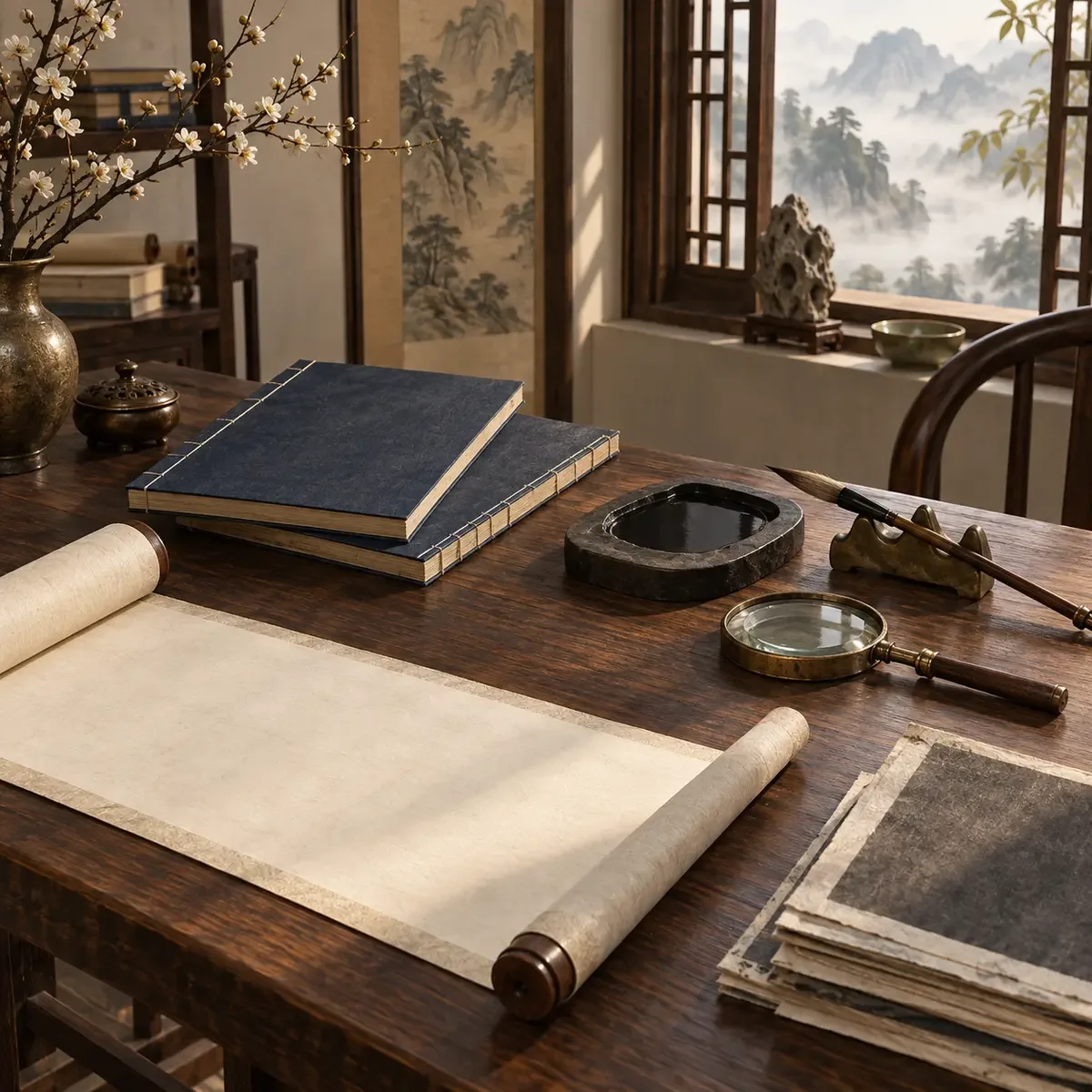
Editorial illustration of a reading table for comparing catalogues, reproductions and calligraphy materials. AI-generated; no historical document is represented.
Early models reach us through transmission
Wang Xizhi remains central to later calligraphic study, yet the surviving evidence often comes through tracing, copying, carving and rubbing. The Met labels its On the Seventeenth Day as a thirteenth-century rubbing of fourth-century texts and explains that versions differ in quality.
That layered record lets you ask better questions. What belongs to the letter text, the transmitted model, the carved version, the paper impression or later mounting? The History guide explains these date layers in more detail.
Compare particular works from the Tang
Do not reduce Tang calligraphy to one fixed group of regular-script masters. Select a clearly identified inscription, rubbing or manuscript and note its format. Then compare structure, spacing and line quality with another object rather than copying an adjective attached to a famous name.
The National Palace Museum presents Huaisu's Autobiography as a handscroll dated 777 and describes both speed and control in its cursive movement. Read those observations against the long format itself; a biography or a story about temperament is not a technical instruction.
Follow change within and across later writers
Letters associated with Su Shi, Mi Fu and other Song writers can be studied as situated acts of writing, not only as samples of a period style. Look at addressee, purpose, scale and current attribution. One sheet should not be made to stand for everything its writer produced.
Later study of earlier models also produced new work. Zhao Mengfu's engagement with older traditions and Dong Qichang's copying belong to different historical settings. A catalogue may even compare versions and question an attribution; that disagreement is part of the evidence.
Broaden the field and notice what is missing
A canon reflects survival, collecting, publication and access as well as artistic practice. Women wrote calligraphy, but fewer names and objects entered the histories most often repeated. Add documented works when the evidence is available without making one figure represent every woman who wrote.
Attribution matters here too. A museum may label an image After Guan Daosheng while identifying the surviving artist as unknown. Preserve both statements. Search beyond a familiar list by format, period, region and collection, and distinguish a historical gap from proof that no one practised.
Read theory as an argument in context
Treat a historical text on calligraphy as a writer's intervention, not a timeless instruction manual. Ask when it was composed, what version or translation you are reading, which script or audience it addresses and whether a later preface or attribution has been separated from the text.
Metaphors such as bone, flesh, force and spirit can guide attention, but they need interpretation. Do not turn them into measurements of moral worth or claims that handwriting reveals a complete personality. Use the Brushwork guide to bring descriptive language back to visible marks.
Choose the kind of book you need
A survey maps periods and terms; an exhibition catalogue studies actual objects; a monograph follows one writer or problem; a modelbook supports close comparison in practice. Check the author, full title, publisher, year, edition and the works illustrated before deciding what the book can answer.
Useful verified starting points include the object-based catalogue The Embodied Image (Princeton, 1999) and Lothar Ledderose's Mi Fu and the Classical Tradition of Chinese Calligraphy (Princeton University Press, 1979). Their scopes differ. Neither replaces a clear reproduction of the exact model you intend to study.
Compare reproductions without inventing an original
An ink rubbing, a printed photograph and a digital image are different kinds of record. Lighting, scale, paper tone, stitching and compression can change what seems prominent. Note the source and dimensions, then compare like with like where possible.
If two reproductions disagree, describe the difference before explaining it. The cause may be another rubbing, state, photograph, crop or colour treatment. The disagreement does not by itself reveal which edge, tone or gap belonged to a lost original.
Build a small reading-and-practice route
Choose one identified work, one reliable object record and one question for a short cycle. Look at the whole format, select a few details, read the catalogue, then return to the image and note what changed in your understanding. If practising, label your sheets with the model and reproduction used.
Ask a teacher, curator or knowledgeable reader a specific question: which part of the record affects this interpretation, which reproduction is being compared, or which visible feature supports the description? Continue with the Five Script Styles guide or return to the calligraphy overview to choose another route.