Chinese Seals and Seal Carving: Script, Surface and Impression
中国印章与篆刻:文字、印面与钤印
A Chinese seal can be read in three connected forms: a material object held in the hand, a carved matrix whose design is reversed, and an impression left on paper. Keeping those forms separate prevents several common mistakes. A beautiful red mark is not the whole seal; a famous name is not automatic proof of authorship; and “seal script” is not one unchanging design system.
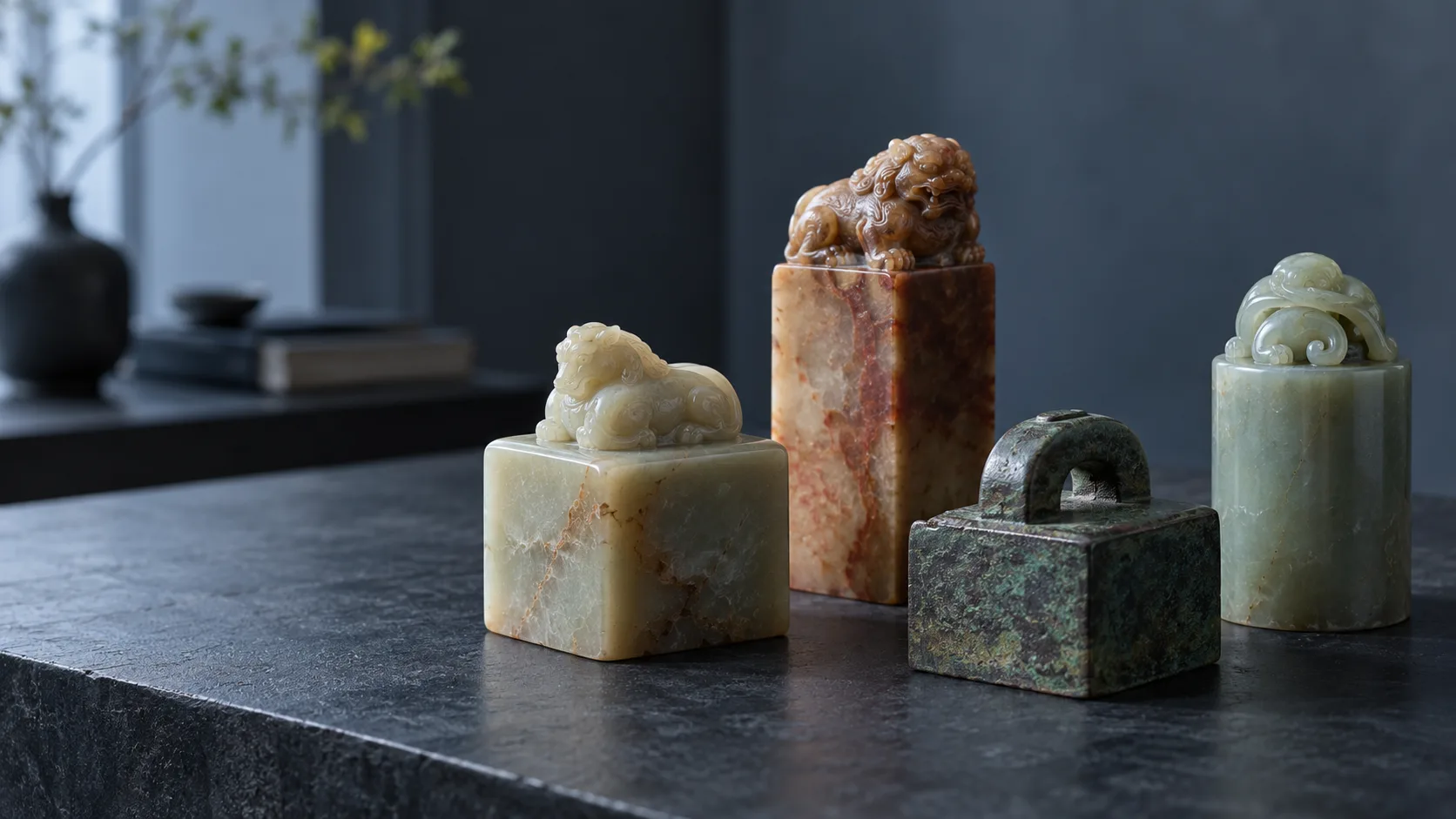
This guide extends the site’s introductions to Chinese calligraphy and the five script families. It focuses on looking: what to record, what a catalogue can establish, and where interpretation should remain cautious.
Begin with object, matrix and impression
1. The object has a body and a history
First look at the complete seal. Record its material, dimensions, shape, knob or handle, side carving, wear and any case or documented accessories. Stone, metal, jade, bamboo, wood and ceramic examples survive, but material alone does not determine date or status. The Palace Museum’s overview traces changing official and private uses while showing how forms and materials varied across long periods.
A catalogue may separate maker, carver, commissioner, owner and later custodian. The Smithsonian’s Fengwan sheng seal, for example, records a bamboo object commissioned in 1964 and recarved in 1972. One small object can therefore contain more than one date and more than one participant.
2. The seal face is a reversed matrix
The carved face is made to print, so its arrangement normally appears reversed before stamping. Examine the outer border, the relation of characters to empty space, the depth and direction of cuts, broken edges, repairs and remaining paste. Do not rotate a photograph until the documented top of the object is clear, and do not supply an attractive reading from shape alone.
A matrix may be carved in relief or intaglio, and both can be combined. Museum records should control the terminology for a specific object. The British Museum’s modern four-character seal, for instance, explicitly identifies an intaglio face in small seal script.
3. The impression is a second object
An impression records contact among matrix, paste, pressure, paper and the hand that stamped it. Uneven colour can come from a worn face, dry paste, soft backing, paper texture or the act of pressing. It should not be turned immediately into a story about age or quality.
Compare a documented impression with photographs of the matrix when both are available. The Metropolitan Museum’s 1981 pair “Xie, Zhiliu” presents object and impressions together and notes how two archaic-script choices change their pictorial effect.
Read a long history without flattening it
4. Seals served authority, identity and exchange
Seals functioned as credentials for states, officials and individuals, and they also entered collecting, painting, calligraphy and the scholar’s studio. These roles overlap but are not interchangeable. An official seal, a personal name seal, a studio-name seal and a collector’s mark ask different questions about authority, ownership and use.
The Palace Museum places the earliest transmitted excavated examples in the Warring States period and describes later Qin–Han systems, but this broad chronology is not a shortcut for dating an unprovenanced seal. Establish the object record first.
5. Qin and Han models remained resources, not frozen rules
Forms now grouped as seal script were regularised in Qin and Han contexts, yet surviving writing is more varied than one textbook alphabet. The Met’s Eastern Han silver seal is one dated object: its turtle knob, material, square format and inscription belong to that record, not to a universal blueprint for all Chinese seals.
Later artists studied ancient seals, bronzes and stone inscriptions, selected features and developed new styles. Read “archaic” as a historical and artistic claim to investigate, not as proof that a later seal was made in antiquity.
6. Soft stone changed literati seal carving
By the late sixteenth century, soft carving stones helped seal carving become a prominent literati art. The Met’s pair of twentieth-century soapstone seals explains this material turn and also reminds us that valued stone has its own extraction and collecting history.
Calligraphy, layout, carving and the body of the stone could now be considered together. The Met’s Xie Zhiliu exhibition overview proposes four useful aspects: stone, knob decoration, calligraphic style of the legend and carving style. They are connected, but none can date or authenticate an object by itself.
Read form, script and printed colour together
7. Body, knob and side inscription frame the face
The body affects how a seal is held and displayed. A knob may be a simple loop, an animal, an abstract form or no carving at all. Side inscriptions can record a carver, recipient, date, quotation or later intervention, but every line needs transcription and source checking. Ornament does not automatically indicate official rank, and polish does not prove age.
For related studio materials, see the Four Treasures of the Study. A seal belongs near brush, ink, paper and inkstone in many artistic settings, but it has its own materials, tools and evidence.
8. Seal script is a family, not a cipher
Seal makers worked with historical character forms, stylised variants and the demands of a small square or rectangular field. Lines may be compressed, extended, bent or balanced against empty space. This makes an impression visually powerful and sometimes difficult to read.
Begin with a museum transcription rather than guessing character by character. Compare the legend with dated examples and dictionaries appropriate to the claimed period. A modern design can deliberately invoke early scripts; resemblance is not identity.
9. “Red” and “white” describe the printed result
In a relief or zhuwen (朱文) design, the raised lines take paste and usually print as red characters against the paper. In an intaglio or baiwen (白文) design, recessed characters usually remain the paper colour while the surrounding field prints red. Wear, mixed techniques and imperfect stamping can complicate the result.

The visual rhythm comes from the relation of printed and unprinted space, not just from decoding words. Study border thickness, density, asymmetry and how one character answers another before declaring the design crude, elegant or ancient.
Use seals as evidence without asking them to prove too much
10. Name, studio and leisure seals do different work
A personal seal may give a name, courtesy name or art name. Other seals may name a studio, quote a phrase, express a wish or act as a collector’s mark. The wording, documented owner, location on the object and relationship to other inscriptions all matter. A seal can be culturally and visually important even when it does not identify the maker of the surrounding work.
On paintings and calligraphy, distinguish maker-associated marks from later collectors’ and imperial seals. The guide to reading a Chinese handscroll explains how mounting, colophons and seals can accumulate across generations.
11. A famous impression is a lead, not a verdict
Seals can be copied, recut, transferred, stamped later or misread. Paste and pressure also change an impression. A match with a published seal is useful evidence, but attribution should also consider inscription, materials, style, provenance, documented ownership and technical examination.
At Wudang, plaques, couplets and other inscriptions have their own building context. The article on reading plaques and couplets shows why placement, patronage and later renewal must be recorded separately rather than collapsed into a single famous name.
12. A six-step method for looking
- Identify the record. Note collection, object number, stated title, date range, material, dimensions and provenance.
- Separate the forms. Distinguish photographs of the seal body, carved face, side inscriptions and paper impression.
- Describe before translating. Record format, border, relief or intaglio, density, damage and orientation before attempting a reading.
- Check the legend. Use the museum transcription, suitable reference works and dated comparisons; preserve uncertainty where readings differ.
- Ask what the seal did. Was it official, personal, studio-related, expressive, commemorative or a collector’s mark? Avoid assigning a role from appearance alone.
- Test the claim. Compare seal evidence with material, inscription, provenance and the surrounding work; treat each conclusion according to its source.
Historic seals should not be cleaned, inked or stamped casually, and carving tools are sharp. Learn with a qualified teacher, practise only on modern materials intended for the purpose, and use digital museum records to compare important objects. Careful looking begins by preserving both the object and the limits of what we know.