The Guqin as Taoist Cultivation
古琴作为一种修行
The guqin is regularly described as an instrument of Taoist cultivation. As with the other arts on this site, the description contains something real and a good deal that has been added, and the useful work is to sort them.
This page covers the documented Taoist involvement with the instrument, the cosmological framework attached to its music, the important fact that its moral framing is originally more Confucian than Taoist, and one third-century argument that undermines much of the whole edifice and is worth taking seriously.
Three separable claims
The first claim is historical: that Taoists played the instrument and that it had a place in Taoist establishments. This is straightforwardly true and documented.
The second is symbolic: that the instrument's design and its music theory encode a cosmology shared with Taoism. This is also true, with the important qualification that the cosmology in question is general Chinese correlative thinking rather than anything specifically Taoist.
The third is functional: that playing the instrument produces a change in the player of the kind Taoist practice aims at. This is the interesting claim, and it is the one that can be partly examined.
Taoists and the instrument
Taoist priests played the guqin, some monasteries maintained the practice, and several collections of tablature were compiled in Taoist contexts. A number of pieces have explicitly Taoist subjects, and prefaces in some collections frame playing as a cultivation practice in Taoist terms.
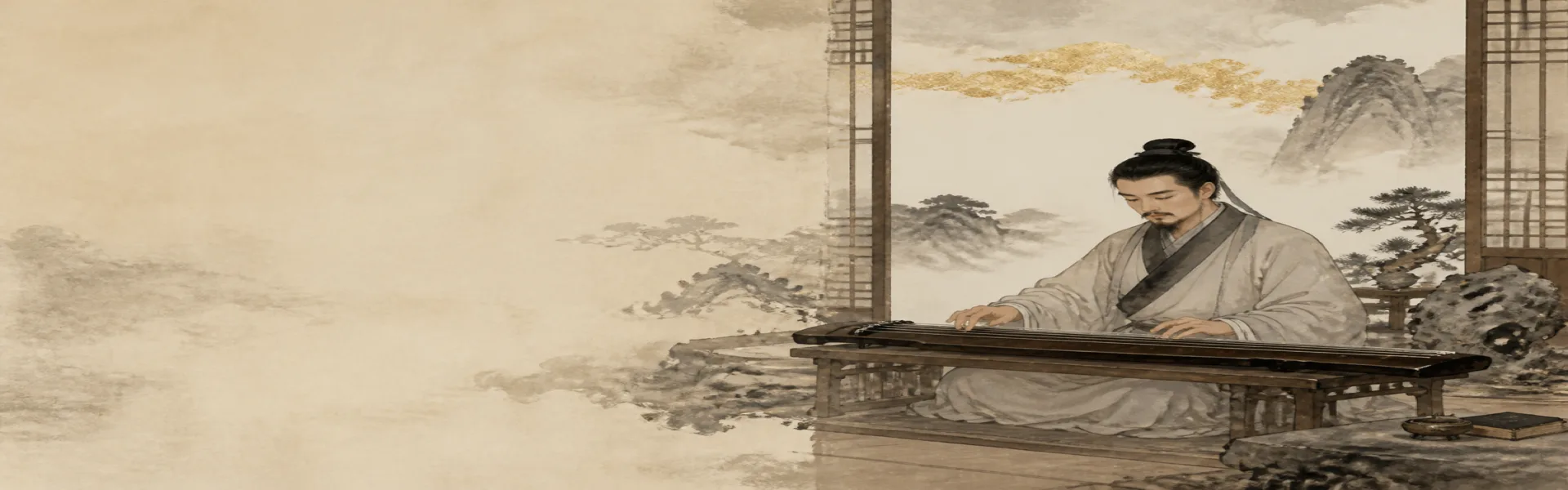
The connection is also geographical. Taoist establishments were often in mountains, and mountains are where the tradition located the ideal setting for playing: outdoors, under pines, beside water, alone or with one companion. The image of a Taoist or recluse playing on a mountain is not only a painter's convention; it describes a real situation.
What is not the case is that the guqin was a Taoist instrument in the sense that it belonged to Taoism or was developed by it. It belonged to educated people generally, and Taoists were among them.
The cosmological framework
The music theory attached to the instrument sits inside the general Chinese system of correspondences. The five-tone scale corresponds to the five phases, to directions, to seasons and to social roles. The twelve pitch standards correspond to the twelve months, and generating them was understood as a mathematical and calendrical matter as much as a musical one. Correct pitch standards were held to be connected to correct government, which is why dynasties periodically revised them.
Add to this the instrument's own symbolism: the length corresponding to the days of the year, the round top and flat bottom as heaven and earth, the strings as the phases, the markers as the months.
All of this is genuine and old. It is worth being precise, though, that this framework is shared across Chinese thought and is at least as prominent in Confucian ritual theory as in Taoist writing. Encountering it does not by itself indicate a Taoist context.
The Confucian claim comes first
This point is regularly left out and it changes the picture. The classical framing of the guqin as an instrument of moral cultivation is Confucian in origin. The classical texts treat music as one of the two pillars of civilised order alongside ritual, hold that music expresses and shapes character, and assign to it the function of harmonising the person and the state.
There is an old gloss, essentially a pun, that the word for the instrument means to restrain: the qin restrains, in the sense of curbing what is excessive in the player. That formulation is a Confucian one, and it is the dominant framing in the classical literature.
The Taoist contribution is different in emphasis. It concerns plainness, the value of what is not sounded, and the ideal of playing without effort or intention. These are real contributions but they are additions to a moral framework that was already in place and was not Taoist.
What Taoist thought adds
Three ideas from the Taoist texts entered the aesthetics of the instrument and are still central to how playing is judged.
The first is plainness. Restraint, absence of display, avoidance of anything ingratiating: the highest praise for a player uses words meaning plain, distant, clear and quiet. This is directly continuous with the Laozi's preference for the unadorned.
The second concerns silence. The Laozi says that the greatest sound has little sound, and this is taken in the tradition as authorising the long silences in the music and the preference for a quiet instrument. There is also a famous anecdote about Tao Yuanming keeping a stringless instrument and stroking it, saying that he obtained the idea of it and needed no sound. Whether he really did this is beside the point; the story was told because it expressed something the tradition believed.
The third is non-deliberate action. The player should eventually not calculate, and the fingers should act without the interposition of intention. This is the same idea found in the Zhuangzi's craftsmen and in calligraphy, and it is probably the most practically useful of the three.
The argument that cuts against all this
Ji Kang, who is central to the instrument's legend, wrote an essay arguing that music has no inherent sorrow or joy. His position is that sounds have properties of their own — they are fast or slow, high or low, agitated or calm — and that the emotions listeners feel are already in the listeners and are merely occasioned by the music, not contained in it.
This is a genuinely radical argument and it was recognised as such at the time, because it undermines the Confucian claim that music shapes character and that a state's music reveals its condition. If music carries no inherent emotional content, the whole apparatus of correspondences between modes, seasons and moral qualities loses its foundation.
It is striking that the most celebrated figure in the instrument's mythology held this view. Anyone told that guqin music produces specific spiritual states should know that the tradition's own most famous player argued the opposite, and that his essay is still read.
What playing actually does
Set the metaphysics aside and something checkable remains, and it is the same set of things that appears in calligraphy and in tea.
Playing requires an upright seated posture held for a long period. It requires sustained attention to small differences, because the music consists of small differences. It gives immediate feedback: a rushed slide or a hard press is audible at once. It is done slowly, and it cannot be done well while distracted or agitated.
Whether this constitutes cultivation depends on what you mean. It is a reliable way of spending forty minutes in a state of concentrated, unhurried attention with the body settled and the breathing regular. That is not nothing, and it does not require any claim about qi or cosmology to be true.
Playing alone
The tradition's insistence that one plays for oneself rather than for an audience is worth taking seriously, because it has a practical consequence. Playing for others introduces a concern with the result that interferes with attention to the process, and this is exactly the concern the practice is supposed to loosen.
The modern revival has largely reversed this, with concerts, competitions and graded examinations. Practitioners disagree about it, and the disagreement is not merely nostalgic: an instrument this quiet, amplified for a hall, is being asked to do something it was not designed to do, and the adjustments required change the playing.
None of this is an argument against performing. It is an argument for keeping a private practice alongside it, which is what many players do.
Trying it as a practice
If you want to approach the instrument this way rather than as a performance skill, a few adjustments help and none of them require any belief.
Begin each session the way you would begin sitting practice: settle, notice the breath, and let the hurry of whatever preceded it drain off before touching the strings. Tune the instrument slowly and attentively rather than treating tuning as an obstacle before the real activity; it is the same transition that grinding ink provides in calligraphy.
Play slowly, and play one short piece repeatedly rather than working through several. Resist evaluating while playing, since the note you become self-conscious about is the note that goes wrong, exactly as in calligraphy. And stop when attention goes rather than finishing what you planned, because continuing inattentively trains the wrong thing.
None of this makes you a better player quickly. It does make the forty minutes different from forty minutes of drilling, and if the cultivation claim has any content, this is where it is.
An honest boundary
Two things should be kept apart. That playing the guqin trains attention, requires settled posture and breathing, rewards patience, and shares an aesthetic vocabulary with Taoist writing is well supported and testable by anyone who tries it.
That particular modes or pieces act on particular organs, that playing circulates qi in specifiable ways, or that the instrument transmits the player's cultivated state to a listener are claims of a different kind. They belong to the correlative system described above, they were sincerely held, and they are not established by the observable effects of playing.
Key points
- Taoists played the instrument and compiled tablature, but the guqin belonged to educated people generally rather than to Taoism.
- The cosmological framework around its music is general Chinese correlative thinking and is at least as Confucian as Taoist.
- The classical framing of the instrument as moral cultivation is Confucian in origin, including the old gloss that the qin restrains.
- Taoist thought contributed plainness, the value of silence and the ideal of non-deliberate action, which remain central to how playing is judged.
- Ji Kang, the tradition's most celebrated figure, argued that music contains no inherent emotion, which undermines much of the cultivation claim.
- What is checkable is that playing trains sustained attention with settled posture and immediate feedback, which needs no metaphysical support.