How to Read a Guqin Handbook: Tablature, Editions and Dapu
如何读古琴谱:减字谱、版本与打谱
A guqin handbook is not simply “sheet music.” It can join tablature, fingering explanations, tuning information, prefaces, melody titles, commentaries and publishing history in one object. Reading it well means asking what the page instructs, what it leaves to a player, and which edition or performance tradition stands behind the copy in front of you.
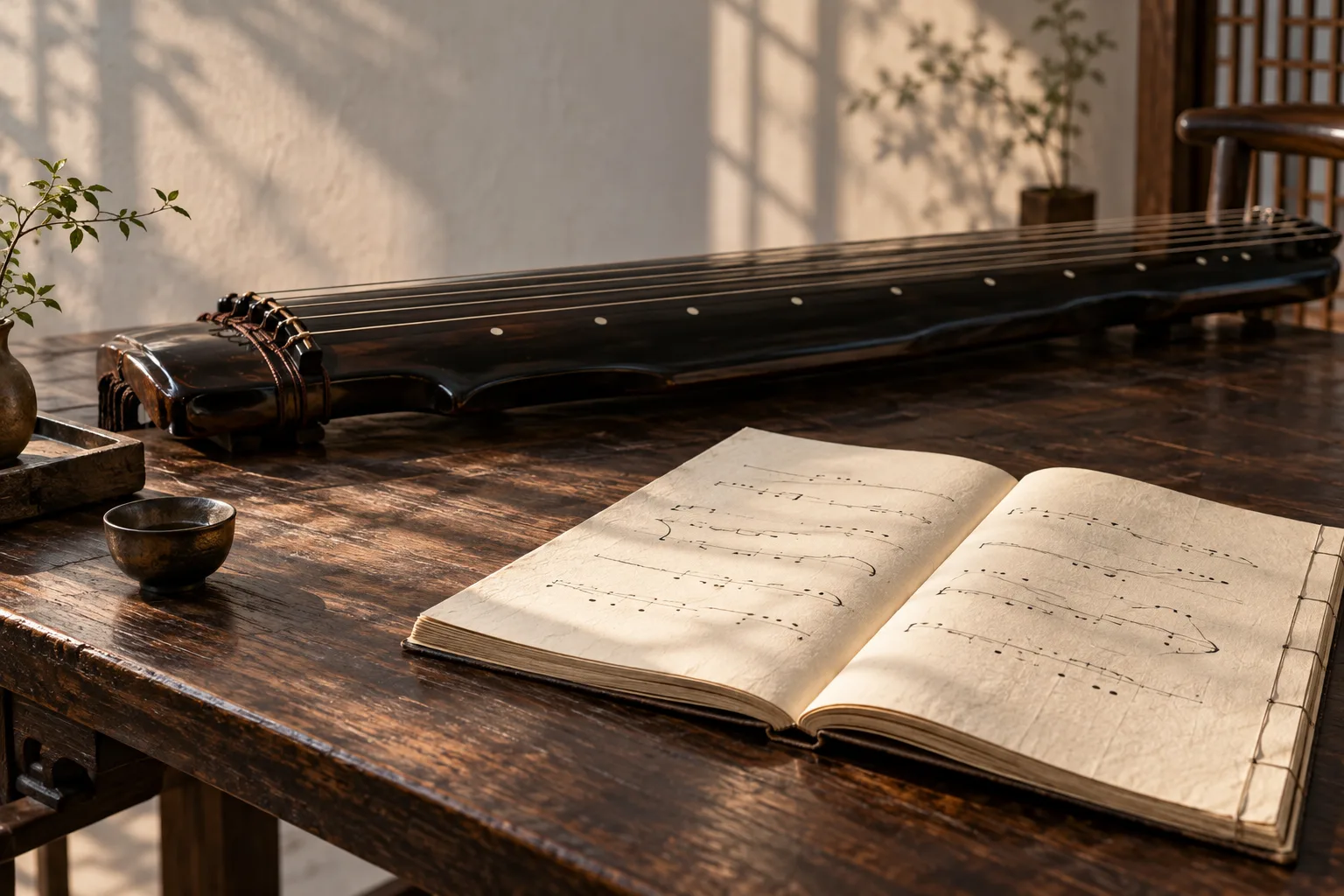
This guide extends the site’s Guqin gateway, instrument and source history, introduction to gesture and notation, melody guide and study pathway. Its subject is the handbook as evidence: how to identify a score witness, compare versions and understand dapu without treating an old page as a complete recording.
Read the handbook before reading the tune
A qinpu can be a score collection and a book of instruction
The word qinpu (琴谱/琴譜) commonly refers to guqin tablature and to books that collect it. Individual handbooks vary. Some foreground melodies; others also contain essays, tuning diagrams, fingering explanations, biographies, prefaces or statements about transmission. The table of contents and preliminary matter therefore belong to the musical evidence rather than serving as disposable decoration.
Begin with the title, compiler or editor, date, place or publisher when known, number of fascicles, sequence of pieces and any notes attached to them. Do not merge a modern reprint, a scan of an older block-printed edition and a teacher’s copied score into one undifferentiated “ancient book.”
Format and page order shape how information is found
Traditional Chinese books can be folded, stitched, rebound or reproduced in later formats. A guqin score may run through vertical columns and may place headings, commentary and tablature in visually different zones. Fold lines, page frames, missing leaves, repairs and later pagination can affect what seems to follow what.
The site’s guide to Chinese thread-bound books explains why binding and fold direction matter. For a qinpu, material form can also reveal whether one is reading an original leaf, a facsimile, a rearranged reproduction or a modern teaching edition with added notation.
Prefaces and colophons make claims, not guarantees
A preface may explain why a collection was assembled, honour a teacher, define a lineage, praise antiquity or describe editorial choices. Such statements are valuable evidence for the people who wrote and transmitted the book. They are not automatic proof that every attributed composer, date or melody origin is historically secure.
Record who wrote a statement, when it entered the surviving edition and whether the wording belongs to the compiler, a later publisher or a modern cataloguer. This simple separation prevents a prestigious story from being mistaken for the date of the notation itself.
Learn what reduced-character tablature records
One compact sign can coordinate both hands
Reduced-character notation, jianzipu (减字谱/減字譜), combines abbreviated character components and numerals. A sign can specify a left-hand finger and position together with a right-hand plucking action and string. The Hong Kong Music Office demonstrates, for example, how the upper and lower parts of one sign coordinate position 7.6, the left thumb, the right middle finger and the fourth string.
This is why the page should first be read as an instruction for physical action. Translating every sign immediately into a pitch can hide slides, harmonics, vibrato, repeated plucks and changes of tone colour that belong to the gesture itself.
Pitch can be recovered more directly than duration
When tuning, string and stopping position are understood, tablature can yield a sequence of sounding pitches. Traditional scores, however, generally do not supply a complete modern account of tempo, note length, metre and phrasing. Some verbal cues, fingering patterns or later pulse marks offer help, but they do not remove every decision.
Tse Chun Yan and Wong Hong Chu’s peer-reviewed study explains that tablature records fingering while much temporal detail was transmitted orally. Their analysis also warns against reducing guqin rhythm to a single regular metre: individual pieces and performances can move among several kinds of temporal organization.
A parallel modern score is an interpretation aid
Modern teaching publications may align jianzipu with numbered notation or staff notation. This makes pitch and timing easier to follow, especially for learners, but the added line is not a neutral decoding of everything the older source “contains.” It represents editorial and performance decisions.
Keep the layers visible: old tablature, modern transcription, recording and teacher’s demonstration. Agreement among them can clarify a passage; disagreement can reveal different solutions rather than one careless error.
Compare editions and versions before claiming a melody
A title can travel through changing notation
The National Museum of Asian Art’s program notes show how named pieces appear in different surviving handbooks. “Wild Geese Alighting on Level Sand” is cited from a 1643 source and performed from an 1868 handbook; “Flowing Waters” survives in the 1425 Shenqi Mipu and in later versions. The same title can therefore connect related but non-identical score witnesses.
Do not ask only, “What is the oldest date attached to this piece?” Ask which handbook contains the version being discussed, what its tablature says, which later source or teacher informed the performance and whether the title’s story changed along the way.
Difference is evidence, not noise
Two versions may vary in fingering, pitches, sectional division, commentary or the order and naming of passages. Those differences can reflect editorial preference, regional practice, teacher–student transmission, printing error or a deliberately reshaped performance. A single comparison cannot always decide which explanation is correct.
Make a small collation before telling a large story: align the opening signs, section labels and ending; mark additions, omissions and substitutions; then compare the book’s date and stated transmission. Preserve uncertainty when the page does not explain why a change occurred.
The physical copy has its own history
A facsimile may reproduce stains, worm damage, broken printing blocks, handwritten corrections or missing leaves. A modern reset edition may silently regularize rare signs or page order. Digital images can make comparison easier while cropping binding edges, colour, scale and the relation between facing pages.
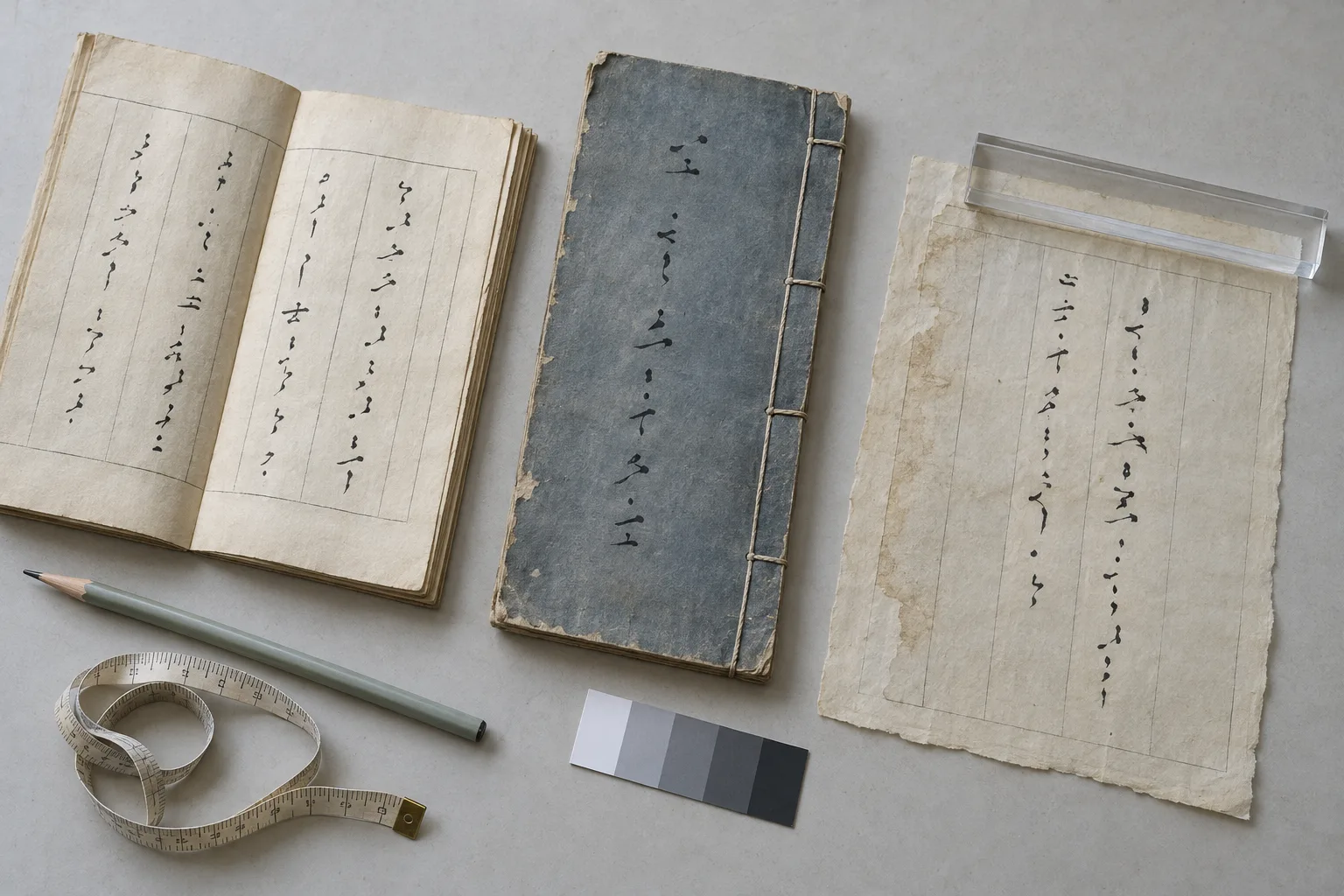
Use a catalogue record for identity, but inspect the pages for evidence. Note image sequence, call numbers, reproduction statements and missing material. If a sign is unclear, say “illegible in this reproduction” rather than inventing a reading from context.
Understand dapu as research and musical interpretation
Dapu brings silent instructions into sounding time
When a score’s performance transmission has been interrupted, a skilled player may undertake dapu (打谱/打譜): studying the source, deciphering its technical instructions and developing a playable realization. The Hong Kong Music Office emphasizes that unnotated rhythm must be recreated; the scholarly literature describes this as interpretive work, not mechanical transcription.
A reconstruction should therefore identify its source and practitioner. It should not be advertised as the one untouched sound of 1425, nor dismissed as arbitrary because judgement is involved. The responsible question is how its decisions were made and documented.
Use a six-step reading method
- Identify the witness. Record handbook title, edition, date, compiler, fascicle and page or image number.
- Map the book. Separate preface, contents, tuning or fingering matter, tablature, commentary and later annotations.
- Parse the signs. Read hands, fingers, string, position and movement before converting them into pitches.
- Mark what is absent. List unresolved rhythm, duration, articulation, tuning or damaged text rather than filling it silently.
- Compare another version. Align sections and a short passage; record differences without ranking them too quickly.
- Name the realization. Link any sounding result to its player, teacher, recording, transcription and editorial method.
Let the page lead back to listening
The best outcome is not mastery of antique-looking signs for their own sake. A handbook gives you sharper listening questions: Which gestures remain audible? Where does a performer shape time? Which phrases differ between versions? What part of the interpretation comes from a living teacher, a recording or a reconstruction?
Useful starting points are the Hong Kong Music Office’s illustrated explanation of tablature and dapu, the National Museum of Asian Art’s handbook-specific performance notes, Tse Chun Yan and Wong Hong Chu’s study of metre and interpretation in qin music, UNESCO’s living-heritage record, and John Thompson’s specialist annotated guide to guqin handbooks. Read together, they keep book history, notation, performance and living transmission in productive tension.