Playing the Guqin: Gesture, Notation and Interpretation
古琴怎样弹、怎样读谱:指法、减字谱与诠释
Watch a guqin player for a moment without trying to name every sound. One hand sets a string in motion; the other may press, touch or travel along it. The musical event does not necessarily end with the pluck. Following what happens next is a useful way into both the instrument’s technique and its distinctive written notation.
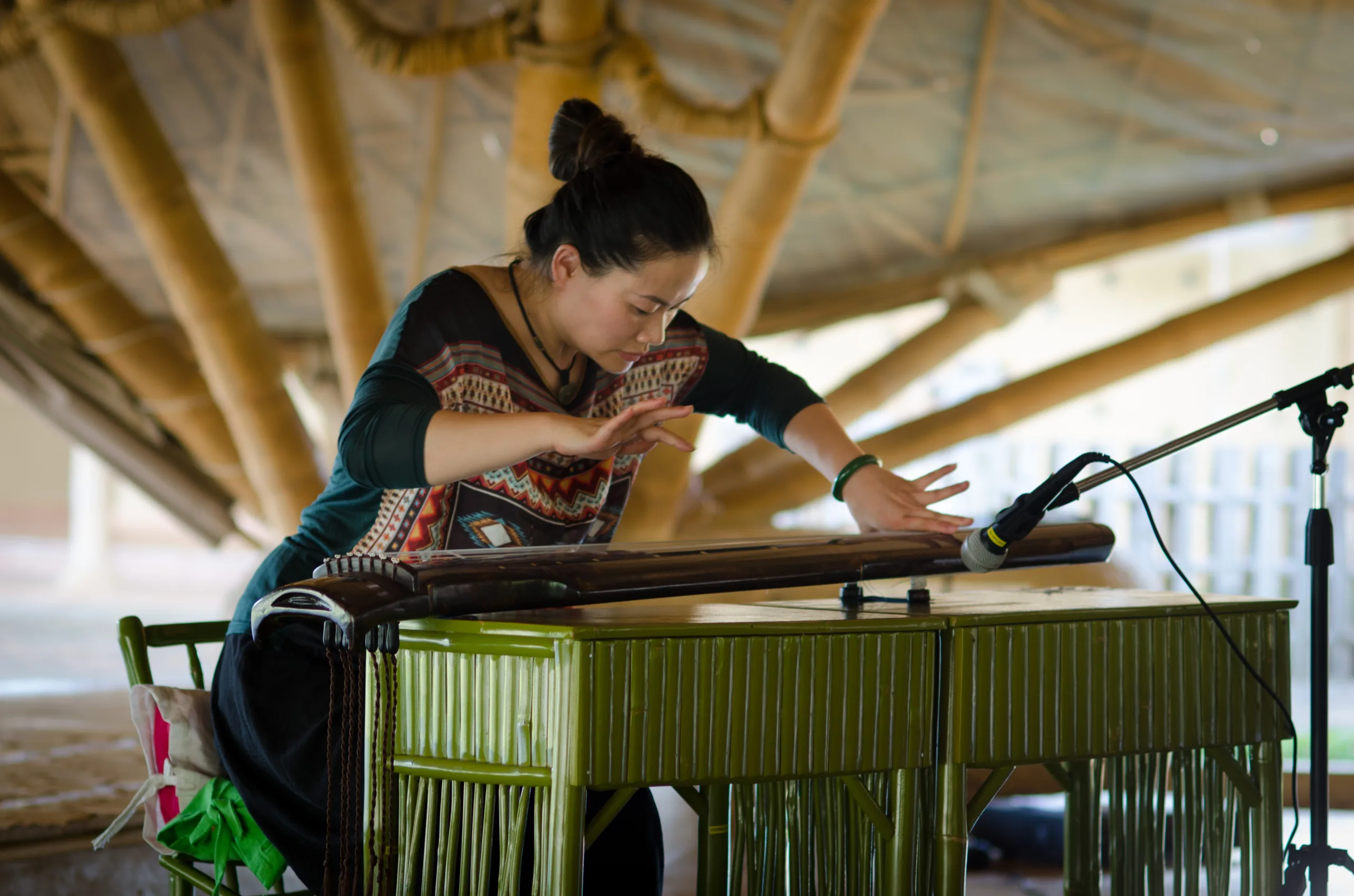
This guide connects the visible instrument in How the Guqin Works with the music made on it. It is a listener’s introduction, not a substitute for individual instruction. Within a Wudang cultural site, the guqin belongs to a wider Chinese musical world: learning about it does not require treating every performance as a Daoist ritual or meditation.
Watch how a sound changes
Two hands, different tasks
Three useful starting points are open strings, pressed sounds and harmonics: san yin, an yin and fan yin. For an open sound, the left hand leaves the string free. Pressing against the surface changes its sounding length; a light touch at a suitable point can produce a harmonic. Peiyou Chang’s introduction provides examples with sound.
For a first viewing, ask only: is the left hand away from the string, pressing it, or touching lightly? A camera angle may not reveal this reliably. Replay the passage and compare what you can see with what you hear; leave uncertain details uncertain instead of guessing a named technique from a single photograph.

Listen beyond the pluck
Left-hand movement can carry a pressed sound into another pitch or ornament it. Chang’s account of left-hand technique introduces a vocabulary that includes yin, nao, chuo, zhu, shang and xia. These names lead into families of movement, not a single expressive formula for every passage.
Try hearing the initial attack and the following movement as related parts of a phrase. Does a pitch settle, continue upwards, return, or give way to a new attack? This question is more useful at first than judging a player by speed or counting techniques. It also directs attention towards musical decisions that a still image cannot show.
Read a gesture, not just a pitch
What jianzipu records
Jianzipu (减字谱) combines abbreviated character components into instructions for playing. A cluster can identify a finger, position, string and action. It differs from jianpu (简谱), the numbered notation familiar from many modern Chinese scores. John Thompson’s tablature introduction explains this distinction and the earlier longhand form, wenzipu.
Reading Chinese helps with some components but does not automatically teach this musical vocabulary. Look for the explanatory key belonging to the edition you are using. Treat a symbol as a question about a particular action in context, not as a picture whose meaning must be obvious. Historical and modern conventions need not be identical.
A small worked example
The Hong Kong Music Office’s guqin exhibition explains a symbol from the Mei’an Qinpu version of Guan Shan Yue: the left thumb presses at position 7.6, while the right middle finger hooks the fourth string. Read the four decisions separately: left finger, position, right-hand action, string.
In the linked exhibition, compare the enlarged symbol with the score excerpt. Notice what you still cannot learn merely from those four decisions: the full phrase’s pacing, the quality of the contact, and how this moment relates to what follows. Decoding an instruction is a beginning, not a finished performance.
How the page becomes music
Rhythm is not absent from the music
Traditional tablature generally does not assign each sound a duration in the manner of modern staff notation. That does not make guqin music rhythm-free. Rhythm concerns the timing of sounds and silences; an unchanging beat is only one way to organize it. Thompson’s study of early Ming tablature discusses rhythmic clues in patterns, phrasing and the comparison of versions. His proposed realizations are interpretations, not recordings recovered from the past.
Nor is every score silent about timing. Chang’s guide to additional signs includes indications for a brief pause and for faster or slower playing. Modern editions may pair tablature with numbered or staff notation, as shown in Thompson’s guide to qin handbooks. Check which layer you are reading and who supplied it.
Teaching, interpretation and dapu
A teacher can demonstrate a phrase, listen to a response and adjust the next attempt. A printed page cannot provide that exchange. Ask a teacher which version is being taught and how the accompanying score is being used. This makes the relationship between hearing, movement and writing explicit without assuming that all teachers follow one sequence.
Dapu (打谱) is used for the work of realizing music from tablature, including older pieces without a continuing performance tradition. In his account of dapu, Thompson distinguishes different reconstructive and creative aims and acknowledges uncertainty. When listening to such a realization, ask what source and interpretive choices the player identifies; “old score” alone does not establish an exact ancient sound.
Make your next listening session more revealing
Follow one short passage
Choose a performance whose player and piece are identified. Listen once without watching. Then replay a short passage with the picture: mark one new pluck, one continuing left-hand movement and one pause. On a third hearing, ask whether the pause feels like an ending or an expectation. There is no need to force every passage into the same answer.
Keep a simple note with four entries: piece and performer; source or version if stated; something heard; something still uncertain. Compare another performance only after making that note. Differences may prompt good questions, but a title shared by two recordings is not proof that they use the same score. Avoid ranking them solely by tempo or by how “meditative” they seem.
Continue from sound to cultural understanding
If you want to play, bring one question from your listening to a teacher. Ask for a short demonstration that connects a sound, a movement and its written sign. Let instruction address your instrument, hand position and practice needs rather than adopting fixed nail lengths or a promised learning timetable from a general article.
Return to the Guqin listening guide for the broader picture, explore objects, texts and transmission in guqin history, or follow the Literati Arts pathway. The point is not to turn music into a list of signs, but to notice how material skill, written memory and a living performance meet.