Origins & History of the Guqin
古琴的源流与历史
The guqin has one of the longest continuous histories of any instrument still played. That history is well documented from the Han onward, is supported by archaeology going back further, and is preceded by legends that should be treated as legends.
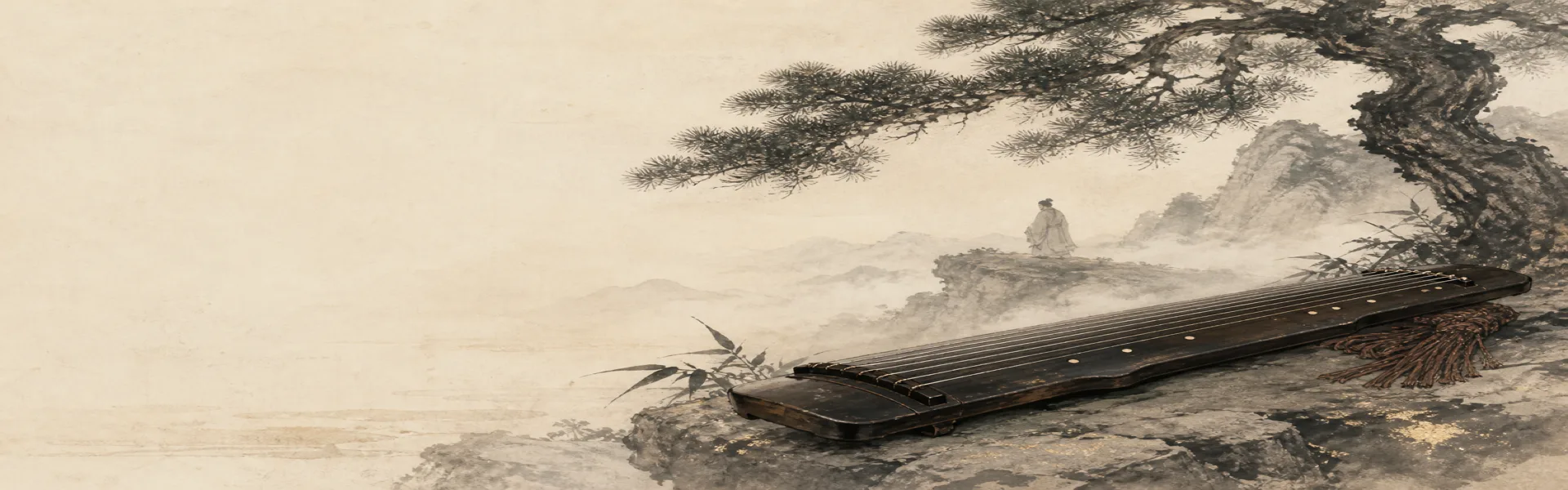
This page follows the sequence: the mythical accounts, the excavated evidence, the formation of the modern instrument, the printed repertoire, and the near-collapse and recovery of the twentieth century.
The legendary accounts
Traditional sources credit the instrument's invention to the mythical culture heroes: Fuxi, sometimes Shennong, sometimes the sage kings Yao and Shun. One account has the original instrument with five strings, to which the Zhou kings Wen and Wu each added one, giving seven.
These stories are not history and were probably not intended as history. They function to place the instrument at the origin of civilisation and to associate it with sagely rule, which is a claim about status rather than about chronology. It is worth knowing them because they are constantly alluded to, and because the seven-string explanation in particular is repeated as fact in a great deal of popular writing.
What archaeology shows
Excavated instruments give a much clearer picture. The tomb of Marquis Yi of Zeng, sealed in 433 BCE, contained a ten-string zither of a type recognisably ancestral to the guqin but distinctly different: shorter, with a differently shaped body and no position markers.
Instruments from Han tombs, including the Mawangdui site sealed in 168 BCE, show a seven-string instrument that is closer but still not modern. The crucial development, the addition of the thirteen inlaid position markers that make precise stopped notes possible, appears later.
By the Han and Wei period the instrument has essentially its present form: seven strings, a long resonating body of two joined boards, thirteen markers, and tuning pegs at one end. An instrument made in the eighth century can be strung and played today, and several are.
Early textual references
The Book of Songs mentions zithers repeatedly, usually in contexts of harmony, courtship and social occasion, which shows the instrument family was familiar by the early first millennium BCE. Confucius is described as playing and as using music in teaching, and the classical texts treat music as an instrument of moral ordering rather than as entertainment.
An important early source is the essay on the qin by Ji Kang in the third century, which argues for the instrument's particular virtues and is the first substantial piece of writing devoted to it. Ji Kang himself is central to the instrument's mythology: executed for political reasons in 262, he is said to have played a piece called Guangling San before his death and remarked that it would now be lost. A piece under that name survives in Ming notation, and its relationship to whatever he played is unknowable.
The Tang and the making of instruments
The Tang is the period from which surviving playable instruments date. The Lei family of Sichuan were the most celebrated makers, and instruments attributed to them are among the most valuable objects in Chinese musical history.
Tang instruments matter because they establish that the form was stable by then and because the ageing of the wood and lacquer is held to improve the sound. An old instrument is not merely venerable; the consensus among players is that the tone genuinely changes over centuries as the lacquer develops fine cracking and the wood dries. This makes the guqin unusual among instruments in that its finest examples are a thousand years old and still in use.
Song and Ming: writing it down
The Song saw imperial collection of instruments, extensive philosophical writing about the qin, and the consolidation of a theory linking playing to self-cultivation. The emperor Huizong assembled a large collection, and a famous painting attributed to him shows a scholar playing under a pine.
The decisive change came with printing. In 1425 the Ming prince Zhu Quan published a collection of tablature that preserved pieces he described as ancient and no longer commonly played. It is the earliest surviving comprehensive printed qin collection, and much of the repertoire played today is reconstructed from it or from collections that followed.
Over the following centuries more than a hundred and fifty collections were printed, together preserving several thousand pieces. This is the largest body of notated music surviving from any pre-modern non-Western tradition, and it exists because printing made it economical to preserve material that only a small number of people played.
The Qing and the formation of schools
Regional traditions of playing consolidated into named schools during the Qing, each with its own preferred repertoire, interpretative habits and printed collections. A widely used collection published in 1722 became a standard reference and remains in print.
The schools matter because of the notation's silence about rhythm. In practice a school is a body of transmitted interpretative decisions, and the survival of a piece depended on a living chain of teachers rather than on the printed page alone. Where that chain broke, the notation remained but the piece stopped being played.
How instruments were made and named
Construction has changed remarkably little. The body is two boards of different woods joined together, traditionally paulownia above for resonance and a harder wood such as catalpa below, hollowed to form a chamber with two sound holes in the underside. The whole is coated in layers of lacquer mixed with deer antler powder, applied and polished over months, which hardens into a durable surface that also affects the tone.
Individual instruments are named, and the name is usually inscribed on the underside along with inscriptions by owners. Names refer to sounds, to landscape or to allusions — a spring in a valley, jade in a stream, the sound of frost. This practice treats an instrument as an individual object with a history rather than as one unit of a type, in much the way that named violins are treated in Europe.
The lacquer surface develops a fine crackle pattern over centuries, and the character of the crackle is used to estimate age. It is also, predictably, faked, and attribution of old instruments is a difficult specialist field with a good deal of wishful thinking in it.
Decline
The nineteenth and early twentieth centuries were bad for the guqin. The instrument depended on the scholar-official class, on a leisured domestic culture and on a system of private transmission, and all three were dismantled by war, revolution, the abolition of the examinations in 1905 and the collapse of the old social order.
There were serious efforts at preservation. A qin society founded in Shanghai in 1936 brought together leading players, made recordings and published research, and the scholar and player Zha Fuxi devoted decades to locating and cataloguing surviving tablature. Without that work the modern revival would have had far less to build on.
The 1950s survey
Between 1954 and 1956 Zha Fuxi led a nationwide survey to locate every remaining player. The team found roughly a hundred, recorded around 270 pieces, and collected instruments, manuscripts and printed collections.
The significance of this is hard to overstate. Many of those recorded were elderly and died within a decade, and several regional traditions survive only in those recordings. The survey is the single most important documentary act in the instrument's modern history, and much of what is played today descends from it.
One of the players recorded, Guan Pinghu, produced the interpretation of Flowing Water that was later selected for the Voyager Golden Record launched in 1977. He had reconstructed the piece from Qing notation, which is a useful reminder that the recording sent out of the solar system is itself an act of interpretation.
Suppression and recovery
The Cultural Revolution treated the guqin as a relic of a feudal class, and playing largely ceased in public. Instruments were destroyed, though a great many were also hidden. Recovery began with the reopening of conservatories from the late 1970s.
UNESCO listed the guqin tradition in 2003, and the effect was substantial: state support, media attention and a large increase in students. Instrument production expanded from a handful of makers to an industry. The number of people who can play is now vastly greater than at any point in the twentieth century.
The revival and its questions
Practitioners disagree about the direction of the revival, and the disagreements are worth understanding rather than smoothing over. Conservatory training standardises interpretation, which conflicts with a tradition where interpretation was the individual's contribution. Concert performance and amplification change an instrument designed to be heard from a metre away. Commercial demand has produced instruments made quickly to meet volume rather than slowly to sound well.
Against this, the tradition is alive, materially secure and being transmitted to large numbers of people for the first time in a century, which is not a small thing. Both positions have merit, and the honest description is that the guqin has survived by changing, as it has before.
Key points
- Legends attributing the instrument to mythical sages are claims about status rather than chronology, and the story of Wen and Wu adding strings is not history.
- A ten-string ancestor was excavated from a tomb sealed in 433 BCE, and the modern seven-string form with position markers was settled by the Han and Wei.
- Tang instruments survive and are still played, and the tone is generally held to improve over centuries as lacquer and wood age.
- Printing from 1425 onward preserved several thousand pieces, the largest notated repertoire from any pre-modern non-Western tradition.
- Because the notation omits rhythm, survival of a piece depended on a living chain of teachers, and broken chains left playable notation for unplayed music.
- The 1954 to 1956 survey found about a hundred players and recorded 270 pieces, and much of today's practice descends directly from it.