Learning the Guqin: Listening, Sources and Finding a Teacher
怎样学古琴:聆听、资料与择师
Learning the guqin does not begin with buying the “right” instrument or memorizing a list of famous pieces. It begins by learning what to hear, what a source can actually establish and what kind of feedback your hands need. This guide connects the site’s history, instrument, technique and repertoire pages into one practical route.
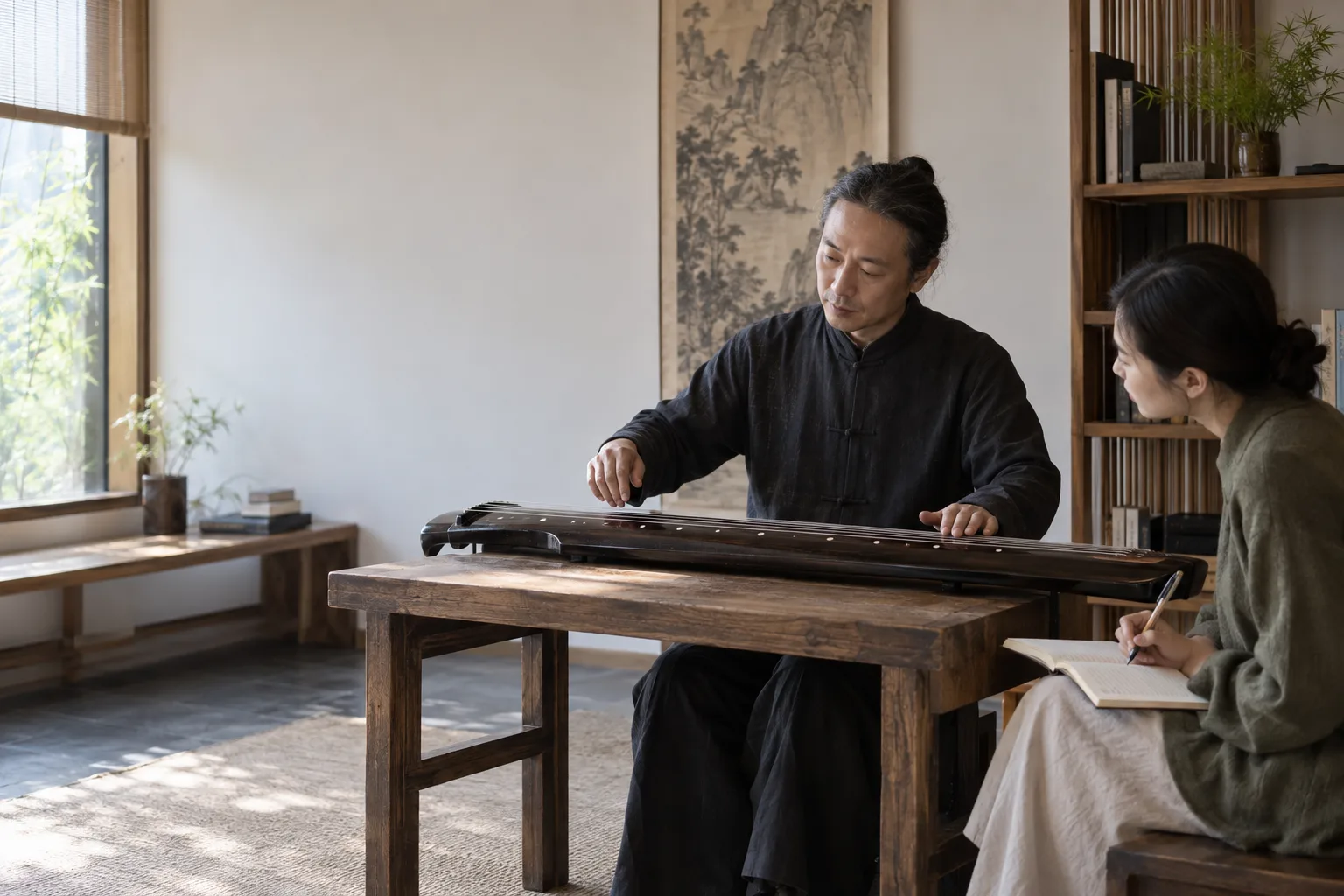
There is no universal waiting period before lessons, no price band that guarantees a good qin and no fixed number of years that defines competence. Your route depends on access, aims, body, budget and the teaching available where you live. Use the steps below as a framework to adapt, not a gatekeeping test.
Build a listening map
Compare one piece in two versions
Choose one piece from Guqin Melodies: Stories, Versions and Ways to Listen, then find two recordings whose performer, piece title and source are identified. Listen first for the overall path. On a second pass, note three concrete details: perhaps an open-string attack, a harmonic, a sliding trace, a pause or the final decay.
Do not begin by ranking the versions. Ask where they differ in pacing, articulation, repeated sections and the space allowed after a sound. A short table—time, sound, observation, question—turns preference into usable listening. It also shows why the same old title does not guarantee an identical score or interpretation.
Hear historic recordings as records, not commandments
Older recordings can preserve musicians, versions and styles no longer otherwise accessible. They also carry the limits of their recording medium, restoration and catalogue data. Surface noise is not an aesthetic ideal, and age alone does not make one performance the final authority.
A well-documented example is Guan Pinghu’s performance of Flowing Water, listed by NASA among the music carried by the 1977 Voyager Golden Record. Its selection is an important episode in modern cultural history; it does not make that rendition the only correct way to play the piece.
Read sources by the question they answer
Keep object, notation, recording and story separate
A surviving qin can show materials, dimensions, inscriptions and later repairs. A tablature records selected actions and structure. A recording documents one performance under particular conditions. A story may preserve how a community remembers a piece. These sources enrich one another, but none silently fills every gap in the others.
Use the history guide to date claims, How the Guqin Works to identify the object and Playing the Guqin to understand what notation does and does not encode. UNESCO’s guqin heritage record supplies a concise institutional overview; it should be read alongside the particular object, edition or performer you are studying.
Record metadata before repeating a claim
For a recording, note performer, piece, date if known, album or archive, track and stable link. For a book or score, record author or compiler, title, edition, publisher, date and page or section. If an upload omits its source, label it unidentified rather than guessing from a filename or comment.
Separate what the record states from your inference. “The catalogue dates this instrument to the Ming dynasty” and “this sound must be exactly how Ming musicians played” are very different claims. That discipline keeps the guqin connected to Wudang’s wider cultural story without inventing a Wudang provenance for every image, tune or teacher.
Find teaching that makes learning visible
Ask what will be taught and corrected
Before committing, ask which notation and repertoire the teacher uses, how beginners learn tuning and basic sounds, how often individual corrections are given and what practice is expected between lessons. A trial lesson can reveal more than a lineage title: can the teacher demonstrate slowly, explain the purpose of an exercise and respond to a clear question?
Online lessons can widen access and allow close video review; in-person lessons can make instrument setup, touch and room sound easier to assess. Neither format is automatically superior. Ask about camera and microphone placement, permitted recordings, feedback between sessions, language support, fees, cancellations and how physical discomfort is handled.
Use self-study as support, not invisible certification
Books, scores and video are useful for vocabulary, comparison and review. They cannot feel your pressure, hear every acoustic detail through a small microphone or decide whether a movement suits your body. Film a short passage only with everyone’s consent, then compare it with one stated task rather than searching for every possible fault.
Stop when a movement causes pain, numbness or persistent strain; “relax” is not a diagnosis. Seek an appropriate professional when a health concern needs one. A careful teacher should welcome questions, avoid medical promises and distinguish musical guidance from healthcare.
Meet instruments, people and places responsibly
Use gatherings and museums to sharpen questions
A concert, small gathering, lesson, archive or museum visit offers a different kind of access. Check current programmes, admission, photography and instrument-handling rules before travelling. At a performance, note the room, amplification and programme information; at a museum, read the catalogue and conservation record rather than judging an unplayed object by appearance alone.
On this Wudang cultural site, qin listening can sit beside Daoist thought, landscape, calligraphy, tea and other arts. Connection does not mean identity. The cultivation guide distinguishes personal reflection, literati culture and formal Daoist practice so that a quiet musical encounter is not mislabeled as ritual.
Try before buying, and preserve the paper trail
When possible, borrow, rent or try several instruments with someone who can explain setup and condition. Ask the seller to identify maker or workshop, date, materials, repairs, fittings, strings, included case, delivery conditions and return terms in writing. Provenance is documentation, not an evocative name.
Judge the particular instrument for stable tuning, playable string height, unwanted buzzing, structural condition, response and fit with the learner. Price, age, lacquer colour and a dramatic “old qin” story are not substitutes for inspection. If remote purchase is unavoidable, request clear unedited sound, detailed photographs and a written inspection or return process.
Begin with four flexible weeks
Weeks one and two: attentive listening
Pick two pieces and two identified versions of each. Listen in short sessions, make time-stamped notes and revisit one comparison after several days. Keep the sound comfortable: the World Health Organization’s safe-listening guidance recommends keeping personal-device volume below 60% of maximum, monitoring exposure and taking breaks from loud sound.
Add one source task: verify a performer credit, locate an institutional catalogue record or compare a modern performance with a named tablature version. The goal is not to consume a giant playlist. It is to make your listening recoverable enough that another reader could find the same evidence.
Weeks three and four: test the path
Observe or take one introductory lesson if accessible. Bring your notes and ask the teacher to explain one sound, one notational sign and one practice task. If lessons are not yet possible, watch a complete, identified demonstration and write down what the camera does not let you assess.
At the end of four weeks, choose a next step: continue listening, arrange lessons, visit a collection, borrow an instrument or postpone purchase. None is failure. Return to the Guqin gateway when you need to reconnect a practical question with history, construction, repertoire or Daoist interpretation.