Reading Guqin Lacquer: Layers, Crack Patterns and Repair
读懂古琴漆面:漆层、断纹与修缮
A guqin’s lacquer is not merely a dark finish around the music. It is part of a layered structure that protects the wooden body, affects how the player’s fingers meet the surface and records changes made during the instrument’s long use. Fine networks of cracks can be visually compelling, but they are also easy to overread. A named crack pattern is not a birth certificate, and an old-looking surface does not by itself prove age, authorship or authenticity.
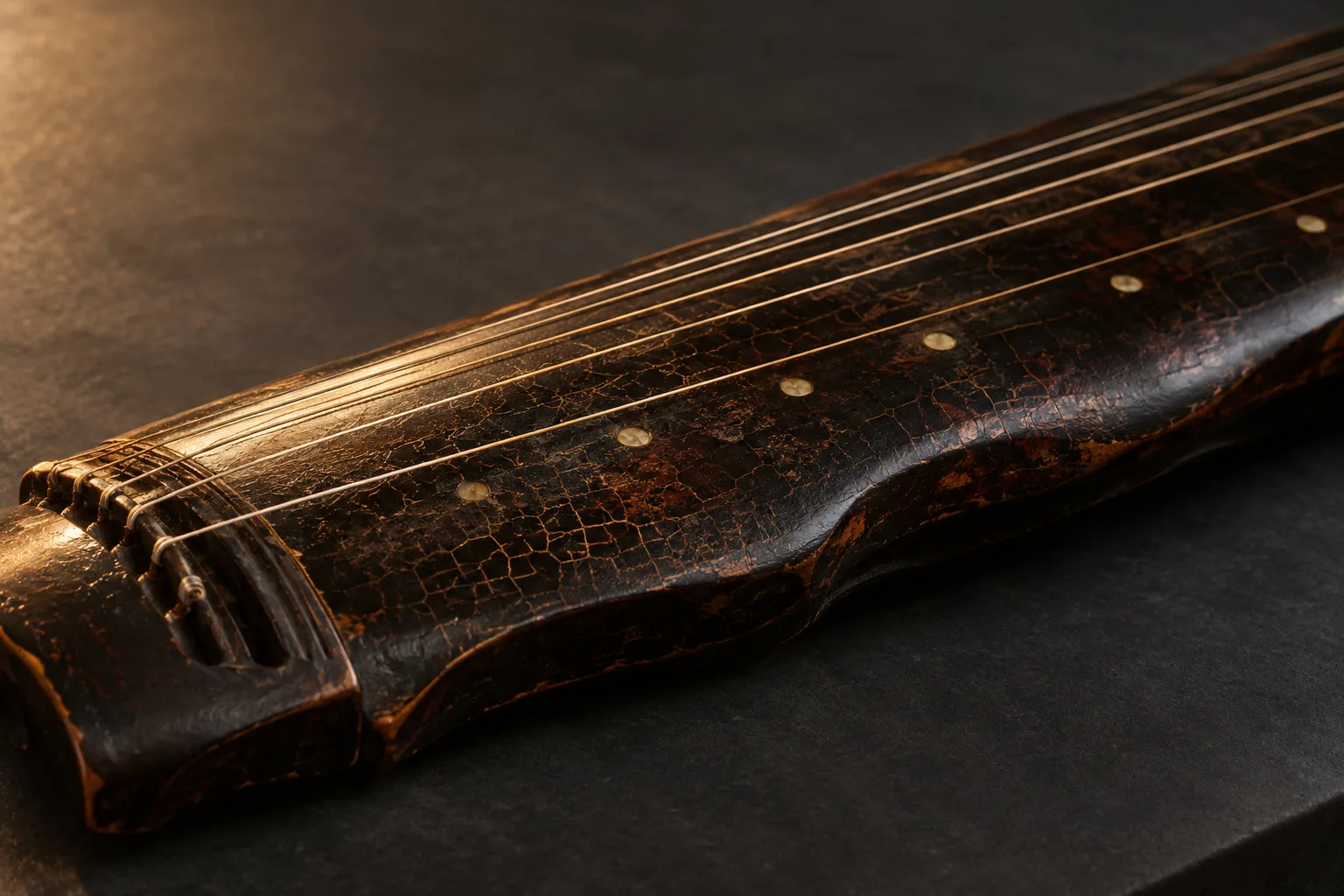
This guide offers a slow, object-based way to look. It complements the site’s introduction to guqin structure and sound and its evidence-led history of the instrument. It does not teach restoration or appraisal. Fragile lacquer, loose ground or an unstable wooden body requires examination by a qualified conservator and, for a playable instrument, an experienced qin maker.
A surface built in layers
Wood, ground and lacquer
Traditional qin making is a sequence rather than a single act of carving. The Hong Kong Intangible Cultural Heritage Office lists nine broad stages: selecting wood, shaping it, hollowing the sound box, fitting and assembling the parts, applying a cement-like ground, sanding, lacquering and finally stringing. The Music Office of Hong Kong’s Leisure and Cultural Services Department likewise describes boards coated with ground and lacquer. These institutional accounts are useful because they place the visible finish within a composite object: wood below, prepared layers in between and lacquer above.
The English word “lacquer” can refer to very different coatings. A catalogue should therefore be read literally. “Lacquered wood,” “resin lacquer,” a modern coating and a later re-lacquering are not interchangeable descriptions. Without technical analysis, a photograph rarely reveals exactly which materials are present or when each layer was added.
A working surface, not decorative skin
On the upper board, strings pass close to the lacquered surface, and left-hand techniques press and slide along the string. The surface must therefore be understood in relation to play as well as appearance. Its profile, smoothness, repairs and local wear may affect use, but none of those features should be diagnosed from an online image alone.
Construction also matters to sound. The lacquer does not operate independently of the hollow wooden body, bridges, stringing and playing technique. For that larger system, return to How the Guqin Works or compare the physical setup described in Guqin Tables and Playing Spaces.
What duanwen describes
Named patterns are a vocabulary of looking
Crack networks in old qin lacquer are commonly called duanwen (断纹). Historical and modern writers use vivid names—often translated with images such as “snake belly,” “ice cracks” or “plum blossom”—to describe visual configurations. These terms can help observers compare spacing, direction and scale. They should be treated as descriptive language, not as a mechanical classification that guarantees one date.
The Metropolitan Museum of Art’s catalogue entry for a nineteenth-century guqin notes the traditional esteem accorded to older instruments and identifies duanwen as cracks in the lacquer. That is valuable evidence for how the surface has been understood, but a museum label’s summary of tradition is not a substitute for technical examination of a particular instrument.
Craquelure is not the same as damage
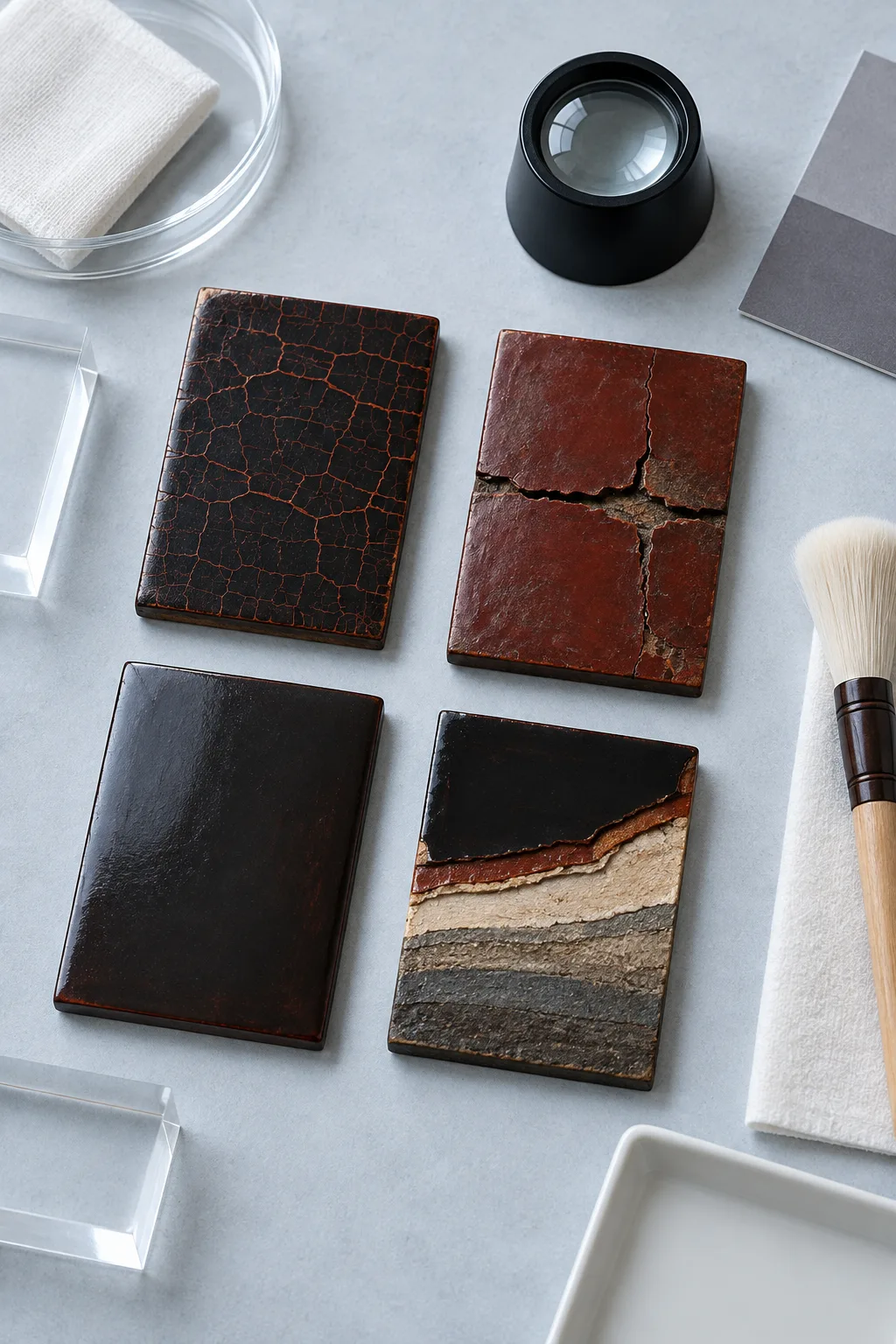
From a distance, fine stable-looking crackle, a split in the wooden body, lifting lacquer, loss of ground and a repaired seam may all appear as “lines.” They are materially different. Look for changes in level, exposed substrate, curling edges, movement and discontinuities across joints, while remembering that only in-person examination can establish condition.
Recent conservation research also resists simple visual categories. A 2025 American Institute for Conservation programme included a study titled “Re-defining the craquelure patterns on traditional Chinese musical instrument guqin with advanced imaging techniques RTI and micro-CT.” Its very premise is a useful warning: surface names do not exhaust what imaging can reveal about cracks within layered structures.
Why a crack pattern cannot date a qin by itself
Age is an argument assembled from several kinds of evidence
A responsible attribution brings together construction, dimensions, inscriptions, seals, documentary provenance, repair history and comparison with securely catalogued instruments. Material and imaging studies can add further evidence. Each strand has limits: an inscription may be later, a component may be replaced and a documented owner may have acquired an already old or altered instrument.
The Music Office exhibition notes that inscriptions on the lower board can contribute to an instrument’s history. “Contribute” is the important word. A name or date must be read, contextualized and compared; it does not automatically settle who made the qin or when every part of it took its present form.
Surfaces can have more than one date
A wooden body, ground layer, topcoat, filled loss and retouched area may belong to different moments. Re-lacquering can cover earlier evidence; later wear can expose it again. Repairs may preserve playability or stabilize damage while also changing what the eye sees. The most honest label may therefore describe a sequence rather than assign the entire surface to one year.
This is why convincing antiquarian appearance can mislead. Crackle may be genuine but belong to a later coating; an old body may carry new surface work; a repair may imitate surrounding texture. Conversely, a carefully conserved instrument need not look untouched. “Old,” “original,” “authentic” and “unrepaired” are different claims.
Repair as part of the object’s biography
Do not erase the evidence too quickly
A repair can record changing standards of craft, ownership and use. Fill material, retouching, replaced fittings or a reworked surface may be visually distracting, yet they can help explain how the instrument survived. Conservation normally begins by documenting condition and previous interventions before deciding whether treatment is necessary.
Environmental response also depends on the whole layered structure. Smithsonian conservation abstracts on East Asian lacquer emphasize interactions among ground, lacquer, light, relative humidity and handling. That complexity is another reason to avoid universal home recipes. Washing, oiling, polishing, filling cracks or forcing a warped surface can remove evidence or worsen instability.
Playability and preservation may ask different questions
A museum may prioritize stabilization and legibility of evidence. A musician may also ask whether the strings can be tuned and whether the surface allows safe technique. Neither goal authorizes casual intervention. Decisions should identify the intended use, the significance of older materials and the reversibility or visibility of any proposed work.
For living practice, see gesture, notation and interpretation. UNESCO’s account of “Guqin and its music” is also a reminder that the heritage is not only a class of objects: repertoire, knowledge, performance and transmission matter alongside surviving instruments.
A six-pass museum looking method
Observe first; interpret second
- Read the whole profile. Note the body shape, upper and lower boards, joints, feet, bridge areas and overall deformation before zooming into cracks.
- Map the surface. Record where fine crackle, wider openings, losses, glossy patches and retouching appear; do not give them a cause yet.
- Compare levels and edges. A line confined to the coating differs from lifting material, an exposed ground or a split that continues through the body.
- Check both faces. Compare the playing surface with the lower board, inscriptions, seals, sound holes and repaired seams.
- Separate evidence streams. Keep visual description, catalogue history, provenance, inscriptions and technical results distinct before bringing them together.
- State the limit. If the object is behind glass or known only from photographs, say what cannot be confirmed and leave treatment to specialists.
Questions worth carrying forward
After looking, ask: Which layers are actually visible? Which observations come from the object, and which from a label? Could a repair explain the change in colour or texture? What evidence supports the proposed date beyond the crack pattern? These questions make the surface more interesting, not less certain merely for caution’s sake.
A guqin can be both a musical instrument and a record of material decisions accumulated over time. Reading its lacquer well means respecting that double life: attentive to beauty, but unwilling to turn beauty into proof.
Sources and further reading
- Hong Kong Intangible Cultural Heritage Office, “The Arts of the Guqin (The Craft of Qin Making)”.
- Hong Kong Music Office, guqin roving exhibition.
- The Metropolitan Museum of Art, Guqin (19th century), object 1981.79.
- American Institute for Conservation, 2025 Annual Meeting imaging programme.
- UNESCO, “Guqin and its music”.