Anatomy of the Instrument
古琴的形制与用材
The guqin is a simple object made with considerable care. Understanding its parts explains a good deal about how it is played, why it sounds as it does, and what the tradition believed it represented. This page covers the construction, the naming of the parts, the position markers, the strings and tuning, the symbolism attached to the design, and what to look for in an instrument.
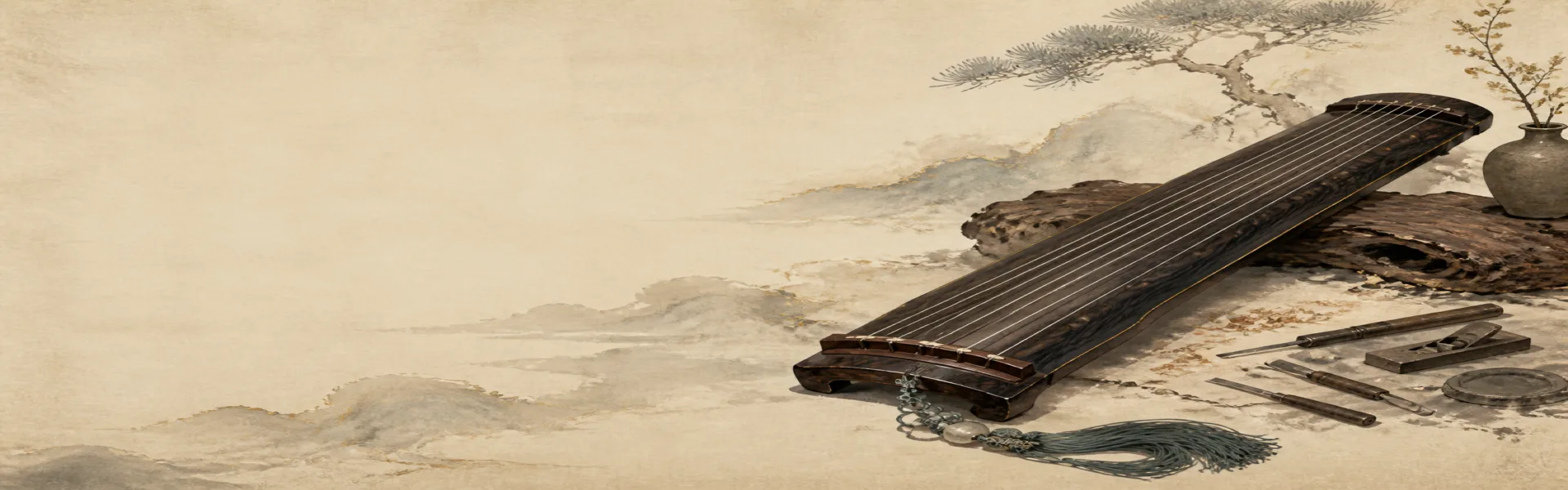
The overall form
An instrument is roughly 120 to 125 centimetres long, about 20 centimetres wide at the head and narrowing toward the tail, and around 5 centimetres deep. It lies flat on a table, wider end to the player's right, with the seven strings running its length.
The upper surface is gently curved along its width and the lower surface is flat. This is not only structural: the tradition explains it as heaven above being round and earth below being square, and the explanation appears in the earliest treatises.
The two boards
The body is made from two boards glued together. The upper board is traditionally paulownia, a very light, soft, open-grained wood chosen for resonance. The lower board is a harder wood, usually catalpa, which reflects sound rather than absorbing it.
Both are hollowed to create an internal chamber, and the shaping of that chamber is where a maker's skill principally lies. Two openings are cut in the underside, called the dragon pool and the phoenix pond, which let the sound out and allow the internal cavity to be seen. Inside, two small posts connect the boards at specific points, transmitting vibration and controlling the resonance; their placement is a closely guarded part of the craft.
Old instruments are prized partly because the wood dries and stabilises over centuries. Makers have long sought aged timber, and there are documented cases of instruments made from the beams of demolished old buildings for exactly this reason.
The lacquer
The assembled body is coated in raw lacquer mixed with powdered deer antler, applied in many thin layers and polished between coats. The process takes months and the result is a hard, slightly resilient surface that both protects the instrument and materially affects its tone.
Over centuries the lacquer develops a network of fine cracks, and the pattern is described by comparison to natural forms: snake belly, ox hair, plum blossom, ice. The presence and character of the crackle is used in estimating an instrument's age, which means it is also imitated, and assessing an old instrument is a specialist matter with a good deal of optimism in it.
The named parts
Almost every component has a name, and most names are anatomical or landscape metaphors. The ridge over which the strings pass at the head is the mountain. The corresponding ridge at the tail is the dragon's gums. The head area is the forehead and the shoulder and waist describe the outline. Two feet at the underside near the tail, called the goose feet, anchor the string ends. The tail piece is called the scorched tail, after a story in which a scholar rescued a burning piece of wood from a fire and made an instrument from it, the scorch mark remaining visible.
These names are worth learning if you intend to read anything about the instrument, because instructional texts use them constantly and without explanation.
The thirteen markers
Inlaid into the upper surface along the outer edge are thirteen small discs, traditionally of mother of pearl, sometimes jade or gold. They mark the positions where the left hand touches or stops the string.
These positions are not arbitrary. They fall at the natural harmonic nodes of a vibrating string: the midpoint, the thirds, the quarters, the fifths, the sixths, the eighths. Touching lightly at these points produces clear harmonics, and this is why the guqin has an unusually large harmonic repertoire compared with most instruments.
The markers also serve as reference points for stopped notes, though stopped positions frequently fall between markers and are located by ear and by proportional judgement. Learning to find those intermediate positions accurately is one of the longest tasks in learning the instrument.
Strings and tuning
Traditionally the strings were twisted silk, which gives a soft, slightly grainy tone with a fast decay. Silk is fragile, sensitive to humidity, difficult to make and expensive, and from the mid-twentieth century steel core strings wound with nylon became standard. These are louder, far more stable and much longer lasting, at the cost of a certain quality of texture. Silk strings are made again today and a minority of players prefer them.
The strings run from tuning pegs at the head, through the body, to the goose feet at the underside of the tail. The pegs are turned to tune, and the ends are wrapped around the feet in a manner that is fiddly for beginners.
The standard tuning is a pentatonic set spanning about an octave and a half, most simply described in relative terms as the intervals of a major pentatonic scale. Absolute pitch varies: there is no universal standard, and players tune to suit the instrument and the piece. Several alternative tunings exist for particular pieces, and retuning mid-recital is normal.
What the design is said to mean
The tradition attaches a full cosmological reading to the instrument, and it appears in sources from the Han onward. The length is given as three chi six cun and five fen, corresponding to the days of the year. The curved top and flat bottom are heaven and earth. The five original strings correspond to the five phases, and the two added strings to the civil and martial virtues of the Zhou kings. The thirteen markers correspond to the twelve months plus the intercalary month.
How much weight to put on this is a fair question. The correspondences are not all internally consistent, the measurements do not match surviving instruments precisely, and it is likely that the symbolism was elaborated after the form had settled for practical reasons. But the symbolism was believed, it shaped how the instrument was discussed for two thousand years, and it is the reason the guqin was treated as a philosophical object rather than merely as a musical one.
Shapes and styles
Instruments come in a number of recognised outline shapes, each with a name and a traditional attribution. The Zhongni style, named for Confucius, is plain, with a simple concave indentation at the shoulder and waist, and is by a wide margin the most common. The Fuxi style is broader and more rounded. The banana-leaf style has a wavy edge suggesting the veined margin of a leaf. Others imitate a bell, a lotus petal or a fallen begonia blossom.
The shape affects the internal volume and therefore the tone, but the effect is smaller than the effect of wood, hollowing and lacquer, and the choice is largely aesthetic. Beginners are usually steered to the Zhongni style, partly because it is standard and partly because its plainness matches the tradition's stated preference for the unornamented.
Decoration is generally minimal. Inscriptions on the underside, sometimes several by successive owners, are the main addition, and heavily ornamented instruments are looked on with some suspicion as prioritising appearance over sound.
Judging an instrument
Traditional connoisseurship lists nine qualities a fine instrument should have, and the terms are worth knowing even though several are subjective: it should sound antique and unusual, the tone should carry through the body, it should be quiet in the sense of free from extraneous noise, moist rather than dry, round rather than thin, clear, even across all strings and positions, and fragrant, meaning that the tone lingers.
In practice a buyer should check more mundane things. Play every string at every marker and listen for buzzing, which indicates the surface is not properly level. Check that the tone is balanced across the strings, since many cheap instruments are strong in the middle and weak at the edges. Check that stopped notes speak cleanly. And listen for how long a note sustains, since a short decay severely limits what the left hand can do.
Care
The main enemy is humidity change. Rapid drying can crack the lacquer or open the joint between the boards; excessive damp affects the tone and can distort the surface. Keep the instrument in a stable environment, away from direct heating and direct sun, and use a case or cover.
Strings should be wiped after playing, since skin oils shorten their life. Steel-nylon strings last years; silk strings may need replacing annually or more often. Tuning drifts constantly on a new instrument as the strings settle, and this is normal rather than a fault.
Buying
There are three broad tiers. Factory instruments at the lowest prices are adequate for learning the fingering but often have uneven tone and short sustain. Mid-range instruments from small workshops are where most serious students end up and represent the best value. Handmade instruments by named makers are expensive and the price reflects reputation as well as sound.
Antique instruments are a separate market with serious authentication problems and prices driven by collecting. The practical advice is to buy the best mid-range instrument you can try in person, to avoid buying unheard online if at all possible, and to bring a player with you if you are not one yet.
Key points
- The body is two boards, light paulownia above and harder wood below, hollowed and joined, with two sound openings in the underside.
- Lacquer mixed with deer antler powder is built up over months and materially affects tone, and its crackle pattern is used to estimate age.
- The thirteen markers fall at natural harmonic nodes, which is why the instrument has an unusually large harmonic repertoire.
- Silk strings give the traditional texture but are fragile, and steel-nylon strings have been standard since the mid-twentieth century.
- The cosmological reading of the design is old and influential but not internally consistent, and probably followed the form rather than determining it.
- When buying, test every string at every position for buzzing, balance and sustain, and prefer a mid-range instrument you can try in person.