Guqin Forms: Reading Zhongni, Banana-Leaf and Other Shapes
古琴式样:读懂仲尼式、蕉叶式与其他琴式
A museum label may call a guqin Zhongni, Fuxi, Shennong, Lianzhu or banana-leaf style. These names identify families of outline: where the shoulders broaden, where the waist draws in, and how the sides travel from head to tail. They are a useful visual vocabulary, but not a secret chronology. A form name alone cannot prove who made a qin, when it was made, whether every edge is original, or how it sounds.
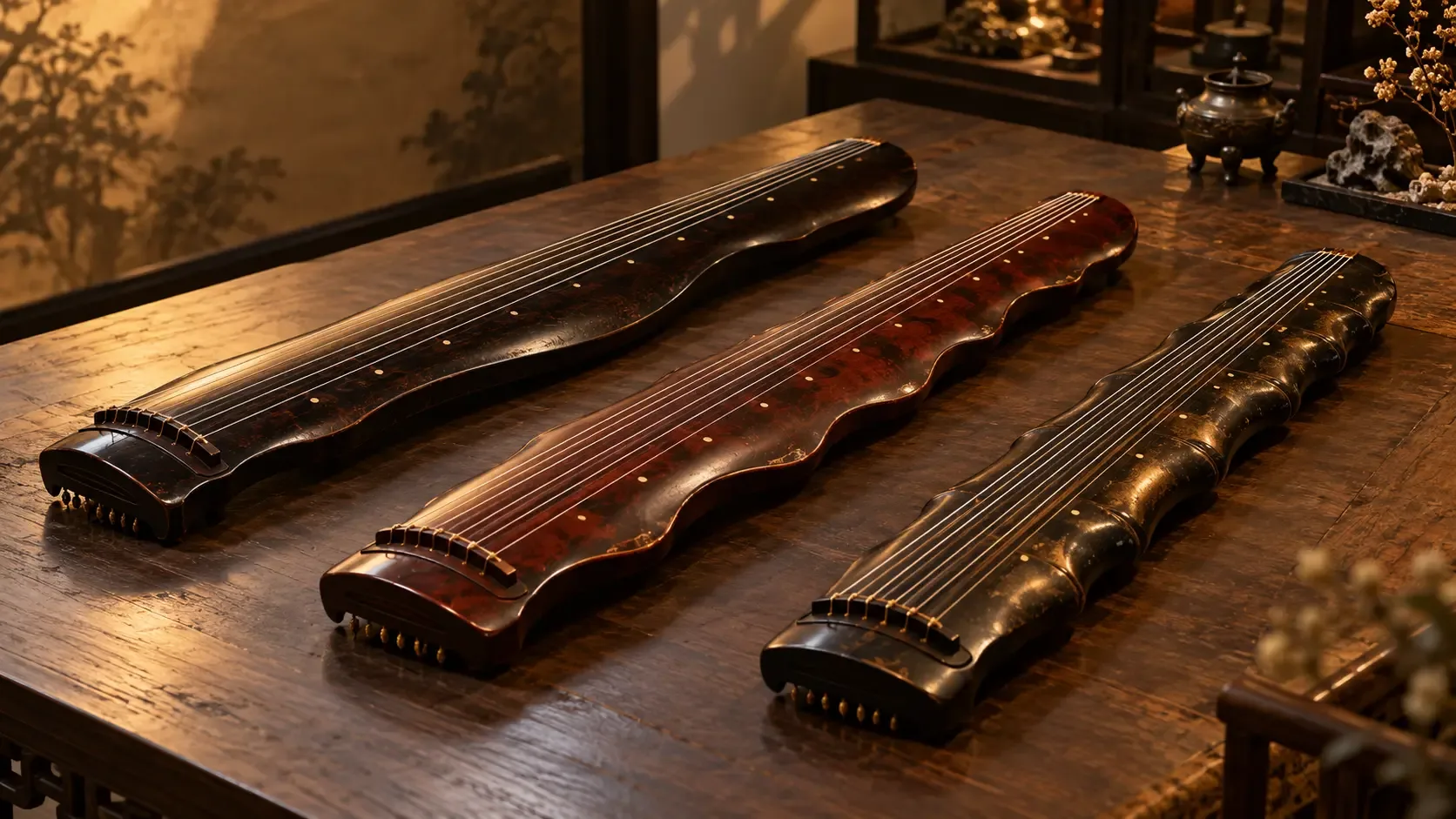
This guide shows how to read form names cautiously. It complements the site’s introductions to guqin structure, lacquer and repair and inscriptions and provenance. The goal is not to identify an instrument from one photograph, but to ask better questions of museum records and physical evidence.
Begin with the shared instrument
Form changes the perimeter, not the basic category
A guqin is a long, fretless zither normally strung with seven strings and marked by thirteen hui position studs. Its upper and lower boards, bridge, string path and sound openings belong to a shared constructional system. Style names usually describe the contour seen from above rather than a different kind of instrument.
The Metropolitan Museum’s “Xiangpu’s Treasure” calls the familiar double-waisted profile “Confucian style” and notes that the guqin took several forms. Its own outline is banana-leaf style, yet it retains the thirteen studs and other defining features. Begin with what the forms share; then compare their edges.
Learn to trace a silhouette
Move from head to tail
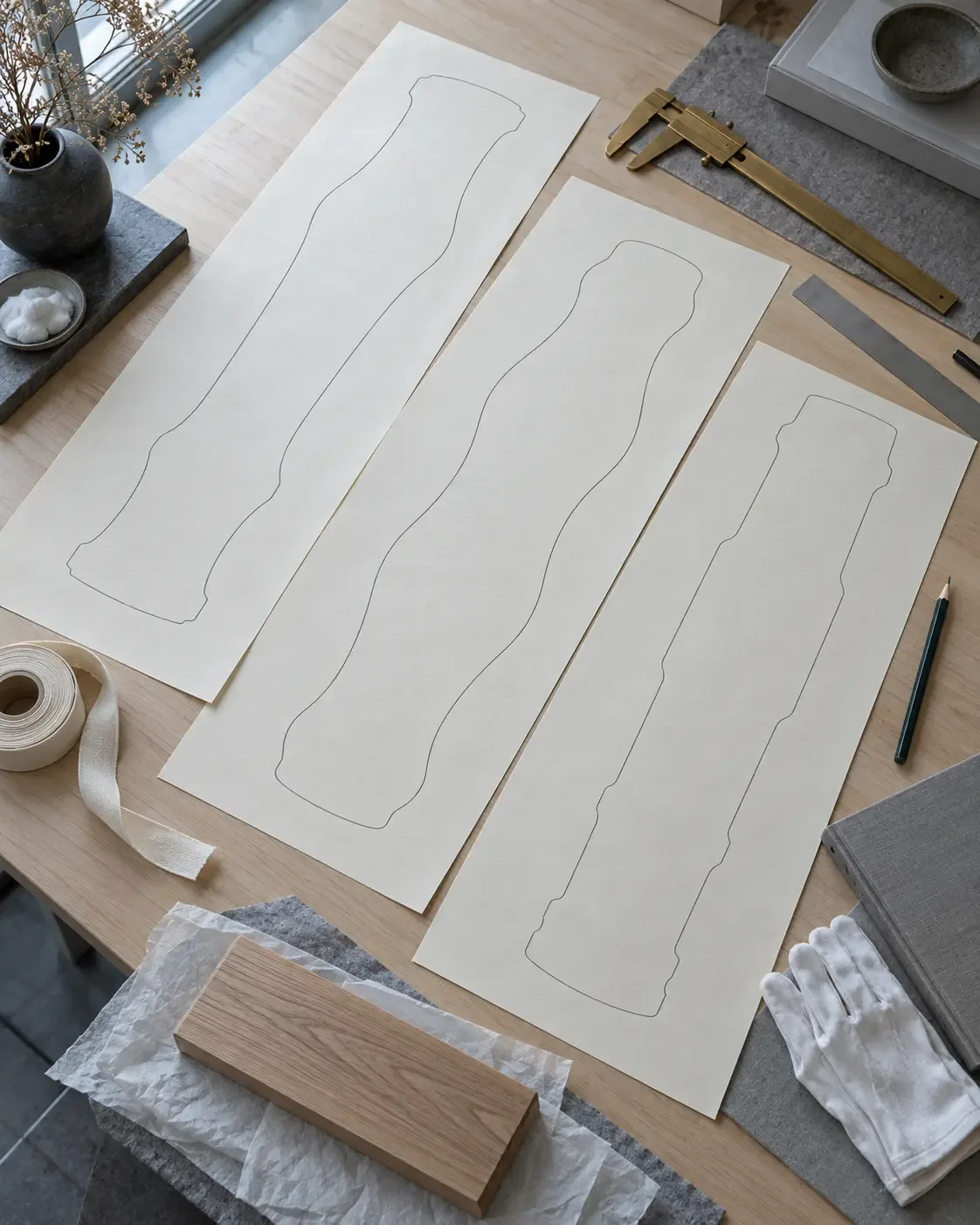
Ignore decoration at first. Follow one side from the forehead and neck through the shoulders, waist and tail. Mark every inward turn, outward swell and straight interval. Then compare the opposite side. A top view is usually more informative than an oblique glamour photograph, which can exaggerate one curve and hide another.
Record total length and widths at comparable points. Note whether a catalogue shows the upper board, underside or both. Form is easier to discuss when words such as “shoulder” and “waist” refer to measured locations rather than impressions.
Keep form, ornament and condition separate
An incised line, a lacquer border or a painted motif is not necessarily the structural edge. Repairs can soften a corner, rebuild a tail or change the apparent symmetry. Compare the silhouette with lacquer layers, join lines and conservation notes before treating every visible contour as original.
Zhongni: the familiar double waist
A common reference point, not a universal template
The name Zhongni is an honorific associated with Confucius; English catalogues may use “Confucian style.” The recognizable feature is a restrained, double-waisted outline: the sides draw inward in two related zones rather than flowing as one continuous leaf edge. It is often the silhouette readers first imagine when they hear “guqin.”
Familiarity does not make it a default from which all other forms evolved. Nor does the name establish a direct design by Confucius. Use it as catalogue vocabulary for an outline family, and check how the institution defines the term for the particular object.
Banana-leaf style: an edge that behaves like a leaf
Continuous undulation replaces a segmented waist
The Palace Museum’s “Listening to Rain in a Banana Grove” explains the type especially clearly: the outline takes the image of a banana leaf, without a sharp division into neck, shoulder, waist and tail; a stem-like element appears at the head and the joined edge resembles the margin of a leaf. The Met’s “Xiangpu’s Treasure” likewise describes undulating sides.
These records show why silhouette comes before symbolism. “Banana leaf” is not merely a poetic title applied to an ordinary waist. The name directs attention to a continuous visual rhythm along the sides. Individual examples still differ, and neither museum object should be treated as the single master template.
Fuxi, Shennong, Lianzhu and Fengshi
Catalogue names identify several coexisting outline families
The Palace Museum lists four celebrated Tang qin under four different form names: the Fuxi-style “Jiuxiao Huanpei,” the Shennong-style “Dasheng Yiyin,” the Fengshi-style “Yulinglong,” and the Lianzhu-style “Feiquan.” That grouping is useful because it prevents a false ladder of “early” and “late” shapes. Several named forms can coexist within one broad historical period.
The museum’s Shennong-style record also notes that transmitted Ming diagrams preserve two variants of the form. Historical names therefore need not describe one immutable geometry. The Lianzhu record preserves a traditional attribution of that style to the Sui recluse Li Yi; it should be reported as a catalogue tradition, not converted into proof of invention.
Use secure records as comparisons, not stencils
The Fuxi-style “Jiuxiao Huanpei” and “Longmen Fengyu” differ in date, condition and later work. “Longmen Fengyu” underwent substantial repair by Guan Pinghu in the late 1940s; “Jiuxiao Huanpei” also carries later lacquer interventions and fittings. A shared form label does not erase those individual biographies.
Why a form name is not an authentication
Classification is an argument
Museum catalogues embody current scholarship, and form identifications can be revised or disputed. Drawings in historical manuals may simplify curves; photographs distort proportion; repair can alter an edge. When specialists disagree, retain the uncertainty rather than forcing a confident label.
A shape can be copied centuries later. Conversely, an old body may have reworked edges or rebuilt lacquer. Date, maker and authenticity require construction, material analysis, inscriptions, provenance and comparison with securely documented objects. Sound quality requires listening and condition assessment; it cannot be read from a silhouette.
A six-pass method for reading a catalogue object
From identity to comparison
- Fix the identity. Record institution, object number, current title and the date you consulted the record.
- Trace the whole outline. Follow head, shoulders, waists and tail on both sides before naming the form.
- Record dimensions. Compare length and widths at equivalent points; do not judge proportion from perspective alone.
- Separate views. Note what the top, underside and side reveal—and what the available image hides.
- Check condition. Look for repaired edges, replaced fittings, lacquer build-up and asymmetry before assuming the contour is untouched.
- Compare language. Consult several securely identified museum objects and preserve qualifications such as “style,” “attributed” and “variant.”
Let the form answer only a form question
A good identification says, “this outline is catalogued within this family, for these visible reasons.” It does not silently add a maker, dynasty, lineage or acoustic rank. Continue with the history of the guqin to place object evidence beside texts and living practice.
Sources and object records
- The Metropolitan Museum of Art, “Xiangpu’s Treasure” Guqin, object 2016.179.1.
- The Palace Museum, “Jiaolin Tingyu” banana-leaf-style qin.
- The Palace Museum, “Dasheng Yiyin” Shennong-style qin.
- The Palace Museum, “Jiuxiao Huanpei” Fuxi-style qin.
- The Palace Museum, “Longmen Fengyu” Fuxi-style qin.
- The Palace Museum, “Feiquan” Lianzhu-style qin.
- The Palace Museum, forum note on four Tang qin and their forms.